The Morocco Instrument:
Sounds That Carry a Nation’s Soul
From the Sahara’s edge to the medinas of Fes — a traveler’s guide to Morocco’s living musical heritage
Before you ever see Morocco, you hear it. A low thrumming bass drifts from a lantern-lit doorway in Marrakech. A reed flute trails off into the mountain air somewhere above Chefchaouen. The clattering of iron castanets rises from a courtyard in Essaouira. Every Morocco instrument you encounter tells a story that no guidebook can fully capture — but this one tries.
More Than Music: A Cultural Compass
There is a tendency, when traveling, to treat music as a backdrop — something pleasant playing in a restaurant while you study the menu. In Morocco, that approach will cause you to miss everything. Music here is a map of identity. The instruments people carry, the rhythms they keep, and the ceremonies they perform with sound are among the most direct expressions of who they are and where they come from.
Morocco sits at an extraordinary crossroads. Over the centuries, Amazigh (Berber) mountain communities, Arab traders and scholars, refugees from Andalusian Spain, and sub-Saharan African peoples through trans-Saharan routes all left their mark on this land — and on its instruments. The result is a musical vocabulary unlike anything else in the world, drawing on African, Arab, Mediterranean, and Iberian roots simultaneously.
Understanding even a little of this will transform what you see and hear during your trip.
Every Morocco instrument you encounter is not simply an object crafted from wood or metal — it is a vessel. It carries ceremony, healing, memory, and in some traditions, a direct line to the spiritual world.
— Morocco Travel InsightThe Essential Morocco Instruments You Should Know
You don’t need to become a musicologist to appreciate these instruments. But knowing their names, sounds, and stories makes the experience of encountering them — in a festival, a wedding procession, or a quiet alley performance — deeply more meaningful.
The pear-shaped ancestor of the European lute, the oud is Morocco’s most aristocratic instrument. Its fretless neck allows musicians to slide between pitches in ways that Western scales simply don’t accommodate. You’ll hear it at the heart of Andalusian classical orchestras in Fes and Rabat, where full ensembles can perform six-hour suites called nuba.
Also called the sintir, the guembri is the sacred bass lute of the Gnawa people — deep, resonant, and hypnotic. Played by a maâlem (master musician), it serves as both rhythmic anchor and spiritual guide during all-night healing ceremonies called lila. Hearing one in Essaouira during the Gnawa Festival is a genuinely unforgettable experience.
Deceptively simple-looking, the bendir is a large frame drum whose inner snares produce a buzzing overtone unlike anything else in world percussion. Used in Sufi rituals, Berber folk dances, and village celebrations, it is one of the oldest instruments in North Africa, with roots dating back to pre-Islamic Amazigh ceremonies.
If there’s one sound that announces a Moroccan celebration from a distance, it’s the ghaita — a powerful double-reed shawm whose piercing cry cuts through open-air festivities. Often played in pairs, the instrument requires circular breathing to sustain its long, wailing notes. You’ll hear it at weddings, moussem festivals, and on Jemaa el-Fna square in Marrakech.
One of the oldest instruments in human civilization, the nay is an end-blown flute with a hauntingly breathy tone. In Morocco it features prominently in Sufi music, where its sound is said to represent the soul’s longing for its divine origin — an idea made famous by the poet Rumi. Skilled players can coax two full octaves of deeply expressive melodies from a simple tube of reed or wood.
These large iron castanets are the percussive engine of Gnawa music. Played in interlocking rhythmic patterns by multiple musicians simultaneously, the qraqeb create a hypnotic, clattering metallic texture that has been described by ethnomusicologists as one of the most sophisticated polyrhythmic systems in the world. Their roots reach deep into sub-Saharan African ceremonial traditions.
The goblet-shaped darbuka is the drummer’s primary voice in Moroccan popular and urban music. Light enough to rest under the arm or on the knee, it produces bright, sharp tones that drive the rhythm in chaabi performances and at social celebrations. Watching a skilled darbuka player improvise rhythmic variations in a medina café is a lesson in spontaneous artistry.
Dating back at least to the 9th and 10th centuries, the rebab is widely considered an ancestor of the European violin. This bowed instrument, often with a small skin-covered body, produces a raw, nasal, penetrating tone. In Berber music traditions it typically carries the main melodic line while percussion instruments hold the rhythmic foundation — you’ll encounter it most often in mountain communities and at folk festivals.
The Musical Regions of Morocco
One thing that surprises many visitors is how different the music sounds from one part of the country to another. Morocco’s musical geography is as varied as its landscapes. What you hear in Fes is not what you hear in Ouarzazate, and neither sounds like what drifts through the alleys of Essaouira. Here’s a rough guide:
The Gnawa Tradition: A UNESCO-Recognized Heritage
No discussion of the Morocco instrument landscape is complete without spending some time with the Gnawa. Descendants of sub-Saharan Africans brought to Morocco through ancient trade routes, the Gnawa developed a musical and spiritual system of remarkable sophistication. In 2019, UNESCO inscribed the Gnawa music of Morocco on its Representative List of the Intangible Cultural Heritage of Humanity — a recognition long overdue.
At the center of Gnawa practice is the lila, an all-night ceremony led by a maâlem who plays the guembri and sings, accompanied by players of the qraqeb. Each color, rhythm, and melody in the ceremony corresponds to a specific spiritual entity, and the whole night is a carefully orchestrated ritual of healing and connection. Attending even a public performance during the Essaouira Gnawa and World Music Festival gives a traveler a window into this world that no museum could replicate.
The Essaouira Gnawa and World Music Festival, held each June, is one of the best places in the world to experience authentic Gnawa music alongside international artists. Book accommodation months in advance — the town fills completely during the four-day event. Many of the most powerful performances happen not on the main stage, but in the medina’s small courtyards late at night.
Andalusian Music: The Sound of Exile and Beauty
In the 15th century, when Muslims and Jews were expelled from Spain at the end of the Reconquista, many settled in the cities of northern Morocco — Fes, Rabat, Tetouan. They brought with them the refined musical tradition of Al-Andalus, the Islamic civilization that had flourished in the Iberian Peninsula for centuries.
That tradition survives today in the form of Moroccan Andalusian music, performed by orchestras that use the oud, rebab, kamenjah (a violin played vertically on the knee), qanun (a plucked zither), darbuka, and taarija. The music is organized into long suites called nuba, originally conceived as music for every hour of the day. Most of the original twenty-four nuba have been lost; the surviving eleven are considered a living treasure.
Attending a performance in the medina of Fes — particularly at the remarkable annual Fes Festival of World Sacred Music — is one of the most distinctly Moroccan cultural experiences available to any traveler.
What the Music Sounds Like Today
Morocco’s musical scene is not frozen in the past. The same country that treasures its Andalusian orchestras is also producing hip-hop artists, rock bands, and fusion musicians who deliberately blend traditional instruments with contemporary global influences. Bands like Bab L’ Bluz — who mix Gnawa music with blues and psychedelia — have brought Moroccan sounds to international audiences while staying rooted in their home traditions.
This tension between preservation and innovation is itself deeply Moroccan. Artisan instrument-makers in the souks of Fes and Marrakech still build guembri and bendir by hand, using goatskin and carved wood, even as their customers include international musicians and recording artists. The Morocco instrument, in short, is both ancient and alive.
How to Experience Morocco’s Music as a Traveler
At Festivals
Morocco’s music festivals are among the richest cultural events on the African continent. The Fes Festival of World Sacred Music (June), the Essaouira Gnawa Festival (June), and Mawazine in Rabat offer extraordinary access to traditional and contemporary performances. Plan your trip around one of these if you can.
In the Medinas
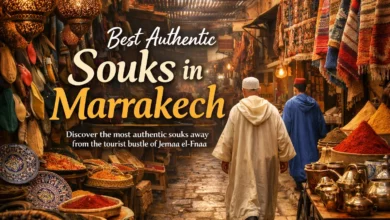
Jemaa el-Fna square in Marrakech is the most famous open-air musical stage in Morocco — and rightly so. As evening falls, musicians playing the ghaita, bendir, and darbuka perform alongside storytellers and acrobats in a scene that has continued, in some form, for centuries. Walk the alleyways of Fes el-Bali after dark and you’ll find smaller, quieter performances in teahouses and private courtyards.
At Cultural Centers
Cities like Fes, Rabat, and Casablanca have cultural centers and conservatories where you can attend formal concerts of Andalusian music or Sufi devotional music. These are less spontaneous than street performances but offer a chance to hear master musicians in acoustic settings specifically designed for the music.
In the Mountains
If your itinerary takes you into the Atlas Mountains or the Rif, keep your ears open. Village celebrations — weddings, religious festivals, harvest seasons — often feature performances by local Amazigh musicians playing bendir, nay, and rebab in the open air. These are not staged for tourists; they’re simply life continuing as it has for generations.
Music in Morocco does not merely entertain — it conveys identity, community, and in many traditions, a direct bridge between the living and the sacred. To hear a Morocco instrument played in its proper context is to understand the country in a way that no amount of sightseeing can provide.
— From our Morocco Travel GuideA Few Notes on Buying Instruments
Many travelers want to bring a piece of Morocco’s music home. The souks of Marrakech, Fes, and Essaouira sell a wide range of instruments — from decorative pieces clearly made for the tourist trade to genuinely playable instruments built by skilled artisans. If you’re buying something to actually play, ask the seller to demonstrate it. The sound will tell you immediately whether it’s functional or purely ornamental.
The guembri and bendir are among the most commonly available. A good guembri, with a proper animal-skin head and well-seated neck, will have a warm, resonant bass tone. A bendir should produce a clear snare-like buzz from the internal strings running across the back of the drum head. Qraqeb are almost always functional — they’re iron, and either work or they don’t.
Instruments made with natural animal skins — bendir, guembri, darbuka — can be sensitive to humidity and temperature changes. If you’re flying home with one, a case or padded bag is a worthwhile investment. Reputable instrument sellers in the medina can advise you on proper care and transport.
Why This Matters to the Traveler
There is a version of travel that is entirely visual: the photographs, the monuments, the Instagram reel. Morocco rewards that kind of travel. But the country also offers something rarer — a full sensory immersion in a musical culture that is genuinely, irreducibly its own.
Every Morocco instrument you encounter — the oud being tuned in a tea-scented room, the qraqeb clattering through a medina at midnight, the bendir keeping time at a mountain wedding — is a point of entry into something larger than tourism. It is an invitation to listen, and in listening, to understand.
That is what makes music the best guide Morocco has to offer.