What language is spoken in Morocco ?
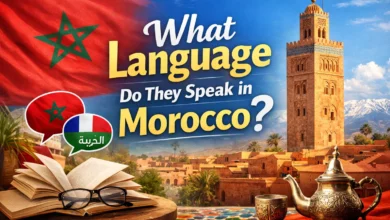
Morocco is a linguistically diverse country where Moroccan Arabic (Darija) is the most widely spoken language in everyday life, used by approximately 92% of the population. However, the official languages are Modern Standard Arabic and Standard Moroccan Berber (Tamazight), recognized by Morocco’s 2011 Constitution. French remains the dominant language in business, education, and government, while Amazigh (Berber) languages preserve Morocco’s indigenous cultural heritage.
The reality is more nuanced than any single answer: Morocco’s linguistic landscape reflects centuries of history, from Amazigh civilizations and Arab conquests to French and Spanish colonial influences.
Morocco’s Two Official Languages
In 2011, Morocco’s Constitution made a historic linguistic shift by recognizing two official languages instead of one.
Modern Standard Arabic, known as Fusha in Arabic, is Morocco’s formal, written language used in:
- Government documents and official correspondence
- Media broadcasts and formal announcements
- Education in schools and universities
- Legal proceedings and courts
- Literature and academic publications
However, here’s the crucial distinction: while Modern Standard Arabic is official, very few Moroccans actually speak it as a native tongue. According to 2024 census data, only 2% of Moroccans use Standard Arabic in personal oral communication. It’s essentially a formal, written register learned in school rather than a living, breathing language of the street.
Tamazight (Standard Moroccan Berber)
Tamazight became Morocco’s second official language following decades of activism by the Amazigh movement. This recognition was historic—acknowledging Morocco’s pre-Arab indigenous heritage.
However, implementation has been gradual. While Tamazight is now taught in schools and used in some government contexts, it remains limited in practical application compared to other languages. The government has committed to extending Tamazight teaching to all primary schools by 2030, yet progress has been slower than many advocates hoped.
Moroccan Arabic: The Real Lingua Franca
The language Moroccans actually speak every day is Darija (the Moroccan vernacular), a distinct Arabic dialect spoken by approximately 91.9% of the population. You’ll hear it in souks, homes, cafés, and streets everywhere.
Darija is beautifully unique because it reflects Morocco’s complex history. It incorporates elements from:
- Amazigh (Berber) — indigenous vocabulary and grammar patterns
- Classical Arabic — foundational vocabulary and structure
- French and Spanish — hundreds of loanwords from colonial and contemporary influences
- Mediterranean languages — traces of historical trading connections
A typical Darija sentence might blend all these influences seamlessly. For example, borrowing from French for modern concepts while using Arabic grammar and Berber phonetics.
Darija vs. Modern Standard Arabic
This distinction matters if you’re traveling to Morocco or learning the language:
| Aspect | Darija | Modern Standard Arabic |
| Usage | Everyday conversation, streets, markets, informal settings | Official documents, formal media, education, law |
| Context | Native, vernacular | Formal, written |
| Speakers | ~92% of population (as native speech) | Mainly in formal contexts; 2% use exclusively in daily life |
| Learning | Acquired naturally through immersion | Taught in schools |
| Written Form | Rarely standardized in writing; typically Latin or Arabic script transcription | Standardized Arabic script |
Practical takeaway: If you’re visiting Morocco or doing business there, learning some Darija phrases will be exponentially more useful than Modern Standard Arabic for genuine, everyday interactions.
Amazigh Languages: Preserving Indigenous Heritage
Amazigh refers to the broader indigenous language family of North Africa, with three major regional dialects spoken in Morocco:
Spoken in the Rif Mountains (northern region), primarily around the Rif area. Tarifit has fewer speakers among the three major Amazigh dialects but remains vital to cultural identity in these regions.
The most widely spoken Amazigh dialect, used primarily in the High Atlas Mountains and the Souss-Massa region (southern Morocco). With over 3 million speakers, Tachelhit is the largest Amazigh language in Morocco.
Spoken in the Middle Atlas region, Tamazight is the basis for Standard Moroccan Berber promoted by the government and education system.
According to the 2024 census, approximately 24.8% of Moroccans speak Berber languages. However, urbanization and generational shifts have impacted transmission—younger Moroccans in cities may be less fluent in ancestral Amazigh languages, even if parents or grandparents speak them natively.
The Amazigh movement has successfully elevated the profile of these languages. Today, Tamazight appears on currency, in parliamentary sessions (with interpretation services introduced in 2022), and increasingly in education. Yet advocates argue implementation remains inconsistent, and that the state should support teaching in Tamazight, not merely teaching about Tamazight.
The Role of French in Modern Morocco
Despite being a former French colony that gained independence in 1956, France’s linguistic influence remains profound in contemporary Morocco.
- Business and commerce: 31% of Moroccans speak French professionally
- Education: French-language instruction is standard in secondary and higher education; most STEM subjects taught in French
- Government administration: Internal communications often conducted in French
- Media: Major newspapers, radio, and television maintain significant French-language programming
- Medicine and science: Professional literature predominantly in French
According to 2024 census data:
- 57.7% of Moroccans speak French
- However, only 12% are truly bilingual in French and Arabic/Darija
- In personal contexts, French usage drops sharply: only 9% speak French daily at home, though 22% write in French
This reflects a practical reality: French is a language of institution and professional necessity, not of intimate, everyday life for most Moroccans. It’s the language of bureaucracy, education, and commerce—a gateway to opportunities—but Arabic and Amazigh remain the languages of home, family, and community.
English: The Emerging Language
English is increasingly prevalent among younger Moroccans, particularly in urban centers and the tourism industry, though it remains limited compared to French.
Current penetration:
- 20.5% of the population speaks some English (2024 census)
- 7% use English professionally
- 3% speak English fluently
Where You’ll Encounter English
- Tourism: Hotels, restaurants, tour companies, and major attractions increasingly cater to English speakers
- Youth culture: Young Moroccans in cities learn English in school and use it on social media
- Technology and startups: Morocco’s growing tech sector operates partly in English
- International business: Multinational companies and export industries use English internally
For visitors, English proficiency is improving but unpredictable. In major tourist destinations like Marrakech and Fez, English speakers are common. In smaller towns or rural areas, you’ll likely need French or Darija.
Spanish in Northern and Southern Regions
Spain’s geographical proximity and historical ties mean Spanish maintains a foothold, particularly in specific regions:
Cities like Tangier and Tetouan (near the Spanish border) have significant Spanish-speaking populations due to:
- Historical and ongoing trade relationships with Spain
- Spanish cultural media and broadcasting
- Geographic convenience for cross-border interactions
Dakhla and southern coastal regions maintain Spanish influence through similar historical and commercial ties.
Census reality: Only 1.2% of the population speaks Spanish nationally, making it the least common major foreign language. Still, in border regions, Spanish can be surprisingly useful.
Understanding how Moroccans actually use language reveals the practicality of multilingualism:
- Darija dominates (96.3% in urban areas, 84.5% in rural areas)
- Amazigh languages used in regions where they’re native
- Code-switching is natural—families might use Darija with occasional Amazigh or French words
- French for formal communications, written reports, and management
- Darija for informal workplace conversation and among colleagues at the same level
- Arabic primarily in legal, government, or highly formal contexts
- French in formal business communications and documentation
- Darija in negotiations, casual dealings, and customer service
- English increasingly in international business and tech sectors
- Darija among Moroccan staff
- French widely understood and used
- English increasingly available, particularly in major tourist hubs
- Spanish useful in northern regions
This linguistic flexibility reflects Morocco’s pragmatic approach: Moroccans navigate multiple language systems, switching fluidly depending on context, audience, and purpose.
Cultural Immersion and Language Learning
For travelers interested in deeper cultural connections, understanding Morocco’s linguistic landscape enhances the experience. To truly understand Moroccan culture—its history, values, humor, and identity—engaging with the language is invaluable.
Whether you’re planning morocco cultural experiences tours or simply curious about Moroccan society, language opens doors. Many tour operators now integrate language-learning components into their offerings, recognizing that even basic Darija phrases create meaningful interactions. When you greet a vendor in Darija, share tea with a family, or ask directions using locally-spoken language, you transition from observer to participant in Moroccan culture.
What language should I learn if I’m visiting Morocco?
Prioritize Darija (Moroccan Arabic) for practical, everyday communication. Learn basic phrases for greetings, directions, and market haggling. French is also invaluable for formal interactions, business, and reading signs. English is increasingly available in tourist areas but shouldn’t be your primary expectation outside major cities.
Is it difficult to understand Moroccan Arabic (Darija) if I speak Modern Standard Arabic?
Darija shares approximately 85–90% vocabulary with Modern Standard Arabic, so speakers of classical Arabic can often grasp the gist of conversations. However, the pronunciation, grammar, and loanwords make it distinctly different. Darija speakers can typically understand classical Arabic, but not vice versa—another reason Darija dominates in daily life.
Do all Moroccans speak French?
No. While French is taught universally in schools, proficiency varies. Urban, educated, and younger Moroccans are more likely to speak French. Rural areas and older generations may have limited French. Still, 57.7% of the population speaks some French, making it useful for travel.
Are Amazigh languages still spoken, or are they dying out?
Amazigh languages remain vital, with approximately 24.8% of the population speaking them. However, urbanization and educational policies favoring Arabic and French have impacted intergenerational transmission. The 2011 constitutional recognition and introduction of Tamazight into schools are helping preserve and revitalize these languages.
How is the Amazigh language written?
Traditionally, Tamazight uses Tifinagh, an ancient Berber script. However, it’s also written in Latin characters and Arabic script. The Tifinagh script appears on Moroccan currency and in official contexts but is less common in everyday writing. For modern communication, Latin transcription is often used.
What’s the difference between Amazigh, Berber, and Tamazight?
Berber is the older term for the indigenous North African people and their languages; some consider it outdated or problematic. Amazigh is the preferred term used by indigenous communities, meaning “free people” in their language. Tamazight is one specific Amazigh language (spoken in the Middle Atlas), though it’s also used as an umbrella term for standard Moroccan Berber.
Can I get by speaking only English in Morocco?
In major tourist destinations (Marrakech, Fez, Essaouira), yes—many hospitality workers speak English. However, outside these areas, English proficiency drops significantly. French is far more reliable, and learning even basic Darija phrases dramatically improves your experience and interactions.
Morocco’s linguistic reality defies simple categorization. It’s a country where Arabic, Amazigh, French, and increasingly English coexist, each serving distinct social, cultural, and professional functions. Moroccans navigate this multilingual landscape with remarkable fluidity, switching between languages depending on context—a practical response to historical forces and contemporary opportunities.
Understanding this complexity enriches travel, business interactions, and genuine cultural connection. While Darija is what you’ll hear on the street, French gets you through bureaucracy, and Amazigh languages connect you to Morocco’s ancient soul.
[1] Life in Morocco. (2025). Languages spoken by Moroccans in 2025. Retrieved from https://life-in-morocco.com/moroccan-languages-spoken-2025 [2] Wikipedia. (2024). Languages of Morocco. Retrieved from https://en.wikipedia.org/wiki/Languages_of_Morocco [3] Polilingua. (2023). Languages of Morocco and translation of Moroccan languages. Retrieved from https://www.polilingua.com/blog/post/languages-of-morocco-translations.htm [4] New Arab. (2023). Identity, citizenship, and the Amazigh language in Morocco. Retrieved from https://www.newarab.com/analysis/identity-citizenship-and-amazigh-language-morocco [5] IWGIA. (2024). The Indigenous World 2024: Morocco. Retrieved from https://iwgia.org/en/morocco/5357-iw-2024-morocco.html [6] Wikipedia. (2024). Moroccan Arabic. Retrieved from https://en.wikipedia.org/wiki/Moroccan_Arabic [7] Transfers.ma. (2025). What language is spoken in Morocco? A 2025 traveler’s guide to Moroccan languages. Retrieved from https://transfers.ma/what-language-is-spoken-in-morocco-a-2025-travelers-guide-to-moroccan-languages/