What to Wear in Morocco for Women
Dress with elegance, travel with confidence — a curated guide to the Morocco female dress code
Morocco dresses its landscapes in saffron, cobalt, and rose gold — and the women who visit deserve to look just as striking. This guide isn’t a list of prohibitions. It is an invitation to dress intentionally, honoring a culture that takes beauty seriously, while expressing every bit of your personal style. Whether you are sipping mint tea on a riad terrace in Marrakech, getting lost in the blue lanes of Chefchaouen, or watching the Sahara turn amber at dusk, you will find exactly what to pack and how to wear it here.
Before diving into the specifics, it helps to understand the broader context. Morocco sits at a fascinating crossroads — geographically between Europe and sub-Saharan Africa, culturally between the Arab world and Amazigh traditions, and socially between a modern cosmopolitan outlook and deeply rooted Islamic values. That blend shapes everything, including how visitors are perceived when it comes to clothing. Understanding the Morocco female dress code is less about rules and more about reading the room.
The Golden Rule: Context Is Your Compass
Morocco is not a monolith. What is perfectly appropriate in the pool area of a luxury resort in Agadir may feel jarring in the souks of Fès. The general principle is simple: the more traditional or religious the setting, the more modest your outfit should be. This is not about restriction — it is about elegance and situational awareness, both of which are the hallmarks of a seasoned traveller.
As a baseline across most of the country, opt for clothing that covers your shoulders and knees. Loose silhouettes in natural fabrics like linen, cotton voile, or silk breathe beautifully in Morocco’s warm climate, drape flatteringly, and read as effortlessly chic wherever you are. This is the foundation from which all the outfits in this guide are built.
Natural fibres — linen, cotton, silk — are your best friends in Morocco. They breathe in the heat, resist dust, and look genuinely beautiful in photographs. Avoid polyester blends, especially in summer, when temperatures in the interior can exceed 38 °C.
Dressing for Every Setting: A Location-by-Location Guide
The cities and landscapes of Morocco each carry their own atmosphere. Here is how to dress for the most iconic stops you are likely to visit, keeping what to wear in Morocco for women both practical and beautiful.
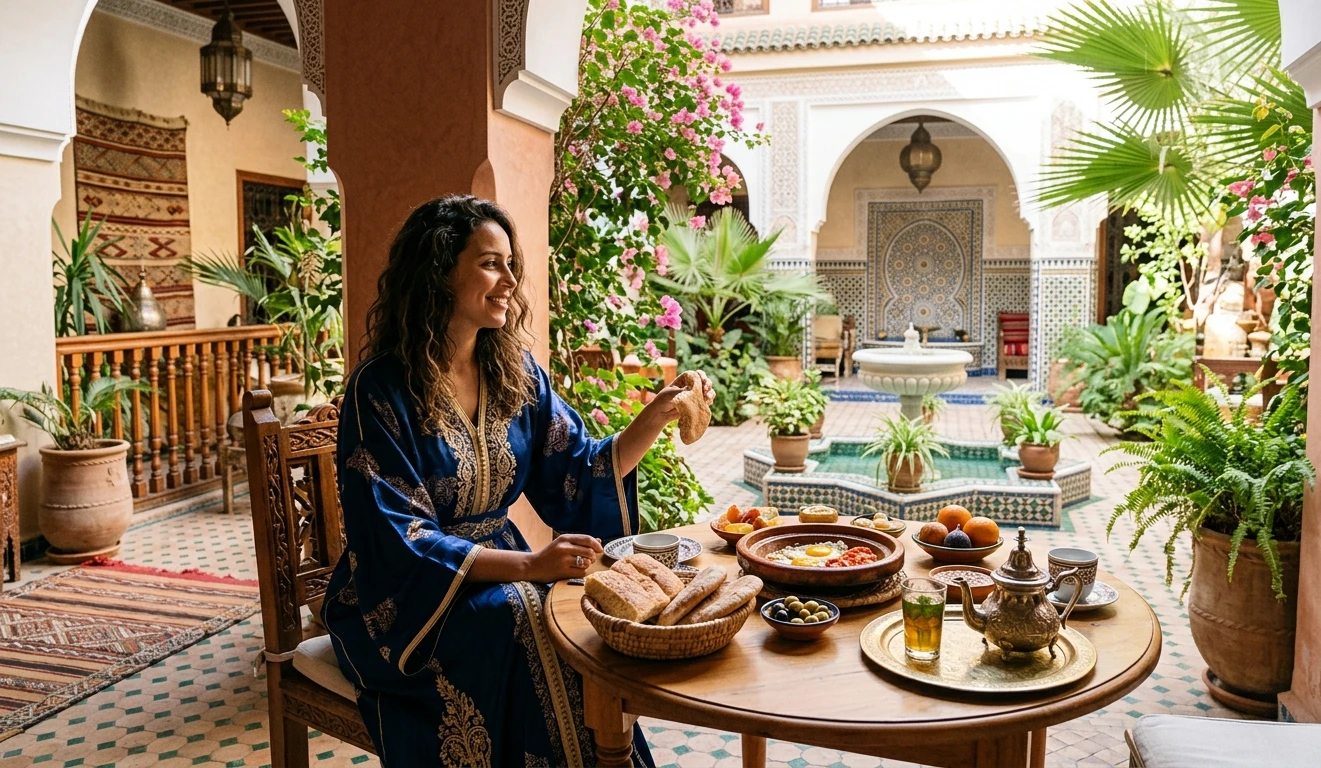
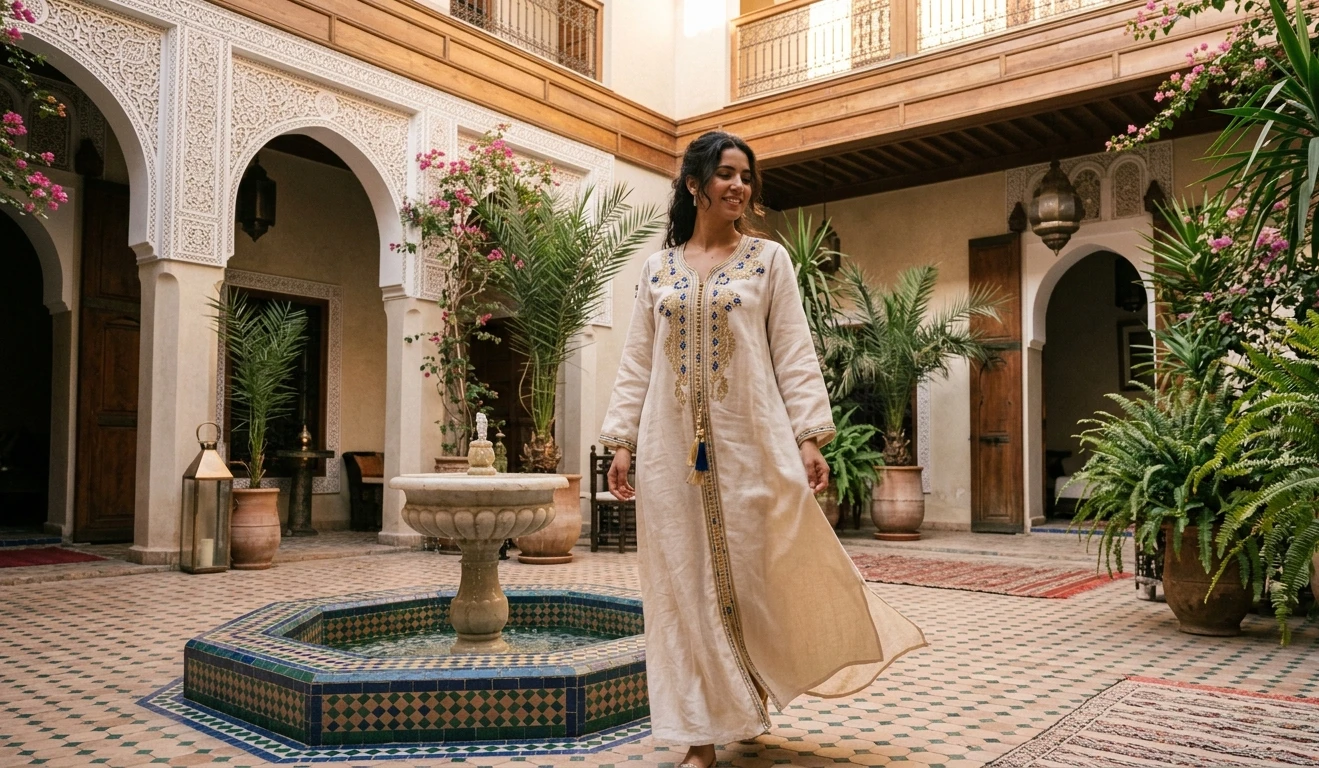
Inside a riad or five-star hotel, dress codes are relaxed and the focus shifts entirely to elegance. This is where you reach for your lightest, most beautiful pieces.
- Flowing midi or maxi dresses in muted jewel tones or warm neutrals
- Silk or cotton loungewear for the pool terrace (modest one-piece or tasteful bikini within the private pool area)
- Embroidered kaftans — the ultimate Morocco souvenir worn as a cover-up or evening dress
- Strappy sandals with low block heels or leather mules
- Statement gold jewellery — oversized hoops, layered chains
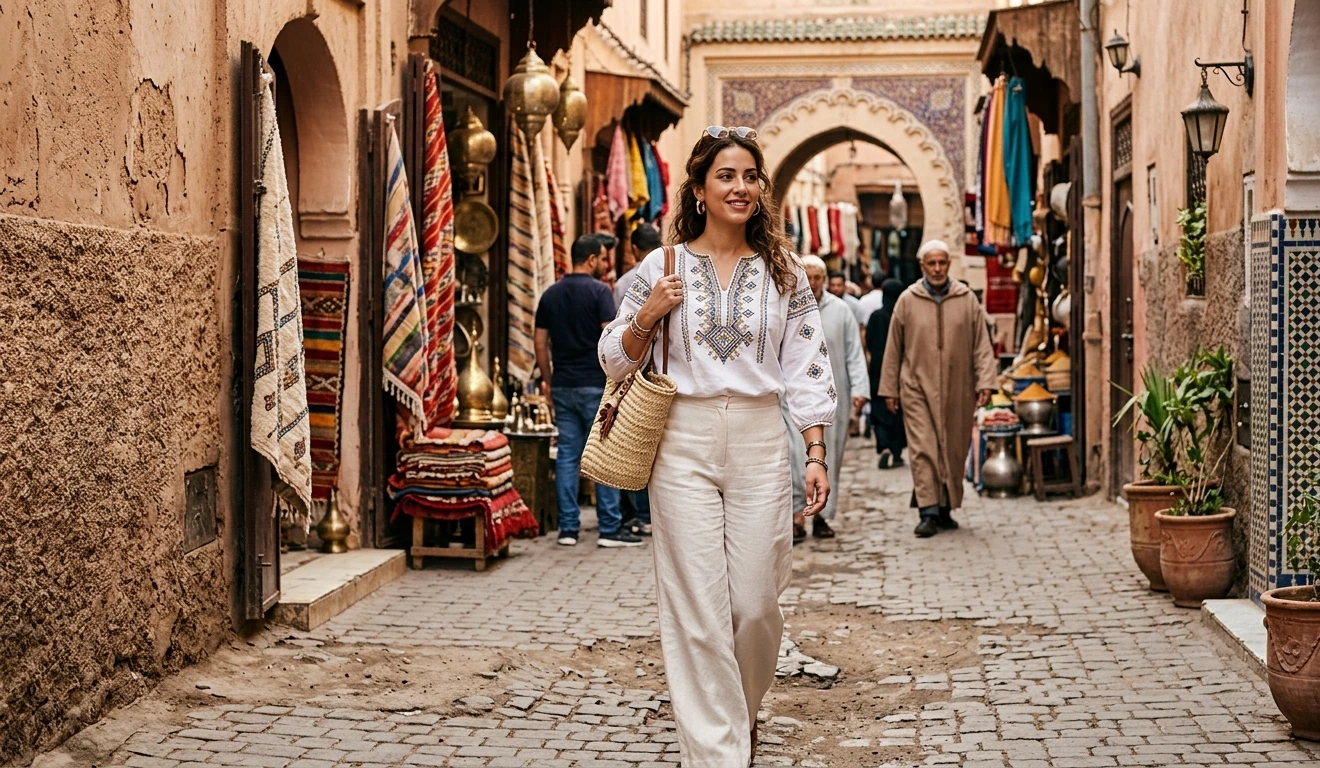
The medina demands an outfit that is practical, respectful, and camera-ready all at once. Narrow alleyways, artisan workshops, and centuries-old mosques sit side by side.
- Wide-leg linen trousers paired with a loose, tucked-in blouse
- A long skirt (below knee) with a breathable long-sleeve top
- A light cotton scarf in your bag — doubles as shoulder cover or impromptu head wrap
- Flat leather sandals or clean white sneakers (cobblestones are unforgiving)
- A structured crossbody bag to keep hands free for exploring
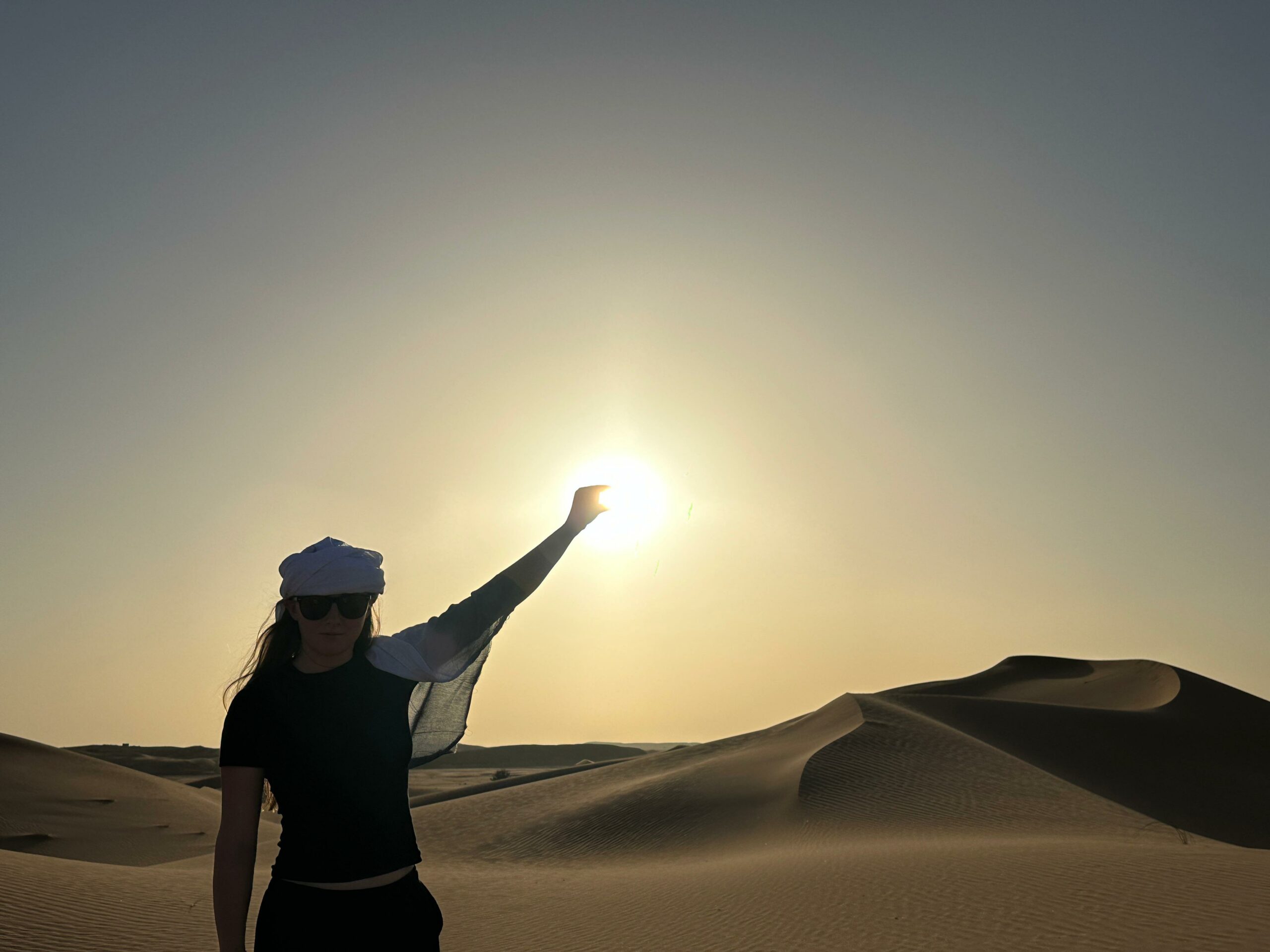
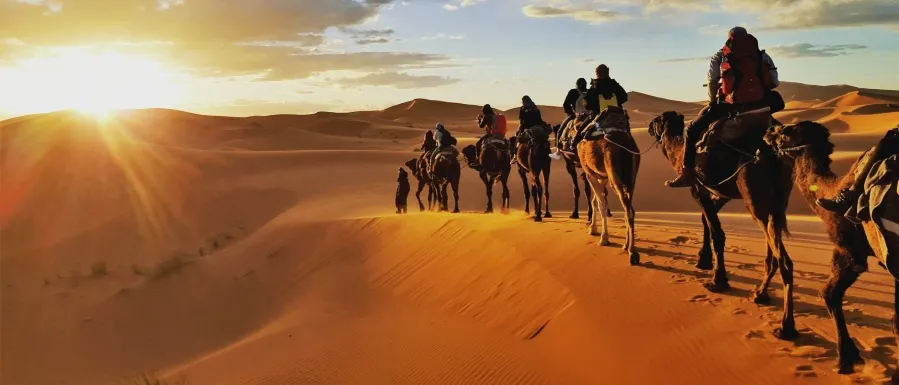
A Sahara sunrise tour is as photogenic as it sounds, and your outfit should match that extraordinary backdrop. The desert also presents practical challenges: fine sand penetrates everything and temperature swings between night and day can exceed 20 °C.
- A sand-toned or cream linen maxi dress — flowy enough for camel trekking photos
- A loose Berber-style turban or large scarf to protect from sun and sand
- Lightweight base layer for cool desert nights
- Closed-toe shoes or ankle boots (sand gets everywhere in open sandals)
- A light cardigan or denim jacket for the evening bonfire
Coastal Resorts & Atlantic Beaches (Agadir, Essaouira, Taghazout)
Morocco’s Atlantic coast is noticeably more relaxed than the interior. In beach towns popular with international surfers and visitors — such as Taghazout and Essaouira — bikinis are the norm on the sand. Agadir’s hotel beach zones are particularly liberal. That said, when you step away from the beach and into the town, throw on a linen cover-up or a sarong dress out of simple courtesy. Essaouira’s seafront is windy almost year-round, making a lightweight kimono jacket genuinely practical as well as stylish.
Hiking in the Atlas Mountains
The High Atlas has a different energy: cooler, quieter, and home to Amazigh villages with a strong sense of tradition. When choosing hiking clothes for Atlas Mountains female travellers, the emphasis shifts toward modesty and performance fabric simultaneously. Opt for lightweight moisture-wicking leggings (not shorts) paired with a longline tunic or quick-dry shirt that falls to the hip. Layers are essential — mornings below 2,000 m can be genuinely cold even in July. A fleece zip-up and a windproof shell complete the look without sacrificing style.
When passing through Berber villages on your Atlas trek, a loose long-sleeve shirt and full-length trousers or skirt shows cultural sensitivity that will be noticed and appreciated by local communities. Reserve shorts and leggings for the trail itself, not for village stops or tea with local families.
Hassan II Mosque Dress Code for Women
The Hassan II Mosque dress code for women is the most specific in the country, and the most important to get right. Casablanca’s iconic mosque — one of the largest in the world and one of the very few in Morocco open to non-Muslim visitors — requires a headscarf, a long dress or skirt, and covered shoulders and arms for entry. This is non-negotiable at the entrance. Keep a long pashmina in your bag whenever you visit Casablanca; it solves all three requirements in one piece of fabric. Inside the mosque, you will be handed a disposable head covering if you arrive without one, but bringing your own is a sign of respect. For everything else Casablanca has to offer, check our guide to the cities of Morocco and plan your itinerary accordingly.
Modest Swimwear for Morocco Hotels
If you are visiting a mixed-gender public pool or a hotel with a community pool — common at mid-range riads — modest swimwear for Morocco hotels is a thoughtful choice. A one-piece swimsuit with a sarong or long beach wrap is universally appropriate. Burkinis are increasingly available and worn by both Moroccan women and international visitors who simply prefer more coverage in the sun. At private pool villas or adults-only luxury resorts, bikinis are standard and unremarkable. The key is reading the venue: a boutique family riad in the medina calls for different choices than a five-star resort with an ocean-facing infinity pool.
Dressing During Ramadan
Visiting Morocco during Ramadan — which shifts approximately 11 days earlier each year — is a genuinely special experience, but it asks a little more from visitors in terms of awareness. During daylight hours, locals are fasting and refrain from eating, drinking, or smoking in public spaces. As a sign of solidarity and respect, dressing a touch more conservatively than usual is a gesture that locals genuinely notice and appreciate. Add an extra layer over your shoulders, choose longer hemlines, and avoid skin-baring outfits in public streets and markets during the day. After iftar (the evening meal), the mood lifts dramatically, and the streets become festive — slightly more relaxed dressing is perfectly fine for evening strolls and restaurant dinners.
Packing by Season
Ideal temperatures. Light layers, cotton dresses, a lightweight jacket for evenings.
Very hot inland. Go ultra-light: linen, cotton voile. Always carry a scarf. Coastal breeze saves everything.
Perhaps the best time to visit. Layer a trench coat over dresses. Perfect photography light.
Cold at altitude, mild on the coast. Knitwear, leather boots, and a warm coat at night in Fès or Marrakech.
Shopping for Clothes in Morocco
One of the most joyful aspects of visiting Morocco is that you can build your ideal wardrobe right there in the souks. Genuine handwoven kaftans, embroidered djellabas, leather babouche slippers, and hand-blocked cotton fabrics are all available — and often far more elegant than anything you could have packed from home. Budget a small amount in Moroccan dirhams (check our guide on what currency Morocco uses before your trip) specifically for textile shopping. A hand-stitched kaftan from a Fès artisan is not only beautiful — it is the single most versatile piece you will own for the entire trip.
Dressing modestly does genuinely reduce unwanted attention in busy medinas — but it is not a guarantee, and it is never the fault of the traveller either way. For practical safety guidance beyond clothing, read our full article on the safest cities in Morocco for women and our broader look at whether Morocco is safe to visit for tourists.
Quick Answers: Common Questions About the Morocco Female Dress Code
Yes, in the right settings. Shorts are entirely appropriate on beach resorts, hotel pools, and Atlantic coastal towns like Agadir and Taghazout. In busy city centres, popular tourist areas like Jemaa el-Fna in Marrakech, and especially in traditional neighbourhoods and medinas, longer trousers or skirts are strongly preferred. Think of it this way: shorts belong at the beach, not the bazaar.
No — with one important exception. In daily Moroccan life, international women are not expected to cover their hair. However, when visiting places of worship — most notably the Hassan II Mosque in Casablanca — a headscarf is required for entry and a sign of genuine respect. Having a light scarf in your bag at all times is the simplest solution; it does double duty as sun protection and an instant modesty layer whenever you need it.
Slightly more modest than your usual Morocco packing list. During the day, keep shoulders and legs covered in public, and choose looser silhouettes. Avoid crop tops, tight-fitting outfits, or anything that might be considered provocative in a public space where people are fasting. After sunset, the atmosphere relaxes considerably and you can dress as you would on any other evening out in Morocco. The key word is intention — locals appreciate the effort even if your Ramadan outfit is simply a light linen dress instead of shorts.
Morocco occupies a nuanced middle ground. It is a Muslim-majority country with genuine respect for modest dressing in public, but it is also a cosmopolitan nation with a thriving fashion scene, glamorous beach resorts, and a long history of welcoming international visitors. Cities like Casablanca and Rabat feel noticeably modern, while rural areas and older medina quarters hold more traditional values. Calling it simply “conservative” misses the richness of that spectrum. For broader cultural context, our article on Morocco’s development and global positioning offers useful perspective.
Flat, comfortable, closed-toe shoes are the medina’s best friend. Cobblestone streets, uneven surfaces, and dust make heels impractical and white trainers temporarily off-white. Traditional leather babouche slippers — bought locally for under 100 dirhams — are perfectly adapted to Moroccan streets and doubles as a beautiful souvenir. For beach days: sandals. For the Atlas Mountains: ankle-support trail shoes. For riad dinners: block-heel mules or embellished flats.
The Essential Morocco Packing List for Women
Based on everything above, here is a distilled list of what actually earns its place in your suitcase:
- 2–3 linen or cotton maxi/midi dresses in neutral or earthy tones
- 1–2 pairs of wide-leg trousers in lightweight fabric
- 3–4 loose blouses or long-sleeve tops that can tuck or layer
- 1 lightweight kaftan (or budget to buy one on arrival)
- 2 large cotton or silk scarves (sun protection, modesty cover, and styling accessory all in one)
- 1 pair of flat leather sandals and 1 pair of clean trainers
- A swimsuit or modest one-piece for hotel pools
- 1 light cardigan or linen jacket for cool evenings and mountain excursions
- 1 warmer layer (fleece or knit) if travelling in winter or visiting the Atlas
- A small structured crossbody bag and a tote for souk shopping
Style Is the Best Souvenir
The women who travel Morocco most confidently are not the ones who stripped their wardrobe down to the safest possible choices — they are the ones who engaged with the culture, bought a local kaftan on day two, and wore it everywhere from a rooftop dinner to a desert camp. Understanding what to wear in Morocco for women is ultimately about reading the landscape, honouring the people, and letting Morocco’s extraordinary sense of colour and craft influence your own aesthetic.
Pack the linen, carry the scarf, wear the jewellery. Morocco is one of the most visually spectacular countries on Earth — and you deserve to look the part.
For more practical travel planning — from finding the right city to understanding local costs — explore our complete guide to Morocco’s cities and our overview of safety for tourists in Morocco.