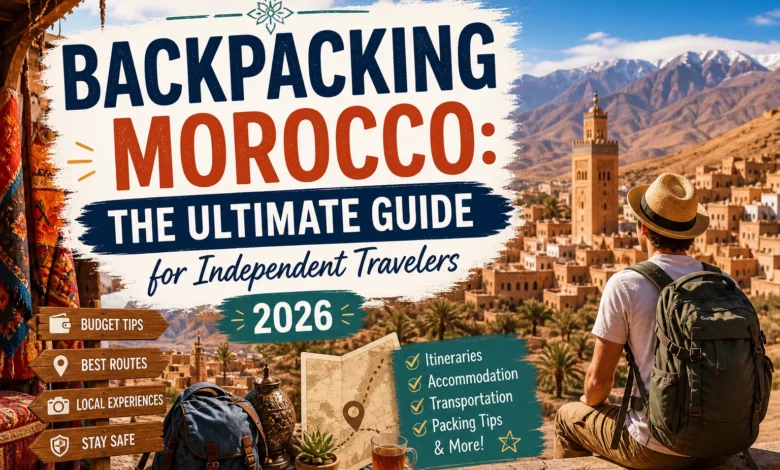
Backpacking Morocco: The Ultimate Guide for Independent Travelers
Routes, budgets, best cities, safety, food, and everything else you need to plan an unforgettable backpacking Morocco adventure — updated for 2026.
Morocco sits just eight miles from Spain across the Strait of Gibraltar, yet the moment you step off the ferry or plane, the feeling is unmistakable: you have crossed into an entirely different world. Ancient medinas that have changed little in a thousand years, Berber villages clinging to the slopes of the High Atlas, Saharan dunes that glow amber at sunset — and all of it reachable on a genuinely lean budget.
Backpacking Morocco has surged in popularity in recent years, and for good reason. The infrastructure has quietly improved, the hostel scene has matured, and the country’s sheer variety — desert, mountain, coast, medieval city — means you can design an itinerary that feels entirely your own. Whether you have one week or three months, this guide gives you everything you need to plan it properly.
Why Backpack Morocco? ↑
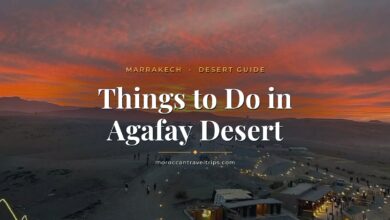
It is not one thing that makes Morocco compelling — it is the collision of things. Morocco’s physical features are staggering in their range: the Rif and Atlas mountain ranges, the Atlantic and Mediterranean coastlines, the pre-Saharan plains that fade into the great sand seas of Erg Chebbi. In the span of a single country, you can go from surfing cold Atlantic swells in Taghazout to camping on golden dunes outside Merzouga in under 24 hours.
Beyond landscape, the cultural depth is extraordinary. Morocco’s identity is woven from Amazigh (Berber), Arab, Andalusian, and sub-Saharan African threads, and that layering is visible in architecture, cuisine, music, and everyday conversation. No other destination in the Mediterranean world packs this much into such an accessible package.
Best Time to Visit Morocco ↑
The honest answer is that Morocco has no truly bad season — but it does have seasons that suit different kinds of travel.
| Season | Months | Weather | Crowds & Prices | Best For |
|---|---|---|---|---|
| Spring | Mar – May | Warm, green landscapes, occasional rain in north | Moderate — rising | Trekking, cities, overall balance |
| Summer | Jun – Aug | Very hot inland (45 °C+), cool coastal breeze | High (especially coasts) | Surfing, coastal towns, festivals |
| Autumn | Sep – Nov | Excellent — warm days, cool evenings | Moderate — ideal | Sahara, Atlas treks, photography |
| Winter | Dec – Feb | Cold in mountains (snow), mild on coast & south | Low — best prices | Budget travelers, Marrakech, desert |
Getting to Morocco ↑
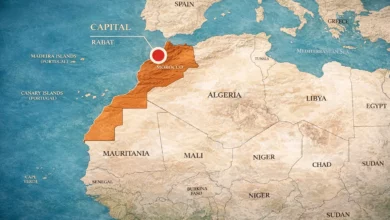
If you are wondering where Morocco is in relation to your starting point, the answer is almost certainly “closer than you think.” Morocco is in northwest Africa, tucked between the Atlantic Ocean and the Mediterranean Sea, with Algeria to the east and the Spanish-governed enclave of Ceuta to the north.
By Air
Budget airlines — Ryanair, easyJet, Transavia — fly into Marrakech, Fes, Agadir, Casablanca, and Tangier from dozens of European cities, often for well under €60 one-way if booked in advance. Casablanca’s Mohammed V International Airport is the main hub for long-haul arrivals from the Americas, the Gulf, and West Africa.
By Ferry from Spain
The Algeciras–Tarifa to Tangier ferry is one of travel’s great short crossings: roughly 35–90 minutes depending on the route, with several departures daily. It is an especially popular option for backpackers combining Morocco with a trip through Spain or Portugal. Prices start around €40–€60 for a foot-passenger ticket.
Visas
Citizens of 69+ countries — including the entire EU, the UK, the US, Canada, and Australia — can enter Morocco visa-free for up to 90 days. Check current requirements before travel, as policies can shift. Most visitors simply receive an entry stamp on arrival.
Budget & Daily Costs in 2026 ↑
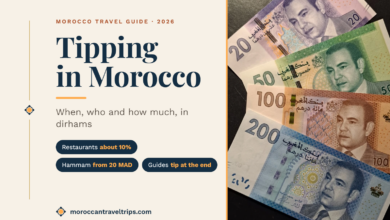
One of the great surprises of backpacking Morocco is how far your money goes. As of early 2026, one US dollar buys roughly 9.8–10 Moroccan dirhams (MAD). For context on what currency Morocco uses and current exchange rates, it is worth checking before you travel.
| Budget Level | Daily Cost (MAD) | Daily Cost (USD) | What You Get |
|---|---|---|---|
| Shoestring | 185 – 300 MAD | ~$19 – $30 | Dorm bed, market food, buses, free sights |
| Backpacker | 300 – 450 MAD | ~$30 – $45 | Private hostel room or budget riad, local restaurants, trains |
| Mid-Range | 500 – 900 MAD | ~$50 – $90 | Comfort guesthouse, tours, taxis, all meals out |
| Flexible / Splurge | 1,000+ MAD | $100+ | Boutique riads, private drivers, desert camps |
Money Tips
Morocco operates largely as a cash economy. Carry dirhams for medinas, markets, and smaller guesthouses — many smaller vendors do not accept cards. Al Barid Bank ATMs are generally the most backpacker-friendly, allowing withdrawals up to 2,000 MAD with low or no additional foreign fees. Avoid airport exchange desks; rates in city-centre banks and exchange offices are consistently better.
Top Destinations for Backpacking Morocco ↑
Morocco has a remarkably extensive list of cities and destinations worth visiting, but these are the ones that appear on almost every backpacking itinerary for good reason.
Backpacking Morocco Routes & Itineraries ↑
1 Week – The Classic South Loop
Tight but doable if you move efficiently. Best entered via Marrakech.
2 Weeks – North to South (Recommended)
The most popular backpacking route in Morocco, covering imperial cities, mountains, and desert.
3–4 Weeks – The Full Morocco Experience
Three or more weeks allows you to add the Atlantic surf coast (Taghazout, Mirleft), the Todra and Dades Gorges, a Toubkal trek, and quieter towns most tourists never reach. Follow the two-week route above and add the Atlantic coast south of Agadir, looping back north through the Anti-Atlas.
Where to Stay While Backpacking Morocco ↑
Hostels
The hostel scene in Morocco has matured considerably. Marrakech, Fes, Chefchaouen, Essaouira, Rabat, and Casablanca all have solid options with dorm beds ranging from 70 MAD in smaller cities to 150–220 MAD in peak season in tourist hotspots. Many are housed in traditional buildings — an experience in itself.
Riads & Budget Guesthouses
A riad is a traditional Moroccan courtyard house, and many family-run riads offer private rooms at surprisingly affordable rates — sometimes cheaper than a hostel private room, with breakfast included. These are often the best-value stays in Morocco and come with genuine local character. Look beyond Booking.com for the best deals; direct negotiation at arrival can yield 15–20% savings.
Desert Camps
For the Sahara experience, desert bivouacs range from basic shared camps (300–500 MAD per person including dinner and breakfast) to luxury private tent camps with proper beds, solar lighting, and private bathrooms at 1,500+ MAD. For backpackers, shared camps are perfectly comfortable and the social atmosphere is often a highlight of the trip.
Food & Drink in Morocco ↑
Moroccan food is one of the world’s great cuisines, and for backpackers it represents extraordinary value. Eating where workers eat — at market stalls, simple restaurants on side streets, and food carts around bus stations — will keep your daily food budget between 80 and 150 MAD while delivering consistently excellent meals.
Essential Dishes to Try
Tagine — slow-cooked meat or vegetables in a clay pot with aromatic spices. Ubiquitous, warming, and available everywhere from 30–80 MAD. Couscous is Morocco’s Friday tradition; families gather and restaurants offer their best versions for lunch. Harira is a thick soup of tomatoes, lentils, chickpeas, and lamb — Morocco’s great comfort food, especially during Ramadan. Msemen (layered flatbread) and b’stilla (pigeon or chicken pie wrapped in flaky pastry) are both extraordinary. And everywhere, always: fresh-squeezed orange juice for 5–8 MAD.
Mint Tea
Moroccan mint tea — poured dramatically from height to create froth — is not just a beverage but a social ritual. You will be offered it constantly, and accepting it is the right call. It signals openness and respect. Drinking it slowly is part of the pleasure.
Alcohol
Morocco is a Muslim-majority country and alcohol is not part of daily culture, but it is available. Supermarkets in larger cities sell beer and wine; bars and licensed restaurants serve alcohol in tourist areas. Prices are significantly higher than street food — factor this in if it is part of your budget.
Getting Around Morocco on a Budget ↑
| Transport Type | Best For | Typical Cost | Notes |
|---|---|---|---|
| ONCF Train | Casablanca–Rabat–Fes–Marrakech axis | 40–180 MAD | Comfortable, reliable, book ahead for Marrakech |
| CTM / Supratours Bus | Most intercity routes | 60–220 MAD | Air-con, luggage storage, online booking available |
| Grand Taxi | Short regional hops | 15–80 MAD shared | Shared Mercedes, fills before departing, fast |
| Petit Taxi | Within cities | 7–25 MAD | Metered in larger cities; negotiate upfront elsewhere |
| Domestic Flight | Long hauls (e.g. Marrakech → Agadir) | 200–500 MAD | RAM and budget carriers; check deals in advance |
Safety Tips for Backpacking Morocco ↑
Morocco is safe to visit — the country’s crime rate relative to visitor numbers is remarkably low. That said, some nuances are worth knowing.
Common Scams to Know
Most hassle in Morocco is concentrated in the busiest tourist medinas, particularly Marrakech and Fes. The most common scenario involves a friendly stranger offering to “show you around” or “help you find” something, who then expects payment. Simply declining politely and walking with purpose is usually enough. If you do accept help, agree on a price beforehand.
Snake charmers and monkey handlers in Djemaa el-Fna charge for photos — sometimes aggressively. Henna artists who approach you often add charges after application. These are not dangerous, just costly if you are unprepared.
For Solo Female Travelers
Morocco is manageable for solo women but requires more active boundary-setting than some destinations. Wearing loose, covering clothing (not necessarily religious dress, just modest) reduces attention significantly. Learning to walk confidently without making eye contact with street vendors is a skill that develops quickly. Many solo women backpack Morocco without incident and find the experience deeply rewarding.
Health & Vaccinations
No vaccinations are legally required to enter Morocco. The Hepatitis A and B vaccines are recommended, as is an up-to-date Tetanus booster. Tap water in Morocco is technically treated but varies in quality by region — a filtered water bottle is the sensible call. Travel insurance that covers medical evacuation is strongly recommended.
Packing List for Morocco ↑
Morocco’s climate and cultural context make packing choices matter more than in many destinations. A 40–50 litre backpack is ideal — large enough for layers but light enough to navigate medina alleys with ease.
🎒 Clothing
- Lightweight long trousers (men & women)
- Loose long-sleeve shirts or tunics
- Light scarf or pashmina (mosques, cold nights)
- Comfortable walking shoes
- Sandals for medina and hammam
- Warm layer for Atlas & desert nights
- Quick-dry underwear & socks
💊 Health & Hygiene
- Water bottle with filter (e.g. LifeStraw)
- Sunscreen (50+ SPF)
- Lip balm with UV protection
- Hand sanitizer & antibacterial wipes
- Electrolyte sachets
- Basic first-aid & prescription meds
- Wet wipes (invaluable everywhere)
📱 Tech & Navigation
- Unlocked phone + local SIM (Maroc Telecom or Orange)
- Offline maps (Maps.me or Google Maps offline)
- Universal adapter + power bank
- Headtorch (for medinas & camping)
- Earphones
🗂 Documents & Money
- Passport (6+ months validity)
- Printed & digital copies of key docs
- Travel insurance documents
- Mix of cash (MAD) + one backup card
- Small cash wallet for daily use
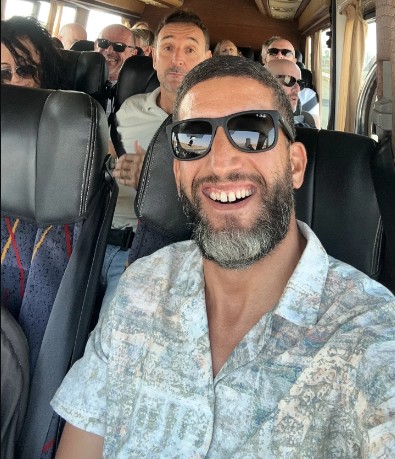
Mouhssine ELIOUJ
Licensed Tourist Guide · Ref. No. 2898 · Morocco Ministry of Tourism
Planning your Morocco backpacking itinerary and need expert, on-the-ground guidance? Mouhssine is a government-licensed tourist guide with deep knowledge of Morocco’s medinas, desert routes, mountain trails, and hidden gems. Whether you want a half-day medina walk, a multi-day tour, or simply reliable local advice, you can reach him directly and confidentially via WhatsApp — no agencies, no markups.
Chat on WhatsApp