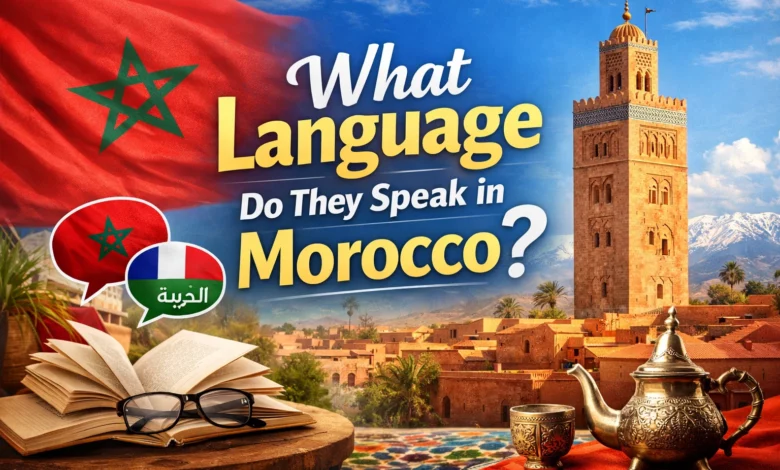
What Language Do They Speak in Morocco?
A Complete Guide to Morocco’s Languages, Dialects & Linguistic Identity
Morocco is not a country you can define with a single language. It is a living mosaic — Berber roots, Arab history, French influence, and the pulse of its own street tongue all woven into everyday speech. If you are wondering what language do they speak in Morocco, the answer is fascinatingly layered.
Situated at the crossroads of Africa, the Arab world, and Europe, Morocco has always been a meeting point of civilisations. That geography is etched into its speech. From the ancient mountain villages of the Atlas to the cosmopolitan boulevards of cities in Morocco like Fes, Casablanca, and Marrakech, you will hear a rich rotation of languages that shifts with every neighbourhood, social class, and generation.
The Official Languages of Morocco
Morocco officially recognises two languages in its constitution: Modern Standard Arabic (Fusha) and Tamazight (Amazigh). Arabic was enshrined from independence in 1956, while Tamazight earned official status through the landmark 2011 constitutional reform — a historic acknowledgement of the Amazigh people’s cultural legacy.
Modern Standard Arabic appears in government documents, national newspapers, formal education, and state broadcasting. However, most Moroccans would not use it for casual conversation — for that, they reach for something entirely their own.
Darija — The True Voice of Morocco
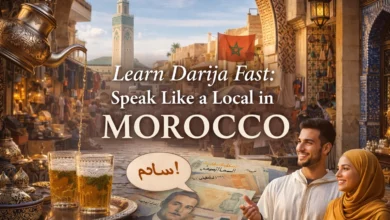
Ask any Moroccan what language they actually live in, and they will tell you: Darija. This is Moroccan colloquial Arabic — a dialect so distinct from Standard Arabic that speakers from Cairo or Damascus often struggle to follow it. And that is partly the point.
Darija is the most spoken language in Morocco by everyday usage. It borrows liberally from Tamazight, French, Spanish, and even Portuguese — folded into an Arabic grammatical skeleton that has evolved over centuries. Words slip between languages mid-sentence with breathtaking ease, a phenomenon linguists call code-switching.
Darija is predominantly spoken rather than written. You will rarely see it in formal print. Yet social media has given it a new written life — often typed in Latin script or a mix of Arabic numerals and letters called “Arabizi.”
Tamazight — Morocco’s Ancient Tongue
Long before Arab conquest reached North Africa, the Amazigh people (historically called Berbers, though many prefer Amazigh) inhabited the Moroccan landscape. Their language, Tamazight, is not one monolithic tongue but a family of related dialects:
- Tachelhit (Shilha) — spoken by roughly 8–10 million people, mainly in the Souss region, Anti-Atlas, and Agadir area.
- Central Atlas Tamazight — the dialect of Atlas Mountain communities, stretching across central Morocco.
- Tarifit (Riffian) — spoken in the northern Rif region around Al Hoceima and Nador.
Since gaining official status, Tamazight is now taught in schools using the Tifinagh script — an ancient writing system restored for modern use. The language is deeply tied to Moroccan identity and is flourishing in music, literature, and cultural advocacy.
French — The Language of Business and Education
France’s protectorate over Morocco (1912–1956) left a linguistic legacy that has proved remarkably durable. French is not an official language, yet it functions as Morocco’s de facto language of commerce, higher education, medicine, law, and international affairs.
Morocco language spoken percentage in French contexts is striking: virtually all university instruction beyond the first cycle is conducted in French, most major corporations operate internally in French, and elite families often raise bilingual Arabic-French children. French-language newspapers like Le Matin remain widely read.
If you are visiting for business — or simply navigating a city menu — French will rarely let you down in Morocco.
What Language Is Spoken in Casablanca, Morocco?
Casablanca is Morocco’s economic engine, and its linguistic environment reflects that cosmopolitan status. What language is spoken in Casablanca Morocco is a question with a multi-part answer. Darija dominates street-level interaction, but French is everywhere in offices, hotels, and signage. You will also encounter English increasingly among the younger, internationally educated professional class.
Casa’s immigrant communities — sub-Saharan Africans, expats from Europe, Gulf nationals — add further texture to the city’s soundscape. To navigate Morocco well, a few words of Darija and basic French go a very long way.
What Language Is Spoken in Morocco — Marrakech?
Marrakech draws millions of visitors each year, and the linguistic reality there is somewhat different from Casablanca. What language is spoken in Morocco Marrakech is overwhelmingly Darija in the medina, souks, and residential neighbourhoods — but English is far more present here than in most other Moroccan cities, driven entirely by tourism.
Souk merchants are famously multilingual: a Marrakchi vendor may pivot between Darija, French, English, Spanish, and Italian within a single negotiation. It is pragmatic polyglottery at its finest. You will also notice that many signs in the Djemaa el-Fna area appear in French and English — a conscious concession to the tourist trade.
“In Morocco, language is not just communication — it is identity, history, and belonging, all spoken in the same breath.”
Spanish — A Northern Legacy
Spain’s influence in northern Morocco is impossible to ignore. The cities of Tetouan, Larache, Al Hoceima, and the Spanish enclaves of Ceuta and Melilla were part of the Spanish Protectorate until 1956. As a result, Spanish remains genuinely spoken — not just for tourism — in the northern regions.
In Tetouan, you can walk into an ordinary shop and hold a full conversation in Spanish. The Rif region has strong ties to Spanish-speaking Moroccan diaspora in Europe, and satellite television from Spain keeps the language fresh among younger generations.
English — A Rising Force
English is climbing fast. Moroccan universities have introduced English-medium programmes; multinationals expanding into Morocco require it; and the explosion of international tourism has made it economically valuable. Among Moroccans under 30 in urban centres, English proficiency is increasingly common and proudly worn.
For tourists concerned about communication: if you speak English, you will manage comfortably in most tourist-facing situations. And if you wonder whether Morocco is safe to visit for tourists, the answer is a reassuring yes — and the linguistic accessibility in tourist areas is part of what makes it so welcoming.
- Darija — Everyday spoken life across the country. Essential for genuine local connection.
- Modern Standard Arabic — Official use, formal education, religious contexts.
- Tamazight — Co-official; spoken widely in rural and Amazigh communities.
- French — Business, higher education, upscale services. Very useful for travellers.
- Spanish — Northern Morocco, especially Tetouan and the Rif.
- English — Tourist areas, young urban professionals, growing fast.
Practical Language Tips for Travellers
Understanding the linguistic landscape will genuinely enrich your experience. Before you travel, it helps to know a little about what currency Morocco uses and to learn a handful of Darija phrases — locals respond with visible warmth when a visitor makes even a small effort.
- “As-salamu alaykum” — The universal greeting. Always appreciated.
- “Shukran” — Thank you. Simple, effective, universally understood.
- “Bshal?” — How much? Useful in any souk across the cities of Morocco.
- “La, shukran” — No, thank you. Polite but clear — invaluable in busy medinas.
Book Your Tour Directly via WhatsApp
The best way to truly experience Morocco — its languages, its people, its hidden corners — is alongside someone who lives it every day. Our licensed local guide is available to plan and lead your journey, from the imperial cities to the Sahara’s edge, and can communicate in Arabic, Darija, French, and English.
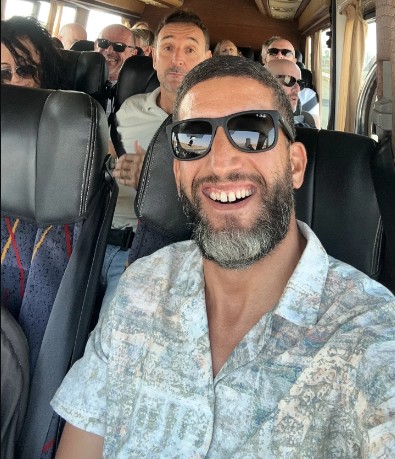
🏅 Licensed Official Tour Guide
Guide Mouhssine
License: No Réf. 2898
Certified, experienced, and passionate about sharing Morocco’s heritage — its languages, history, cuisine, and landscapes. Personalised tours across all of Morocco, tailored to your rhythm and interests.
Simply send a message via WhatsApp to +212 671 437 971 to discuss your itinerary, ask questions, or reserve your dates. Guide Mouhssine typically responds within a few hours.
Final Thoughts
So, what language do they speak in Morocco? The honest answer is: several, simultaneously, and with remarkable fluency. Morocco’s linguistic plurality is not confusion — it is sophistication. It is the accumulated consequence of thousands of years of trade, conquest, migration, and cultural exchange.
Whether you find yourself navigating the medina of Fes, bargaining in a Marrakech souk, or sipping coffee on a Casablanca terrace, you will encounter this beautiful layering firsthand. Come with curiosity, a few phrases of Darija, and a readiness to be surprised — Morocco will do the rest.