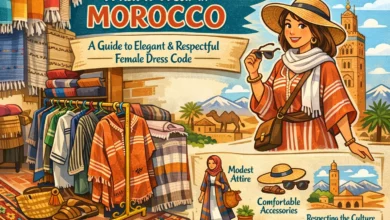
What to Wear in Morocco:
The Ultimate Packing List
A practical, culture-savvy guide to dressing right for every corner of Morocco — from the Sahara to the souks.
Why Your Clothing Choice Matters in Morocco ↑ Back
Planning what to wear in Morocco is one of the most overlooked — and most impactful — parts of any trip. Morocco sits at a fascinating crossroads: it is a predominantly Muslim country with deeply rooted traditions, yet it also welcomes millions of international visitors every year with warmth and genuine hospitality. Getting the dress code right means more meaningful interactions with locals, more comfortable days in the heat or mountain cold, and fewer moments of feeling like an outsider.

Vibrant medina streets in Marrakech — where dressing thoughtfully makes all the difference.
There is no strict dress code enforced by law for tourists, but modesty is deeply valued — especially in medinas, mosques, rural villages, and the Sahara. The good news is that packing for Morocco does not mean sacrificing style. Lightweight, breathable fabrics in warm earthy tones do double duty: they respect local culture and look fantastic against the country’s breathtaking backdrops.
New to Morocco?
Before diving into clothing specifics, it helps to understand the country’s geography and culture. Check our guide on where Morocco is located to get a feel for its diverse landscapes — from Atlantic coast to High Atlas peaks to Sahara dunes — each of which calls for slightly different outfits.
Think of Morocco’s dress culture as a spectrum. In cosmopolitan Casablanca or the beach town of Agadir, you will see locals in jeans and T-shirts. In the ancient medinas of Fes or Chefchaouen, conservative dress draws less attention and more respect. In the Sahara desert, warmth matters as much as modesty. Your Morocco packing list should account for all of this.
What to Wear in Morocco for Women ↑ Back
Women visiting Morocco face the most questions around clothing, and rightly so — the right choices genuinely shape your experience. As a female traveller, you will feel most comfortable and receive the warmest reception when your outfits cover your shoulders, cleavage, and knees. This does not mean you need to dress like a local; it simply means choosing pieces that offer a little more coverage than you might wear at home.
For a deeper dive specifically tailored to female travellers, we have a full dedicated resource on what to wear in Morocco for women with outfit ideas, shopping tips, and region-specific advice.
Linen trousers and a loose long-sleeve top — a perfect base outfit for exploring any medina.
Core Wardrobe Essentials for Women
Maxi Dresses & Skirts
Flowy, ankle-length dresses in cotton or linen are ideal. They keep you cool, cover your legs, and look effortlessly put-together. Stick to one solid or subtle print to avoid standing out.
Loose-Fit Tops & Tunics
Opt for tops that cover your shoulders and collarbone. Linen shirts, relaxed-fit blouses, and longer tunics pair beautifully with wide-leg trousers or leggings.
Lightweight Scarves
Pack at least two thin cotton or bamboo scarves. They serve triple duty: covering your head when entering sacred spaces, protecting from desert sun, and adding a layer of warmth at night.
Wide-Leg Linen Trousers
Your most versatile piece. Pair them with anything, roll them up slightly for a relaxed look, and know that they will never be too hot in summer or too cold in early spring evenings.
A Tailored Cardigan or Kimono
Evenings in Marrakech and Fes can be cooler than expected, especially outside of peak summer. A quality kimono-style layer adds warmth and coverage without bulk.
Swimwear (for Riads & Resorts)
Yes, bring a swimsuit — but keep it for riad pools, hotel pools, and beach resorts like Agadir or Essaouira. Wearing swimwear in public spaces or markets is not appropriate.
Local Tip
If you forget anything or simply want to travel lighter, the souks of Marrakech and Fes sell beautiful locally-made caftans, djellabas, and scarves at reasonable prices. Pick one up when you arrive — it makes for a wonderful souvenir and a perfect outfit.
What to Wear in Morocco for Men ↑ Back
Male travellers generally have a little more flexibility, but the core principle remains the same: avoid overly revealing or beach-casual outfits when exploring cities, medinas, or rural areas. Shorts are widely accepted in coastal and resort towns, but in more conservative inland medinas — particularly Fes and rural mountain villages — long trousers will always be the more respectful (and comfortable) choice.
- Lightweight chino or linen trousers in neutral tones (khaki, slate, olive)
- Breathable cotton or linen shirts — half-sleeved is fine for daytime
- A light zip-up fleece or thin knit for Atlas Mountain hikes and desert nights
- T-shirts for casual days, kept tucked into trousers in more traditional settings
- A smart casual shirt for riad dinners or rooftop evenings
- Board shorts or swim trunks strictly for pool and beach use
- Tank tops as your primary shirt in medinas or mosques
- Very short shorts in traditional or rural areas
- Anything with offensive graphics or slogans
- Flip-flops for serious hiking or medina walking (they’ll wreck your feet on cobblestones)
In terms of colours, Morocco’s natural palette of terracotta, sand, and deep blue already inspires what to pack. Neutral tones photograph beautifully against the country’s architecture and landscapes, and they are easy to mix and match, reducing the total number of items you need to bring.
Dressing for Different Regions of Morocco ↑ Back
Morocco is remarkably diverse — a single trip might take you from coastal Atlantic towns to high mountain passes to the edge of the Sahara. The cities of Morocco each have their own character and, by extension, their own dress expectations. Here’s how to dress for each major context:
From the Sahara to the Atlas, Morocco’s landscapes demand different outfit strategies.
🕌 Imperial Cities: Marrakech, Fes, Meknes, Rabat
These are Morocco’s cultural heartlands — ancient medinas, historic mosques, and a strong sense of traditional identity. This is where modesty matters most. Women should keep shoulders and knees covered at all times when outside the riad or hotel. Men should opt for long trousers. Breathable cotton or linen is your best friend here, as the summer heat in Marrakech can be intense.
🏔️ Atlas Mountains & Berber Villages
If you are trekking in the High Atlas or visiting traditional Berber communities, conservative dress is even more important out of genuine respect for local customs. You will also need to layer: mountain temperatures can drop sharply after sunset even in summer. Pack a quality fleece, a windproof outer layer, and moisture-wicking base layers for serious hiking days.
🌊 Coastal Cities: Agadir, Essaouira, Tangier, El Jadida
Morocco’s Atlantic coast is noticeably more relaxed. In beach resort areas and the more international zones of Agadir, swimwear is perfectly acceptable on the beach. Shorts and short sleeves are widely worn by tourists and younger locals alike. That said, once you step away from the beach front into local neighbourhoods or markets, it is worth covering up a little more.
🏜️ Sahara Desert: Merzouga & Zagora
The desert calls for a specific strategy. Days can be scorchingly hot, but nights — especially on overnight camel treks — are surprisingly cold. A loose, long-sleeved linen shirt protects against sun and sand while keeping you cool. Pack a warm layer for the evenings. A cotton tagelmust (desert wrap) is not just a style choice — it is genuinely effective protection against sandstorms and harsh wind.
Seasonal Packing Guide ↑ Back
The season you travel in fundamentally changes what to pack for Morocco. The country’s climate varies enormously — from Mediterranean and Atlantic coasts to high Alpine peaks and sub-Saharan desert. Here’s a quick seasonal breakdown:
| Season | Typical Temps | What to Prioritise | Key Extras |
|---|---|---|---|
| 🌸 Spring (Mar–May) | 18–28 °C | Light layers, linen trousers, long tops | Light cardigan, comfortable walking shoes |
| ☀️ Summer (Jun–Aug) | 28–42 °C | Ultra-lightweight fabrics, max coverage with minimum fabric | Sun hat, SPF 50+, cotton scarf for shade |
| 🍂 Autumn (Sep–Nov) | 20–30 °C | Mixed layers, mid-weight fabrics | Light jacket for evenings, closed-toe shoes |
| ❄️ Winter (Dec–Feb) | 5–18 °C | Warm layers especially for Atlas & Sahara nights | Fleece, warm scarf, waterproof jacket for Atlas |
Summer Note
Summer in interior Morocco (particularly Marrakech and the pre-Saharan region) is genuinely intense. Temperatures routinely exceed 40 °C. Paradoxically, covering up in light linen actually keeps you cooler than exposing skin to direct sun. Think of how local Berber and desert traditions approach heat — full-length robes in pale fabrics have kept people comfortable for centuries.
Footwear: What Actually Works on the Ground ↑ Back
Shoe choice will make or break your comfort in Morocco. The medinas of Fes and Marrakech are a labyrinth of ancient cobblestones, uneven lanes, and steep alleys. Footwear that looks good but offers zero grip or support will leave you exhausted and in pain within hours.
- Comfortable leather sandals with a proper footbed — not flat flip-flops. Brands like Birkenstock or Ecco are worth the investment.
- Cushioned walking shoes or lightweight trainers for medina days and mountain exploration.
- Lightweight hiking boots (low-cut is fine) if you plan to trek in the Atlas.
- Moroccan babouches (slip-on slippers) bought locally — perfect inside riads and as a comfortable evening shoe.
- High heels — genuinely dangerous on medina cobblestones.
- Flat flip-flops for long walking days — your feet will suffer.
- Brand-new shoes that haven’t been broken in — blisters in a Moroccan souk are not a pleasant experience.
Shopping Tip
Moroccan leather goods are world-class. The tanneries of Fes produce some of the finest leather on earth, and you can find beautifully crafted sandals and babouches throughout the medinas. If you have room in your bag, picking up a pair locally is one of the most rewarding Morocco experiences.
Must-Have Accessories for Morocco ↑ Back
Accessories are not an afterthought when it comes to your Morocco travel outfit — they are functional essentials. These small additions can make the difference between a comfortable, confident day and a miserable one.
The right accessories transform any Morocco outfit from functional to refined.
Wide-Brim Sun Hat
Essential for the Sahara, Atlas hikes, and any summer travel. A straw hat or UPF-rated cotton hat offers genuine protection and looks great in photos.
Quality Sunglasses
UV-protective lenses are a must, not a luxury. Morocco’s light is intensely bright, especially in the desert and at altitude. Polarised lenses are worth the extra cost.
Crossbody Bag
A small leather or canvas crossbody keeps essentials secure and your hands free while navigating busy medinas. Backpacks are fine but easier targets for opportunistic pickpockets in very crowded areas.
SPF 50+ Sunscreen
Not clothing, but essential. Good-quality sunscreen can be expensive or hard to find outside major cities. Bring enough from home for the whole trip, especially if heading to the desert.
Simple Jewellery
Leave flashy or expensive jewellery at home. Simple silver or beaded pieces fit beautifully with Morocco’s aesthetic and won’t attract unwanted attention in markets.
Lightweight Daypack
A foldable daypack is invaluable for Atlas hikes and desert trips. Choose one that compresses small when not in use.
What NOT to Wear in Morocco ↑ Back
Understanding what to avoid is just as important as knowing what to pack. Morocco is a welcoming country — and understanding how safe Morocco is for tourists also involves knowing how to dress and behave respectfully. Some clothing choices that would be perfectly normal in other destinations can attract unwanted attention or cause genuine offence here.
- Revealing crop tops when outside the hotel or beach resort — covers the midriff when in public spaces.
- Mini skirts or very short shorts in medinas, mosques, or rural areas — knee-length or longer is always the safer choice.
- Sleeveless tops as your only upper layer in traditional settings — always have a scarf or cardigan to hand.
- See-through or sheer fabrics without an appropriate layer underneath.
- Swimwear in non-beach public spaces — this applies to both men and women.
- Overly tight or form-fitting clothing, particularly for women in more conservative areas.
- Graphic tees with political slogans or imagery that might be considered provocative.
- Religious symbols used purely as fashion accessories — approach these with sensitivity.
Visiting Mosques
Non-Muslim visitors are generally not permitted to enter mosques in Morocco — with the notable exception of the stunning Hassan II Mosque in Casablanca, which offers official guided tours. If you do visit, both men and women must cover their heads, arms, and legs, and remove footwear before entering.
The Ultimate Morocco Packing Checklist ↑ Back
Use this interactive checklist to track what you have packed. Tick each item as you go — the selections will stay active until you leave the page.
👗 Clothing — Women
👔 Clothing — Men
👟 Footwear
🎒 Accessories & Essentials
Practical Note
Morocco uses the Moroccan Dirham (MAD). Cash is king in the medinas and rural areas — card readers are rare outside hotels and upscale restaurants. Read our guide on what currency Morocco uses before you travel to avoid being caught short.
Frequently Asked Questions ↑ Back
No, you are not required to cover your head as a female tourist in Morocco. Head coverings are a personal and religious choice for local Muslim women. That said, carrying a scarf is always useful — not just for cultural sensitivity when entering more traditional spaces, but also for sun protection, especially in the Sahara.
Shorts are acceptable in coastal resort towns like Agadir and on beaches. In medinas, imperial cities, and rural areas, longer trousers are more appropriate and will be better received. Men can typically get away with knee-length shorts in relaxed coastal settings; women are generally more comfortable in longer styles in public spaces.
For the Sahara, pack loose, long-sleeved shirts in light-coloured fabrics to protect against the sun during the day. A lightweight scarf or turban is invaluable against wind and sand. For evenings and overnight camel treks, bring a warm fleece or down jacket — desert temperatures can drop dramatically after sunset, sometimes into single digits in winter.
Linen and cotton are the two best options for most of Morocco. They are breathable, easy to wash and dry, look elegant even after hours of walking, and provide full coverage without feeling suffocating. For cooler seasons or mountain trips, merino wool is excellent — it regulates temperature well and resists odour, making it ideal for multi-day trips.
Morocco is broadly safe for solo female travellers, though it does come with some challenges in terms of street harassment in busy tourist areas. Dressing modestly, projecting confidence, and sticking to busier streets after dark all help. Our detailed guide on whether Morocco is safe for tourists covers this in much greater depth.
Absolutely — and it can be one of the highlights of your trip. Moroccan caftans, djellabas, and handwoven scarves are beautiful, affordable, and culturally appropriate. Shopping for clothing in the souks of Marrakech or Fes is a wonderful experience in itself. Just be prepared to haggle respectfully and know a rough going rate before you start negotiations.
Final Thought
Knowing what to wear in Morocco ultimately comes down to one simple principle: be comfortable, be covered, and be curious. Dress with a degree of respect for the places you are visiting, and you will find that Morocco opens up in ways that guidebooks rarely capture. The conversations, the invitations to mint tea, the smiles exchanged in a medina alley — these are the moments that define a great trip, and the right outfit quietly sets the stage for all of them.