Tipping in Morocco is a thank-you, not a rule. Menu prices already include service, so round up or leave around 10 percent in a sit-down restaurant, round up taxis, give from 20 MAD in a hammam, and tip guides and drivers once, at the end. Carry 20 MAD notes and 10 MAD coins.
Tipping in Morocco confuses visitors from both directions. Americans arrive braced to add 20 percent to everything, Europeans arrive expecting to tip nothing, and both end up hesitating with a note in hand while a porter waits at the door of a riad. The real practice sits in between: small amounts, given often, always in dirhams.
This guide gives the amounts we would hand over ourselves in Marrakech, explains when a tip is expected and when it is not, and flags the two situations where money changes hands badly: photos in Jemaa el-Fna and help you never asked for.
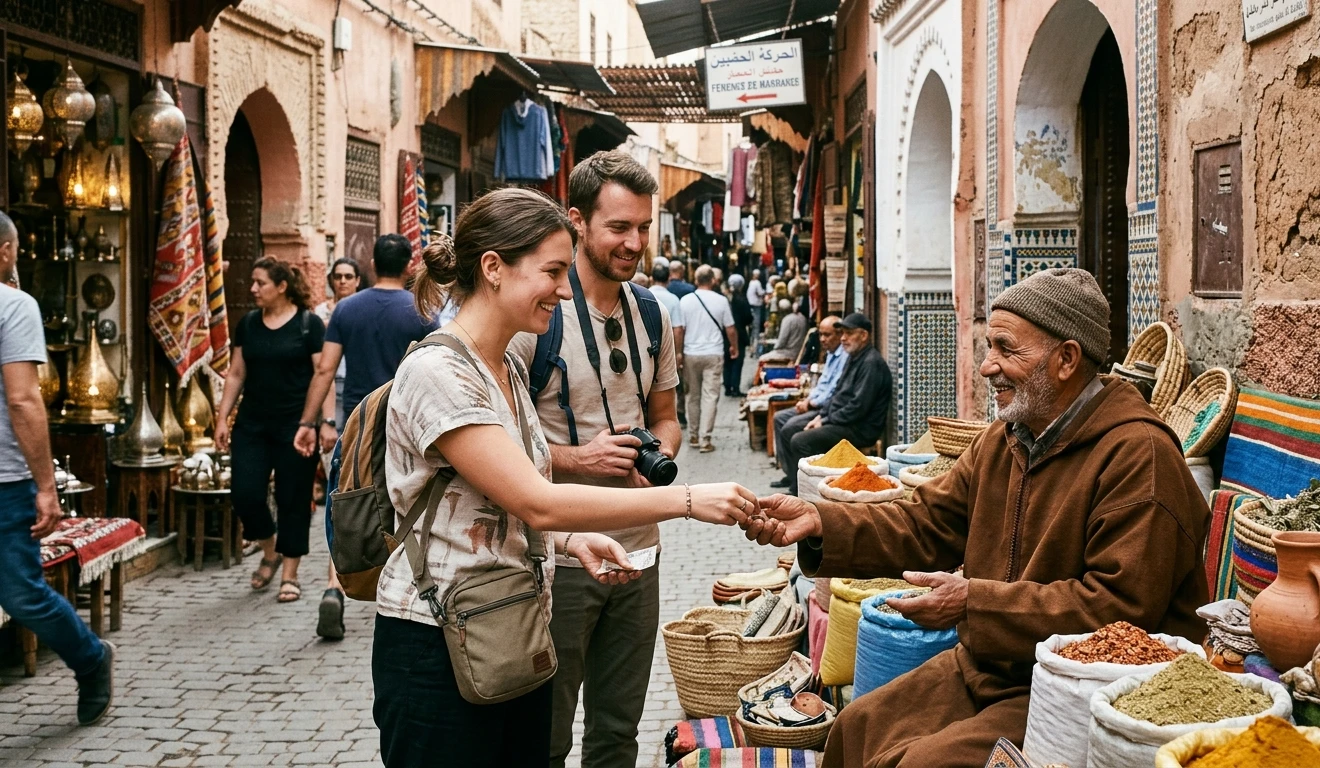
How much to tip in Morocco, situation by situationContents ↑
These are the amounts in Moroccan dirhams (MAD) that work in Marrakech and the other big cities. Treat them as a starting point: tip toward the top of the range when someone clearly went out of their way, and toward the bottom, or nothing, when the service was indifferent.
| Situation | Usual tip | How and when |
|---|---|---|
| Eating and drinking | ||
| Café, mint tea or coffee | 2 to 5 MAD | Leave the coins on the table |
| Sit-down restaurant | About 10% | In cash, with the bill |
| Getting around | ||
| Petit taxi | Round up | To the next 5 or 10 MAD |
| Private airport transfer | 20 to 50 MAD | To the driver, on arrival |
| Parking guardian | 2 to 5 MAD | When you drive off |
| Guides and drivers: tips on top of the agreed fee | ||
| Licensed guide, half day (tip) | 50 to 100 MAD | On top of the fee, for the group |
| Licensed guide, full day (tip) | 100 to 200 MAD | On top of the fee, for the group |
| Driver, multi-day trip (tip) | 100 to 150 MAD a day | On top of the fee, on the last day |
| Where you stay | ||
| Porter or luggage cart | 10 to 20 MAD | When the bags reach your room |
| Housekeeping | 10 to 20 MAD a day | Daily, or one envelope at checkout |
| Hammam and the square | ||
| Local hammam attendant | From 20 MAD | From 30 MAD with a kessal scrub |
| Photo with a performer | About 20 MAD | Agreed before you raise the camera |
Is tipping expected in Morocco?Contents ↑
No law requires it, and no Moroccan will chase you for forgetting a few coins at a café. Still, small tips are part of everyday life here, and visitors are generally expected to leave a little more than locals do. Moroccans themselves round up taxi fares, leave change at the café and give something to the parking guardian, so a tourist who never tips anything does stand out.
The useful way to think about it: a tip in Morocco is a short, personal thank-you to a specific person. It is not a percentage you owe on every transaction. That is why the amounts in the table are flat sums in dirhams rather than percentages, and why the person matters more than the bill. The riad worker who carried two suitcases through the medina deserves more than the waiter who brought one coffee.

Knowing when not to pay matters just as much. Money handed to someone who attached themselves to you uninvited, or who demands payment after a photo you never agreed to, rewards the habit and makes the next visitor’s walk harder. Our guide to common tourist scams in Morocco covers those patterns in detail.
Restaurants, cafés and rooftop terracesContents ↑
Here is the point most guides get wrong: in Moroccan restaurants, the prices on the menu normally cover both the food and the service. The tip on top is your choice, not a hidden part of the bill. So yes, you tip in restaurants in Morocco, but modestly and because you want to.

In practice, rounding up or leaving around 10 percent is plenty in a mid-range or rooftop restaurant. At a café, leaving the small coins from your change is the local habit. At a street food stall or a simple grill where locals eat, nobody expects anything, although rounding up is always welcome.
Leave the tip in cash, on the table or in the server’s hand, even if you pay the bill by card. Card terminals in many restaurants offer no tip line, and cash is the only way to be sure the money reaches the person who looked after you. A quiet “shukran” (thank you) goes with it.
Licensed guides and private driversContents ↑
This is where tipping is most expected, and where people most often overpay or underpay. The fee you agreed for a guided walk or a private car pays for the service. The tip says the day went well.

Tip per group, not per person
Many guides online quote guide tips per person. That works for a couple and becomes awkward for a family of six. A fairer rule is a single amount from the group: 50 to 100 MAD for a half-day walk in the medina, 100 to 200 MAD for a full day, adjusted up for a large group or a guide who went well beyond the plan. Give it at the end, in one go, with a word about what you enjoyed. These figures are the tip alone, paid on top of the fee you agreed for the guide’s service.
Multi-day trips
On a desert or mountain trip with the same driver for several days, most travellers tip once on the last day, in an envelope, rather than every evening. Around 100 to 150 MAD per day for the group is a fair reference. If a separate local guide joins you at a kasbah or in a village, that person is tipped separately, on the spot.
One honest caveat. If a guide takes you into a carpet shop or a cooperative, they may earn a commission on what you buy. That is common practice and does not mean you should cut the tip, but you can always ask to skip shops altogether, and a good guide will agree without fuss. Guiding is a regulated profession in Morocco, and our page on hiring a licensed guide in Marrakech explains how to check a guide’s licence before you book.
Private Desert Tour: Marrakech to Merzouga
Your own driver-guide for three days, a night in the Dades Valley and a night in a desert camp at Erg Chebbi. The driver’s tip is not included in the price, so the per-day reference above is the one to plan for.
See the route and pricesRiads and hotelsContents ↑
Riads are small, and the same three or four people often cook breakfast, clean the rooms and carry the bags. That shapes how tipping works.
- Porters. Cars cannot reach most riads in the medina, so a porter with a cart often walks your luggage the last few hundred metres. 10 to 20 MAD for the load is fair, more if the walk was long or the bags heavy.
- Housekeeping. 10 to 20 MAD a day, left visibly on the bed or the desk. Staff rotate, so a daily tip reaches more people than a single one on the last morning.
- The whole team. In a small riad, an envelope at reception on departure, addressed to the staff, is common and gets shared. Use it instead of chasing each person.
- The host who solved a problem. A last-minute driver, a dinner booking, a lost bag found: a separate thank-you of 50 to 100 MAD is a generous gesture, not an obligation.
Large international hotels work much like hotels anywhere: tip the porter and housekeeping, and nobody else expects anything.
Taxis and airport transfersContents ↑
For a petit taxi, the small city cab, rounding up to the next 5 or 10 MAD is all anyone expects. The real issue with taxis is not the tip but the fare: insist on the meter, or agree the price before you get in. Our Marrakech taxi fare calculator gives you a fair estimate before you flag one down.
Grand taxis on fixed routes between towns sell seats at a set fare, and passengers do not usually tip. A private transfer you booked in advance is different: 20 to 50 MAD to the driver is a normal thank-you, more if the flight was hours late and they waited.
The hammam, local or spaContents ↑
Two very different places share the same word. A neighbourhood hammam is a public bathhouse where locals wash every week. A spa hammam, in a riad or a day spa, is a treatment with a menu, a price list and usually a quieter room.

In a local hammam, giving the attendant from 20 MAD is fair. If you take a kessal or kessala, the attendant who does the full scrub with black soap and the kessa glove, expect from 30 MAD, depending on the hammam. Hand it over at the end, directly to the person who scrubbed you.
Spas are another world in method and in price, so tip as you would for a treatment at home: something modest if you were happy, given to your therapist rather than left at reception.
In a local hammam, settle the scrub price with the kessal before you start, not when you are lying on the warm floor. The amount depends on the hammam, and agreeing first removes the only awkward moment of the visit.
Photos in Jemaa el-Fna: agree on the price firstContents ↑
The square is where most tipping disputes start. Gnawa musicians, snake charmers, men with monkeys and water sellers in red costume earn their living from photos, and they expect to be paid for them.
About 20 MAD is the usual amount for a photo. Many performers will not accept that at first: ask the price, and you will often hear a much higher figure. Discuss it calmly, and it usually comes down. The rule that avoids every argument is simple: do not take a single picture before you have agreed on the amount. A snake placed on your shoulder without asking is not an agreement.
If you only want the atmosphere, photograph the square from a café terrace above it. Wide shots of the crowd rarely cause trouble; close portraits of a performer always come with a price. Our guide to taking photos in Morocco covers people, markets and places where cameras are not welcome.
Unasked help, faux guides and parking guardiansContents ↑
If you asked a shopkeeper for directions and his son walked you to your riad, 10 MAD is a kind thank-you. If someone attached himself to you without being asked and led you around for half an hour, you owe nothing, and paying teaches him to repeat it with the next visitor. A polite “la, shukran” (no, thank you) at the very start saves an argument at the end.
Unofficial “faux guides” are a different matter. Guiding is a regulated profession in Morocco, and the tourist police in Marrakech regularly arrest people working as guides without a licence. Negotiating a price with one does not make the arrangement fair or legal; the safer choice is to decline and book a licensed guide instead.
Parking guardians, often in a reflective vest, watch cars on many streets and car parks. 2 to 5 MAD when you leave is the norm for a short stop.
Dirhams, small change and cardsContents ↑
Tip in Moroccan dirhams. Euros and dollars are accepted in a few large hotels, but for a housekeeper or a taxi driver, foreign cash means a trip to an exchange office, and foreign coins cannot be exchanged at all. Our guide to the currency Morocco uses explains the dirham and where to change money.

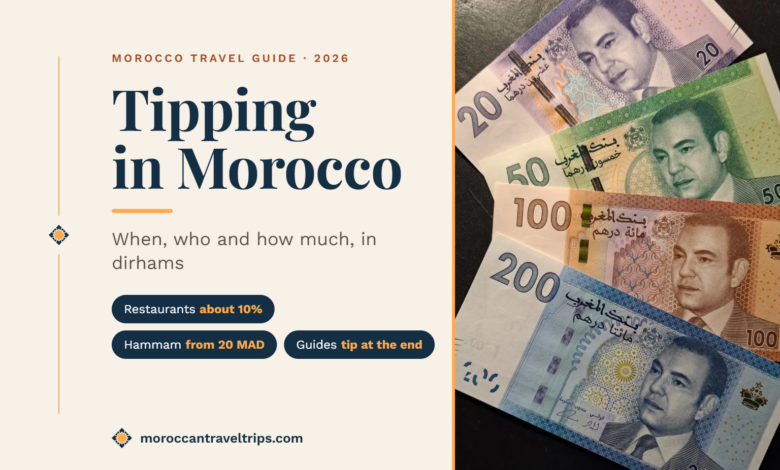
The current banknotes are 20, 50, 100 and 200 MAD, and 10 MAD is a coin, so the tipping kit is 20 MAD notes and a pocket of 10 and 5 MAD coins. Cash machines mostly give 100 and 200 MAD notes, which are hard to break at a café. Our guide to using ATMs in Morocco helps you withdraw without losing money on fees, then break the big notes at your riad’s reception or when paying a larger bill.
One more reason to keep change in mind: the dirham is a closed currency, and you are not meant to take a wad of it home. The last notes in your wallet on departure day are well spent as tips for the riad team or your driver.
Tipping etiquette and insider tipsContents ↑
In Morocco, how a tip is given counts almost as much as the amount. A few habits make the moment easy for both sides.
- Give with the right hand, or both hands. Handing something over with the left hand alone is considered impolite. Two hands is a respectful, slightly formal gesture.
- Say “shukran”. A sincere thank-you with the money, or “shukran bzzaf” (thank you very much) in Darija, turns a payment into a human moment. In a restaurant, “c’est pour vous” (it’s for you) in French works too.
- Cash is king. Card payments are spreading, but tips on cards are not standard. Keep a separate pocket of coins and small notes just for tips.
- Tip housekeeping daily. Staff rotate, so a tip left only on the last morning may reach just one person.
- Be discreet. Fold the note into the person’s hand rather than counting it out in front of others. It is more elegant, and more comfortable for the person receiving it.
- Photos have a price, agreed first. For a performer or someone in traditional dress, about 20 MAD, settled before the camera comes out, as explained in the Jemaa el-Fna section above.
- Don’t ask for change from a tip. If you hand over a 20 MAD note for a 10 MAD thank-you, let it go; the gesture loses its meaning once coins are counted back.
Mistakes we see
Most awkward moments around tipping come from the same three habits.
- Paying before agreeing. In the square, for a hammam scrub or with a self-appointed helper, the problem is never the amount but the order. Agree first.
- Tipping per person for a family. A single sum from the group is the norm and avoids an inflated total.
- Leaving with a pocket of dirhams. Spend the last notes on the people who looked after you.
Questions travellers ask about tippingContents ↑
Is service included in Moroccan restaurant bills?
Usually, yes. Menu prices in Moroccan restaurants normally include both the food and the service, so a tip is your own decision. Rounding up or leaving around 10 percent in cash is a generous thank-you in a sit-down restaurant. If a service line ever appears on the bill, nothing more is needed.
Is it rude not to tip in Morocco?
Not tipping is not rude in itself, especially for poor service or at a street stall. It is noticed in the places where tips are customary: a guided day, a riad stay, a hammam scrub, a porter carrying bags through the medina. In those cases even a small amount in dirhams is better than nothing.
Do locals tip in Morocco?
Yes, in smaller amounts. Moroccans round up taxi fares, leave coins at the café and give a few dirhams to parking guardians and porters, but rarely tip at simple local eateries. Visitors are generally expected to give a little more than locals, which is normal and accepted.
How much should I tip a driver on a 3-day desert trip?
Around 100 to 150 MAD per day for the whole group, given once on the last day, is a fair reference. Tip more if the driver handled a breakdown, a detour or a long wait without complaint. Camp staff and camel handlers are separate people and are tipped separately, if you wish.
Can I tip in euros or dollars?
Notes in euros are better than nothing, but they cost the person time to exchange, and foreign coins cannot be exchanged at all. Keep a stock of 20 MAD notes and 10 MAD coins instead. If you run out, break a large note at your riad’s reception before heading out.
What if someone asks for money after I took their photo?
If you took a close photo of a performer without agreeing on a price, paying around 20 MAD is the quickest way to end it, and a lesson for the next one. Do not hand over a large note expecting change. If you never asked for the photo and were pushed into it, a firm “la, shukran” and walking away is enough.
Do I tip a guide if the tour price was paid in advance?
Yes, if you were happy. The prepaid price covers the guide’s service and the organisation of the day; the tip is the personal thank-you, and it goes to the guide in cash at the end. Check your booking first: some tours state that tips are included, most do not.
Ten minutes of preparation before you landContents ↑
Tipping stops being stressful the moment you have the right change in your pocket. On the first day, withdraw cash, break one large note at your riad, and keep a dedicated pocket for 20 MAD notes and 10 MAD coins. Decide in advance what you will give your guide and your driver, so the end of the trip is a thank-you rather than a calculation.
If you would rather shape the whole trip with someone who knows the ground, our trip planner is the place to start.