How Much Does a Morocco Vacation Actually Cost?
Transparent, realistic breakdowns for budget, mid-range, and luxury travelers — built on real prices, not guesswork.
Morocco is one of the rare destinations where the experience consistently outpaces the price tag. Whether you’re navigating medina alleys on a shoestring or unwinding in a rooftop riad with mint tea and Atlas Mountain views, the country delivers in ways that far more expensive destinations often cannot.
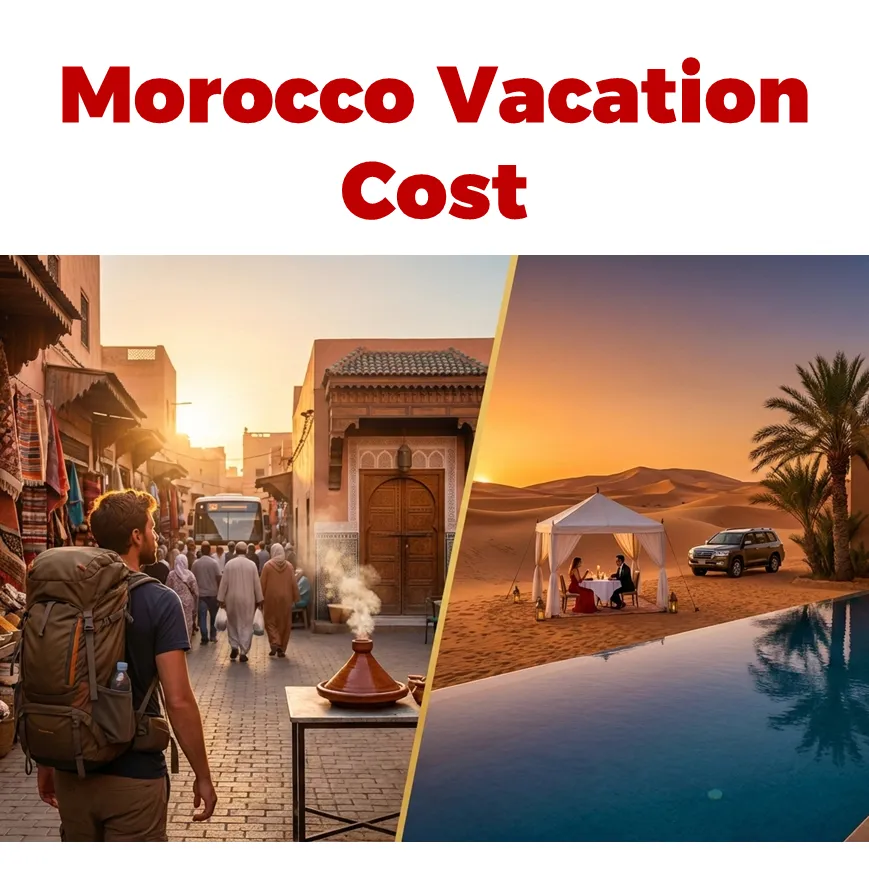
A well-planned 7-day trip to Morocco costs anywhere from $650 for budget travelers to around $3,910 for a fully luxury itinerary, with the sweet spot for most visitors sitting comfortably around $1,335 per person. Every figure in this guide reflects real 2026 ground prices across accommodation, food, transport, and activities.
- Why Morocco offers exceptional value
- Budget trip breakdown ($650 total)
- Mid-range trip breakdown ($1,335 total)
- Luxury trip breakdown ($3,910 total)
- Side-by-side comparison
- Hidden and additional costs
- Money-saving strategies
- Which cities to visit by budget
- Book with a licensed guide
- Frequently asked questions
Why Morocco Offers Exceptional Value
TopMorocco sits in a rare category: a destination where mid-range money buys a genuinely luxurious experience. The exchange rate works strongly in favor of American and European travelers, with the Moroccan dirham offering approximately 10 MAD to the dollar. Operational costs for hotels, restaurants, and guides are significantly lower than in Mediterranean alternatives like Spain or Portugal, which translates directly into lower prices without any sacrifice in quality.
Travelers who make the comparison consistently report spending 40 to 60 percent less than they would for an equivalent trip to southern Europe, while gaining access to richer cultural depth, more personal hospitality, and landscapes that feel genuinely unlike anything else in the world. A beautifully restored riad with a courtyard plunge pool and daily breakfast runs $60 to $150 per night. A tagine slow-cooked to perfection at a local restaurant costs $8 to $12. These numbers are not cherry-picked; they are standard across the country.
Partnering with a licensed Moroccan travel guide adds another layer of value: transparent pricing, authentic access, and the kind of local knowledge that turns a good trip into an extraordinary one.
Budget Trip: 7 Days for $650
TopTraveling Morocco on a tight budget is not a compromise. Street food in Marrakech’s Jemaa el-Fna is genuinely one of the world’s great dining experiences. Free medina exploration in Fes or Chefchaouen is as rewarding as any guided tour. Budget travelers who are flexible and willing to sleep in family-run guesthouses will come home with stories that money could not have improved.
Budget accommodations in Morocco range from hostel dormitories at $15 per night to clean private rooms in family-run riads or guesthouses for $30 to $50. The average across a 7-day stay sits around $40 per night. Desert camp nights, often bundled into multi-day Sahara tours at $70 to $100, include dinner and breakfast, reducing food costs on those days. Booking directly with the establishment rather than through commission platforms routinely saves 10 to 20 percent.
At $15 per day, budget dining in Morocco is genuinely enjoyable. Merguez sandwiches cost $3 to $6, harira soup $3 to $5, and fresh-squeezed orange juice $1 to $2. A full meal at a neighborhood restaurant away from the tourist quarter runs $5 to $8. The trick is to follow the locals: if the menu is only in Arabic or Darija, the prices are usually half what they would be two streets over.
| Route | Cost (USD) | Notes |
|---|---|---|
| In-city petit taxi | $2–4 | Metered, per ride |
| Marrakech to Fes (train) | $15 | 1st class, 7 hrs |
| Fes to Chefchaouen (bus) | $12 | CTM or Supratours |
| Casablanca to Tangier (TGV) | $22 | High-speed, 2 hrs |
| Night train (city-to-city) | $15–20 | Saves one hotel night |
The Bahia Palace in Marrakech costs $5. The Fes medina is free. Sunset from a rooftop is free. Camel trekking runs $20 to $30 for a half-day outing. A guided medina walk with a local costs $20 to $30. Budget travelers who concentrate spending on two or three meaningful experiences, and let the city’s free energy fill the rest, often find this the most satisfying approach of all three tiers.
Mid-Range Trip: 7 Days for $1,335
TopThe mid-range bracket is where Morocco’s value proposition shines most clearly. At around $190 per day, you stay in beautifully decorated riads with private bathrooms and included breakfasts, eat across a range of restaurants, take a Sahara overnight, and still have budget left for a hot air balloon flight or hammam session. This is the sweet spot for most first-time international visitors.
At an average of $80 per night, mid-range travelers access quality riads with traditional courtyard architecture, attentive service, and breakfasts of msemen, honey, fresh juice, and coffee. One or two nights in a quality desert camp ($100 to $150, including afternoon tea, camel ride, traditional dinner, and breakfast) fit comfortably within this budget. Many mid-range riads also include airport transfers, which eliminates additional transport costs on arrival and departure days.
Typical daily breakdown: Breakfast included at your riad. Lunch at a local restaurant with a tagine, salad, and bread for $8 to $12. Dinner at a mid-range establishment with good atmosphere for $12 to $18. Coffee and snacks add $2 to $3. One special dinner per week (a fine dining experience with wine) adds $25 to $35.
Mid-range travelers combine comfortable first-class trains and CTM bus tickets between cities ($15 to $25 per leg) with occasional private taxis in-city. Organized multi-day desert tours typically include 4×4 transport between stops, eliminating the need to arrange intercity travel independently. Daily city taxi use adds $5 to $7 per day when using meters rather than negotiated rates.
A multi-day Sahara experience with camel trekking, overnight desert camp, and all meals runs $120 to $200 per person. A hot air balloon over the Marrakech palm groves at dawn, including Berber breakfast and a flight certificate, costs $150 to $200. A guided half-day in the Fes medina with an English-speaking licensed guide costs $30 to $45. These three experiences alone are enough to make a Morocco trip memorable for a lifetime, and they all fit within this budget.
Luxury Trip: 7 Days for $3,910
TopMorocco’s luxury tier is genuinely world-class. Properties like La Mamounia and Royal Mansour in Marrakech regularly top global hotel rankings, and the level of personal service, cuisine, and craftsmanship on offer is not replicated anywhere else at any price point. For travelers who want seamless logistics, exclusive access, and extraordinary comfort, Morocco rewards that investment spectacularly.
Properties in the $200 to $400 per night range offer plunge pools, butler service, rooftop terraces, and spa facilities within beautifully restored medina palaces. Stepping up to five-star hotels like El Fenn ($350 to $800) or La Mamounia ($650 and above) adds Michelin-caliber dining, signature gardens, and rooms that have been photographed for every major travel publication. Desert stays at luxury camps with private jacuzzis and star-gazing platforms run $250 to $350 per person per night. The 7-night average here is $280 per night.
Luxury dining highlights: Breakfast at your property ($10 to $15 per person). Lunch at acclaimed restaurants ($30 to $50). Dinner at Jean-Georges at La Mamounia or comparable establishments ($80 to $150 per person with wine pairing). Private Berber dinner in a traditional house with live music and entertainment ($75 to $125 per person).
Private drivers with comfortable 4×4 vehicles cost $60 to $100 per day and offer flexibility that public transport cannot match. Domestic flights between Marrakech and Fes via Casablanca cost $80 to $150 per person. Traditional horse-drawn calèche rides in Marrakech cost $30 to $50 per hour. Private airport transfers average $50 to $80 each way.
- Private guided tours with expert art historians or archaeologists: $100 to $200 per day
- Multi-day private Sahara expedition with luxury camp, gourmet meals, and personal guide: $500 to $800 per person
- Hot air balloon with champagne toast and premium breakfast: $200 to $250 per person
- Private cooking class with a traditional Moroccan chef: $75 to $150 per person
- Full spa and hammam package (massage, facial, traditional bath): $150 to $300
- Exclusive artisan studio visits with private transport and tea ceremonies: $100 to $150
Full Cost Comparison
Top| Category | Budget | Mid-Range | Luxury |
|---|---|---|---|
| Accommodation | $280 ($40/nt) | $560 ($80/nt) | $1,960 ($280/nt) |
| Food and dining | $105 ($15/dy) | $245 ($35/dy) | $525 ($75/dy) |
| Transportation | $75 | $120 | $250 |
| Attractions | $70 | $210 | $700 |
| Insurance and misc. | $120 | $200 | $475 |
| 7-Day Total | $650 | $1,335 | $3,910 |
| Per Day | $93 | $190 | $559 |
The most revealing figure in the table is the mid-range versus budget gap: you roughly double your spend to move from budget to mid-range, but the jump in comfort and experience diversity is substantial. Moving from mid-range to luxury multiplies costs by nearly three, with most of the premium concentrated in accommodation and curated activities rather than in the core Moroccan experience itself. Morocco’s free and low-cost offerings — its medinas, landscapes, and people — are equally available to all three tiers.
Travel insurance: Basic plans covering medical and trip cancellation run $25 to $50 for a 7-day visit. Morocco has no reciprocal healthcare agreements with most Western countries, so coverage is strongly recommended rather than optional. Adventure activity coverage (quad biking, trekking) adds $20 to $50.
Visa fees: Citizens of the USA, Canada, EU, UK, and most Commonwealth countries receive visa-free entry for 90 days. Travelers from countries including India can apply for a Morocco e-Visa for approximately $50 to $70.
Tips and gratuities: Culturally expected and meaningful. Budget travelers can plan $1 to $2 daily for guides and hotel staff. Mid-range travelers should anticipate 10 percent at restaurants and $5 to $10 per day for private guides, accumulating to $50 to $150 over a 7-day trip.
Souvenir shopping carries genuinely unlimited potential, but realistic estimates by tier are: budget travelers $30 to $50 (small crafts, postcards, argan oil), mid-range travelers $75 to $150 (modest rugs, quality leather goods), luxury travelers $300 and above (authentic handwoven carpets, fine silver jewelry). Markets require confident bargaining; a useful starting point is 40 to 50 percent of the initial asking price, working toward a respectful compromise.
Alcohol is available at supermarkets and many tourist-facing restaurants. A Moroccan beer runs $3 to $5 at a cafe, local wine $5 to $10 per glass at a mid-range restaurant, and imported wine $50 to $100 per bottle at luxury establishments. Budget this category separately if it is relevant to your travel style.
Money-Saving Strategies That Actually Work
Top- Travel in shoulder seasons. March to May and September to November offer temperatures that are far more comfortable than July or August, and accommodation prices across Morocco drop 30 to 50 percent. You also encounter smaller crowds at popular sites like the Fes medina and Erg Chebbi dunes.
- Book accommodation directly. Riad owners consistently offer better rates for direct reservations and are often willing to negotiate on stays of five nights or more. Savings of 10 to 20 percent over platform pricing are standard.
- Eat where the language shifts. Restaurants near major tourist sites operate at a significant markup. Walking two or three streets into a residential neighborhood, where menus are in Arabic or Darija, typically cuts food costs by 40 to 60 percent while improving quality.
- Use metered taxis. Official petite taxis with running meters cost 50 to 70 percent less than negotiated prices. If the driver refuses to use the meter, wait for the next taxi.
- Bundle the Sahara experience. Booking a 3 to 4 day organized desert tour ($300 to $600 all-inclusive) delivers significantly better per-day value than arranging individual components. Transport, accommodation, meals, and guides are all included at rates below what you would pay assembling each element separately.
- Bargain respectfully, not aggressively. Haggling is a social ritual in Moroccan souks, not a battle. A respectful negotiation starting around 40 to 50 percent of the asking price, moving warmly toward an agreed middle ground, produces better outcomes and better experiences than hard-line tactics.
Which Cities to Visit Based on Your Budget
TopA Marrakech base with a 2 to 3 night Sahara expedition minimizes transport costs while delivering Morocco’s two defining experiences. Alternatively, the northern route through Tangier, Chefchaouen, and Fes stays geographically compact with lower average accommodation prices, particularly in Chefchaouen where quality guesthouses run $25 to $40 per night. Spending a full week in one city with day trips to the surrounding area (Marrakech to the Agafay Desert and Atlas Mountains, for instance) eliminates intercity transport entirely and enables deeper local engagement.
The classic Moroccan circuit works extremely well at this budget: 2 nights in Marrakech, 1 night in the Dades Valley, 2 nights in Merzouga for the Sahara, then north through the Middle Atlas to 2 nights in Fes. A private driver for $60 to $80 per day or a shared group tour makes the logistics straightforward and the per-person transport cost very reasonable. This 7 to 8 day itinerary covers imperial cities, kasbahs, Berber villages, and the Sahara in a single sweep.
Luxury Morocco rewards slower travel. A 10 to 12 day itinerary — Casablanca arrival, 3 nights in Marrakech, 2 nights in the Dades and Todra gorges, 2 to 3 nights at a luxury Merzouga camp, 2 nights in Fes, return to Casablanca — allows depth rather than a rush between landmarks. Private helicopter transfers, exclusive artisan studio visits arranged through your concierge, and gourmet dinners at properties that do not accept walk-in reservations define a luxury Morocco experience well beyond upgraded accommodation alone.
Get personalized advice before you book anything
A licensed local guide can save you time, money, and a great deal of frustration.
Book with a Licensed Morocco Guide
TopThe difference between booking through a random aggregator and working directly with a verified, government-licensed guide is not only financial — it is experiential. A licensed guide knows which riads have honest pricing, which restaurants serve authentic food rather than tourist-adjusted versions, and which roads into the desert are accessible in March versus October. That knowledge protects your budget and shapes every day of your trip.
Mouhssine is an officially licensed Moroccan guide registered with the Ministry of Tourism. With over a decade of experience leading tours across Marrakech, Fes, the Sahara, and beyond, he specializes in helping international travelers plan trips that are realistic, well-priced, and genuinely memorable. He communicates directly on WhatsApp in English, French, and Arabic — no call centers, no hidden fees.
You can reach Mouhssine directly on WhatsApp to ask about itineraries, get honest price quotes, or simply ask questions before committing to anything. No pressure, no scripts.
Frequently Asked Questions
TopHow much spending money per day should I budget for Morocco?
Is Morocco safe for international tourists in 2026?
What is the best time of year to visit Morocco on a budget?
Should I exchange currency before arriving in Morocco?
Is a guided tour worth the cost in Morocco?
Can I visit Morocco for less than $100 per day?
Final Thoughts on Morocco Vacation Costs
Morocco works at every price point, but it works for different reasons depending on where your budget sits. Budget travelers find in it a country where authentic culture and dramatic landscapes are entirely free of charge. Mid-range travelers discover that their money buys experiences that would cost three times as much in Europe. Luxury travelers find a destination with genuine five-star infrastructure, world-class cuisine, and design sensibility that is entirely its own.
The figures in this guide are honest starting points, not guarantees. Costs vary by season, by city, and by how confidently you navigate markets and transport. What does not vary is Morocco’s capacity to exceed expectations at every level. Spend wisely, travel slowly in the places that earn it, and give yourself one or two experiences you will actually remember in ten years. The country will handle the rest.
Contact licensed guide Mouhssine ELIOUJ directly on WhatsApp before your trip: +212 671-437971