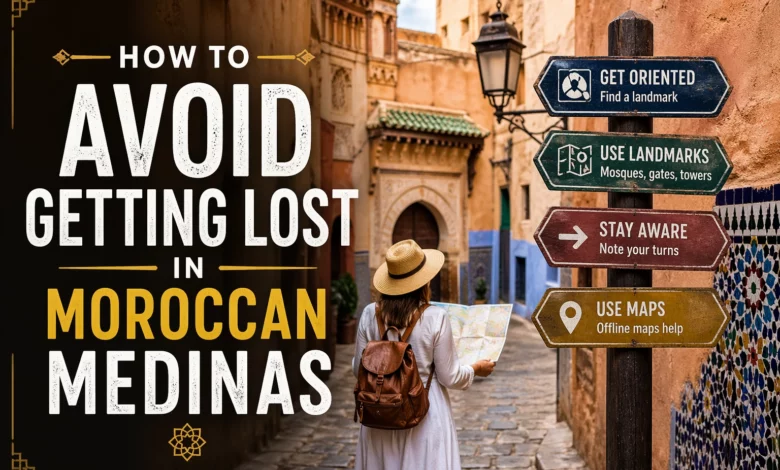

How to Avoid Getting Lost in Moroccan Medinas
The moment you step through the ancient gates of a Moroccan medina — whether it’s the UNESCO-listed Fes el-Bali, the vibrant heart of Marrakech, or the whitewashed lanes of Chefchaouen — you enter a world that has stubbornly resisted the grid. These walled old cities were not designed for twenty-first-century visitors with Google Maps open on their phones. They were built over centuries, following the logic of trade, community, and privacy — and that logic is beautifully, maddeningly non-linear.
Getting disoriented is almost a rite of passage, but getting genuinely lost is a different story. This guide will give you every tool, mindset, and local trick you need to move through Moroccan medinas with confidence — from knowing which cities in Morocco have the most complex medinas, to understanding when it pays to simply hire a licensed local guide.
🏛️ Understanding How Moroccan Medinas Are Laid Out ↑ Top
Before asking how to avoid getting lost in Moroccan medinas, it helps to understand why the confusion happens in the first place. Moroccan medinas were not designed like European town centres with a central square and radiating avenues. Instead, they grew organically over hundreds of years around three functional zones:
The main arteries of a medina are wide enough for a donkey loaded with goods — perhaps two or three metres across. Side streets narrow to shoulder-width. Many share the same appearance: ochre walls, a slice of sky above, a door that looks like every other door. This visual uniformity is the number-one reason even experienced travellers lose their bearings. Morocco’s diverse physical geography also means that medina architecture varies — coastal medinas tend to be cooler and more open, while inland ones like Fes feel denser and more labyrinthine.
🧭 Prepare Before You Enter — The Smart Tourist’s Checklist ↑ Top
The best way to navigate a Moroccan medina for tourists starts before you ever pass through the gate. A few minutes of preparation will save hours of frustration later.
- Download offline maps. Google Maps and Maps.me both allow area downloads before your trip. Do this over Wi-Fi at your riad the evening before.
- Screenshot your riad’s entrance. Take a photo of the door, the street name (if there is one), and any nearby landmark. Your riad host will also share a pin.
- Note two or three landmarks. A city gate, a minaret, a major souk entrance — these are your compass points.
- Carry local currency. Small notes of Moroccan dirhams. Understanding what currency Morocco uses helps you pay for tea while you regroup, hire a guide spontaneously, or tip someone who helped you find your way.
- Write the address in Darija (Moroccan Arabic). Ask your accommodation to write their address in Arabic script and have it ready on your phone.
- Share your location with a travel companion via WhatsApp before you split up.
- Charge your phone to 100% and bring a power bank.
Pro Tip
Take a photo of the sign above your riad’s entrance and the nearest street placard (even if faded) as you leave for the first time. When you’re disoriented, that photo is worth a thousand words.
🗺️ Navigation Techniques That Actually Work in Moroccan Souks ↑ Top
The souk is your map — learn its logic and you’ll always find your way
Follow the Sound Logic
Moroccan medinas are acoustic maps. The hammering of metalworkers, the drone of weavers’ looms, the call to prayer from a specific mosque — all of these sounds come from fixed places. As you walk, pay attention to what you hear. If you know the coppersmith souk is to the north of your riad, and you can hear metal being beaten, you have a bearing.
Use the Five-Landmark Method
This is how locals navigate medinas in Morocco — not by street names, but by a mental chain of recognisable features. As you walk out from your accommodation each morning, consciously note five landmarks in sequence:
Walk the Main Artery to Both Ends
On your first day, do one single task: walk the main souk street of the medina from one end to the other without turning off. Then do it again in reverse. This simple exercise places the spine of the medina in your mental model. Everything else branches off this spine.
Rise Above — Literally
If you can find a rooftop café (and in Morocco, they are everywhere), pay for a mint tea and spend twenty minutes looking down. From above, the logic of the medina suddenly becomes clear: you can see where the major streets run, where the tanneries or the Karaouine mosque sit relative to each other, and where your riad fits in the larger picture.
Local Insight
Moroccans have navigated these alleys their entire lives by combining spatial memory, sound, light direction, and a shared community knowledge. Ask a local for directions and they will almost certainly help — but do ask for a landmark, not a street name. “How do I get to Bab Bou Jeloud?” will yield a much more useful answer than “Where is Rue des Mérinides?”
📱 Can You Use Google Maps in Moroccan Medinas? ↑ Top
A question that travels well: does Google Maps work in medinas? The honest answer is yes, partially — and understanding its limitations is as important as knowing its strengths.
How to Use Google Maps in Moroccan Medinas — Step by Step
🆘 What To Do If You Actually Get Lost in a Moroccan Medina ↑ Top
Despite every precaution, it can happen. The alleys fork unexpectedly, the light shifts, and suddenly you genuinely don’t know which way you came from. Here is exactly what to do if you get lost in Fes medina or any other Moroccan old city:
Calm-Down Strategy
If stress rises, duck into any café, order a mint tea for around 10 MAD, and spend fifteen minutes regrouping. The medina will look completely different after a rest. And the café owner will almost certainly be able to point you in the right direction.
🛡️ Safety Tips for Tourists in Moroccan Medinas ↑ Top
People often ask: are Moroccan medinas safe for tourists? The short answer is yes. Morocco is generally a safe destination and medinas are densely populated, well-observed neighbourhoods where community life is very much alive. That said, petty crime exists in all tourist cities worldwide, and a few sensible habits will keep your experience smooth. Read more in our dedicated guide on whether Morocco is safe to visit for tourists.
- Keep valuables in an internal pocket or money belt, not in an open bag or back pocket.
- Don’t flash expensive cameras or phones unnecessarily in crowded areas.
- Beware of the “free gift” tactic — someone handing you a sprig of herbs or a bracelet before demanding payment. Decline politely and keep walking.
- If a stranger insists on guiding you to a specific shop, understand that they likely receive a commission. This is fine — you don’t have to buy anything — but know what’s happening.
- Trust your instincts. A medina in the evening is perfectly safe on the main streets. Very narrow, completely dark residential alleys late at night are not places to explore alone.
- Stay on main routes after dark. Stick to the lit, busier arteries in the evening.
- Dress modestly, particularly for women. Loose, covered shoulders and knees attract far less unwanted attention.
Busy medina streets are lively, safe, and full of sensory richness — confident navigation is the key
🔵 How to Avoid Getting Lost in Fes Medina — Specific Tips ↑ Top
Fes el-Bali is widely considered the world’s largest car-free urban area and contains over 9,000 narrow streets. Learning how to avoid getting lost in Fes medina requires a slightly different strategy than any other Moroccan city.
🔴 Best Way to Navigate Marrakech Medina for Tourists ↑ Top
Marrakech’s medina is less extensive than Fes’s but moves at a far faster pace. Motorbikes, donkey carts, and crowds converge on its famous souks, making spatial awareness both more chaotic and, paradoxically, easier — because Djemaa el-Fna square acts as an undeniable, unmissable landmark that is never more than a ten-minute walk from anywhere in the central medina.
- Use Djemaa el-Fna as your central anchor. Every route in the Marrakech medina can be plotted from this square. Always know which direction the square is, and you are never truly lost.
- The souks funnel from the square northward. Walk north from Djemaa el-Fna and you enter the souk district — spices, lanterns, textiles, leather — all organised in rough quarters.
- Beware traffic in main alleys. Unlike Fes, Marrakech’s main medina streets carry motorbike traffic. Stay aware and step into a doorway when you hear a horn.
- The Mellah (Jewish Quarter) and the Bahia Palace anchor the eastern side. If you reach either, you can reorient easily.
- Do I need a guide in Marrakech medina? For a casual day’s exploring, probably not — the medina is smaller and more tourist-worn than Fes. But for deeper cultural context, a licensed guide is always worthwhile.
⭐ Key Takeaways — Navigation at a Glance
- Download offline maps the night before — Google Maps and Maps.me.
- Photograph your riad entrance and the nearest street sign immediately.
- Learn two or three fixed landmarks and navigate relative to them.
- Use sound and smell as much as sight to orient yourself.
- In Fes: Bab Bou Jeloud and the Qarawiyyin mosque are your anchors.
- In Marrakech: Djemaa el-Fna is never far away.
- If lost: find a shop owner, aim for a city gate, call your riad.
- For deep cultural exploration, book a licensed guide in advance.
🤝 Explore with Confidence — Book a Licensed Moroccan Guide ↑ Top
Sometimes the very best way to avoid getting lost in a Moroccan medina — and to truly understand what you are walking through — is to walk it with someone who grew up in its alleys. A licensed official guide will not only ensure you don’t miss hidden gems, but will also protect you from scams, decode the architecture, and tell you the stories that no guidebook can replicate.
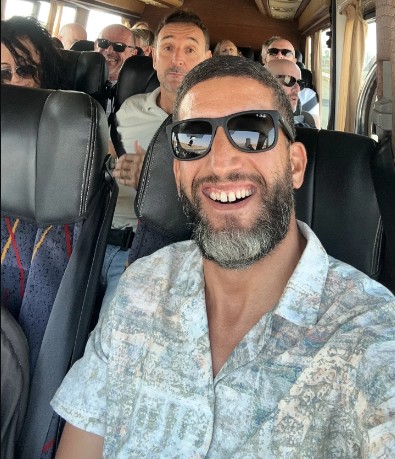
Mouhssine ELIOUJ
Official Licensed Tour Guide · Morocco
📋 Licence No. Réf. 2898 — Issued by the Moroccan Ministry of Tourism
Connect directly with Mouhssine on WhatsApp to plan your medina tour, arrange a private walking guide session, or simply ask for personalised advice for your trip. Available in English, French, and Arabic.
Chat on WhatsAppBooking a licensed guide is also the most responsible way to support local Moroccan tourism professionals and ensure your money reaches the communities you are visiting. Morocco’s unique geography and history make it one of the most rewarding destinations in the world — and a knowledgeable guide transforms a walk into an unforgettable experience.
❓ Frequently Asked Questions ↑ Top
🌟 Final Thoughts — Embrace the Maze ↑ Top
Moroccan medinas are not puzzles to be solved — they are worlds to be experienced. The moment you stop fighting the disorientation and start reading the clues around you — the minaret catching afternoon light, the smell of cumin drifting from a spice stall, the distant drum of a copper artisan — is the moment you begin to navigate not just spatially, but culturally.
Come prepared. Download your maps, learn your landmarks, carry your riad’s details in your pocket, and keep a few dirhams for a tea and a moment of regrouping. And if you want to go deeper — to see the medina as its residents see it — reach out to a licensed guide like Mouhssine ELIOUJ, whose knowledge was built over a lifetime of walking these very streets.
The medina will disorient you. But it will also surprise you, move you, and remain with you long after you have found your way home. That, in the end, is the whole point.