
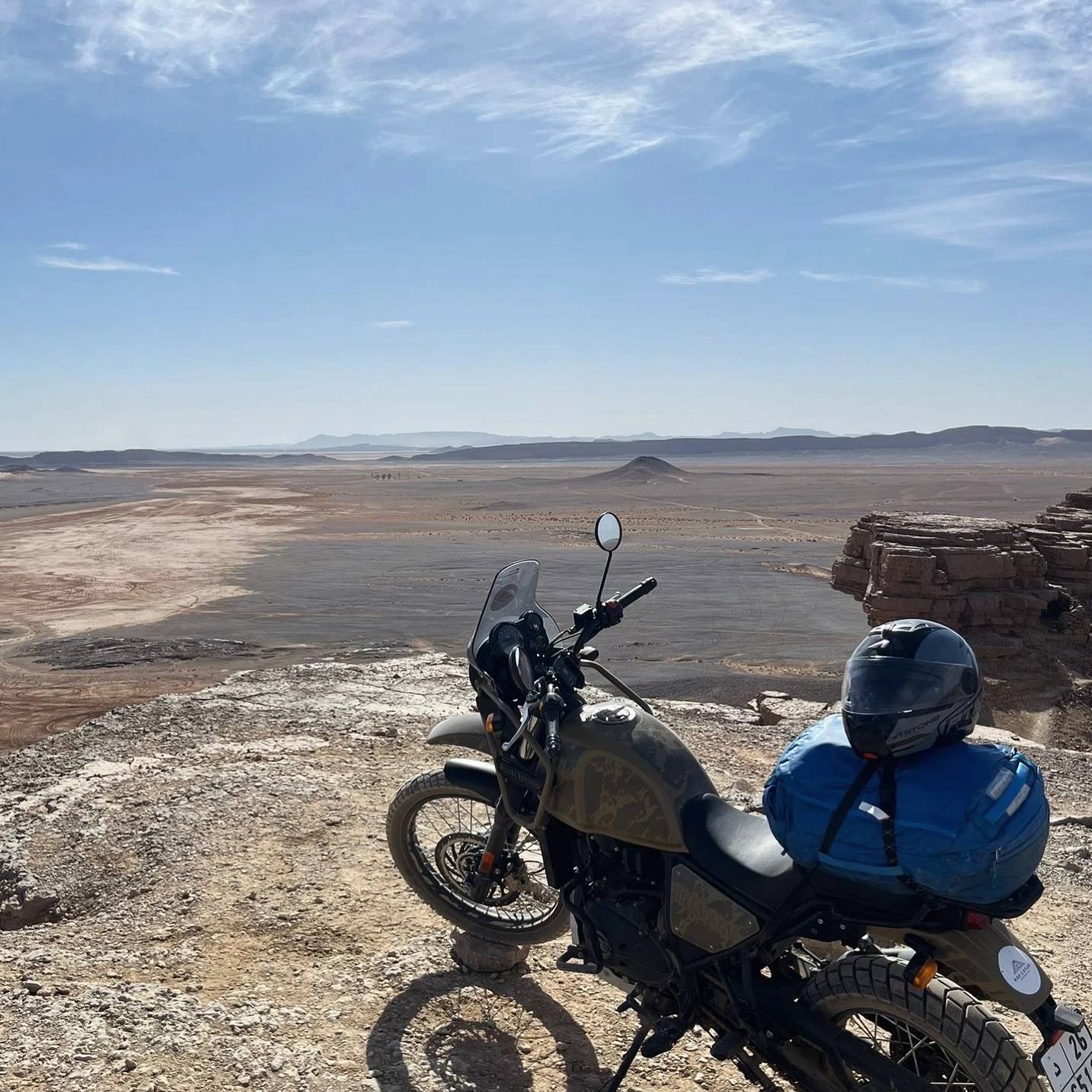
Exploring Gara Medouar: The Secret Round Mountain in Erfoud
Somewhere in the vast hammada south of Erfoud, a mountain sits in a perfect ring. From the ground it looks like any other rocky ridge in the Moroccan desert. From the air it reveals itself as something else entirely: a near-perfect circle, a natural enclosure of layered stone that has no obvious explanation for its shape. Locals call it Gara Medouar. Travelers who find it tend not to forget it. This guide covers everything you need to know to visit this remarkable geological site, including how to get there, what to expect inside, and what makes it one of the Saharan region’s most quietly extraordinary spots.
What Is Gara Medouar? ↑ Contents
Gara Medouar, sometimes written Jbel Gara Medouar or simply “the round mountain,” is a circular geological formation located roughly 20 kilometers southwest of Erfoud, in the Tafilalet region of southeastern Morocco. The name in Tamazight loosely translates to “the rounded mountain” or “the enclosed mountain,” a fitting description for a formation that encloses an interior basin like a natural amphitheater.
What sets it apart from the rest of the desert landscape is immediately obvious: the mountain forms an almost unbroken ring of eroded ridges, approximately 1.5 kilometers in diameter, with the rocky walls rising steeply around a hollow, sheltered interior. Standing inside, the wind drops. The noise of the outside world fades. You are, in effect, standing inside a mountain.
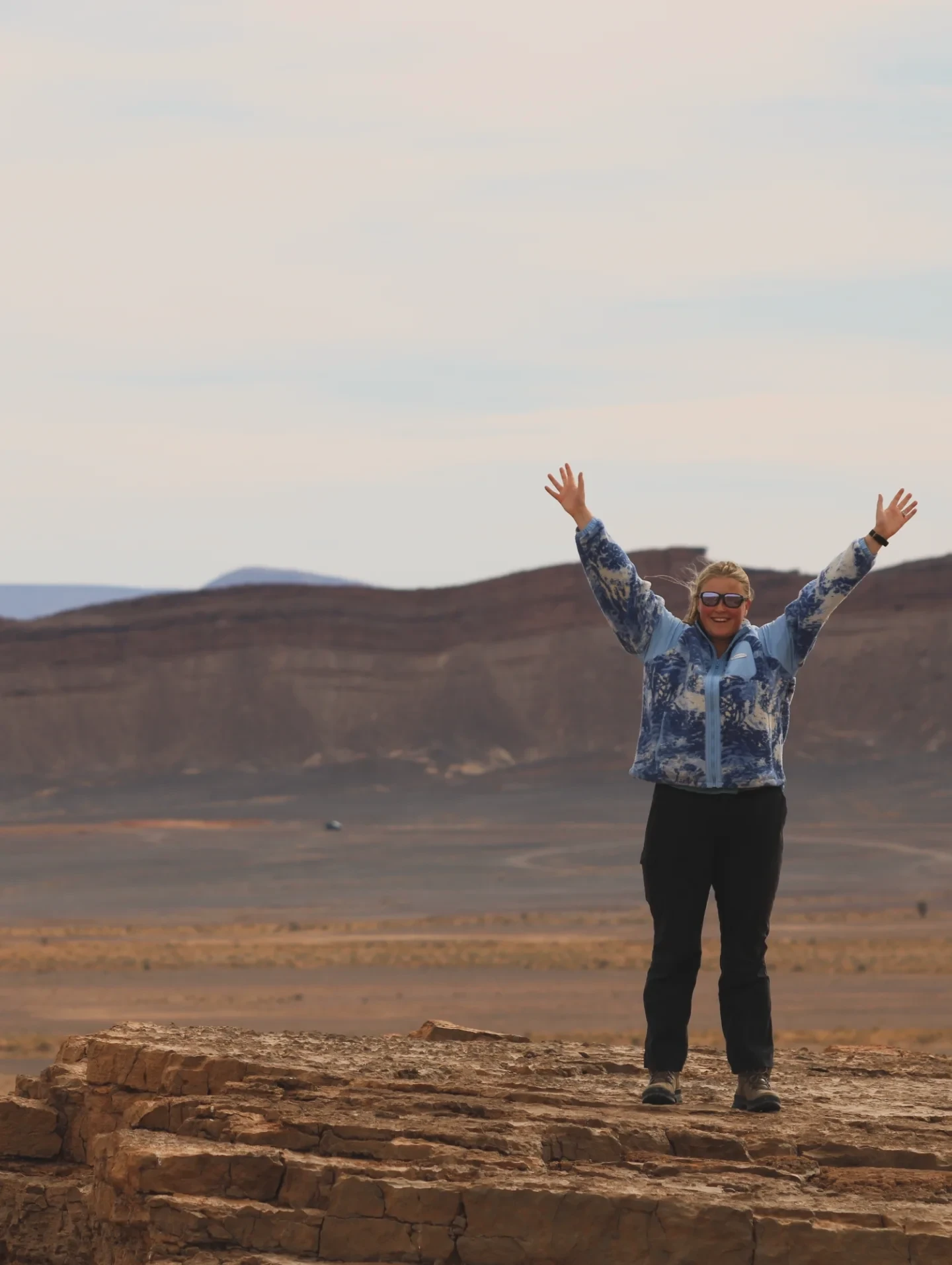
The interior of Gara Medouar forms a natural sheltered basin, completely enclosed by the ring of ancient rock.
Gara Medouar is not officially promoted on most Moroccan travel itineraries, which is precisely why it retains a quality of discovery that more famous sites have long since lost. Visitors who make the effort find a place that feels genuinely untouched, geologically significant, and visually unlike anything else in the region.
The Geology Behind the Shape ↑ Contents
The circular shape of Gara Medouar is not a coincidence or an illusion. It is the result of a specific geological process: differential erosion acting on a domed anticline over hundreds of millions of years. The rock here dates to the Devonian and Ordovician periods, roughly 400 to 480 million years ago, when this region of what is now Morocco’s physical landscape was submerged beneath a shallow tropical sea.
Over geological time, tectonic pressure pushed layers of sedimentary rock upward into a dome. The top of that dome, being the most exposed, eroded away first and fastest. The harder rock forming the flanks of the dome was more resistant and survived longer, leaving the characteristic ring of ridges that surrounds the softer, lower interior. The process is similar to what forms bull’s-eye erosion patterns elsewhere in the world, but Gara Medouar is unusually well-defined and compact, making it especially striking.
Fossils, Trilobites, and the Ancient Sea ↑ Contents
One of the most compelling reasons to visit Gara Medouar, beyond its visual impact, is what is embedded in its rock. The Tafilalet region around Erfoud is globally recognized as one of the richest fossil sites on earth, and Gara Medouar sits squarely within that paleontological zone.
The exposed rock faces around the ring contain an extraordinary density of marine fossils, remnants of the warm Palaeozoic sea that once covered this part of North Africa. Among the most notable finds are trilobites, extinct arthropods that look something like armored woodlice and are among the most sought-after fossils in the world. Species like Hollardops and Drotops have been found in and around this area. You will also encounter orthoceras, the elegant conical shells of ancient cephalopods, as well as brachiopods, crinoids, and various gastropods pressed into the stone at your feet.
It is worth noting that fossil collection in Morocco is regulated, and removing specimens from the site is not permitted without proper authorization. The fossils are best enjoyed in place, where they remain part of the landscape rather than stripped from it.
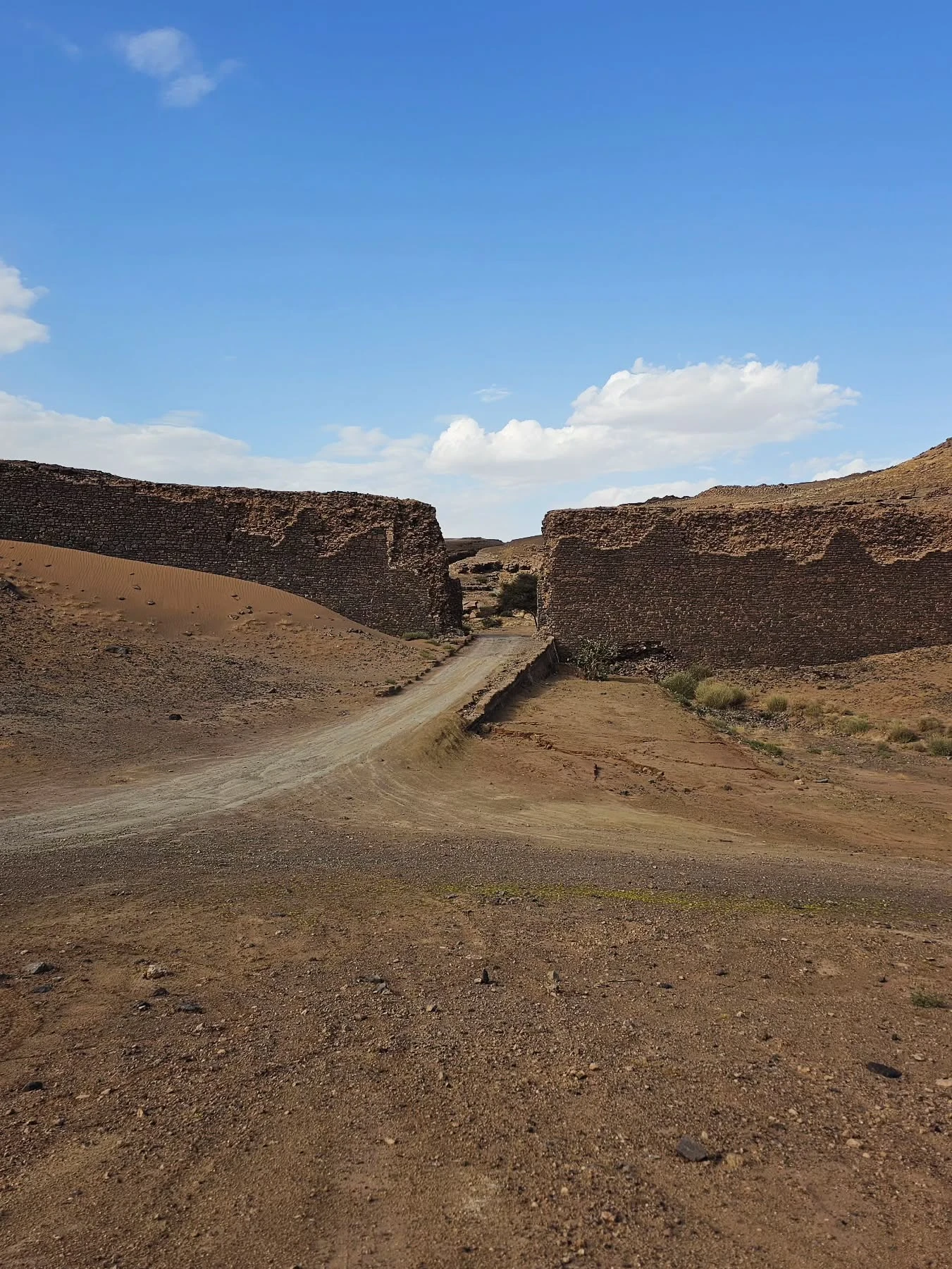
The rock faces at Gara Medouar are dense with Devonian marine fossils, including trilobites that once inhabited a sea covering present-day Morocco.
The fossils at Gara Medouar are not scattered curiosities. They are evidence of one of the great environmental transformations in Earth’s history: the retreat of the Saharan sea and the slow emergence of the landscape you walk through today. Standing here, you are on the floor of an ocean that disappeared 350 million years ago.
What to See and Do at Gara Medouar ↑ Contents
Gara Medouar is not a curated tourist attraction. There are no ticket booths, no guided trails, no interpretive panels. That is part of its appeal. What it offers is open, unstructured exploration in a setting that rewards curiosity and patience.
How to Get There from Erfoud ↑ Contents
Gara Medouar is located approximately 20 km southwest of Erfoud, in the direction of Taouz. There is no direct public transport to the site, which is one reason it remains relatively quiet. Self-drive and guided visits are the only practical options.
Erfoud is one of the key gateway cities in the southeastern Moroccan desert corridor. If you are still planning the broader route, a full overview of cities in Morocco can help you map the most logical journey from wherever you are starting.
Best Time to Visit ↑ Contents
The Erfoud region experiences extreme temperatures, particularly in summer, and the exposed desert setting of Gara Medouar amplifies that. Timing your visit correctly is less a matter of preference and more a matter of comfort and safety.
Whatever the season, carry more water than you think you need. The interior basin, while sheltered from wind, retains heat. A minimum of 2 liters per person for a 2-hour visit is a reasonable baseline outside the cooler winter months.
Practical Information ↑ Contents
| Location | ~20 km southwest of Erfoud, Tafilalet region, southeastern Morocco |
| Entry Fee | No formal entry fee. The site is open and unmanaged. |
| Accessibility | Piste track required. Standard car possible in dry weather; 4WD recommended. |
| Time Needed | 1.5 to 3 hours on-site, depending on how much you explore the ridgeline. |
| Nearest Town | Erfoud (accommodation, fuel, food, and fossil shops). Rissani is also nearby. |
| Mobile Coverage | Intermittent at best. Download offline maps before departure. |
| Facilities | None. No toilets, no water, no shade structures on-site. |
| Fossils | Observation permitted. Removal of specimens requires authorization and is not encouraged for casual visitors. |
For those traveling to southeastern Morocco for the first time, it helps to know the practical basics before arriving. Understanding what currency Morocco uses is a good starting point, as card payment is rarely available in this part of the country and cash is essential. Equally, a clear picture of where Morocco sits geographically helps set realistic expectations about distances: the Tafilalet is remote by design, and that remoteness is part of what makes Gara Medouar worth finding.
Visitors who have concerns about traveling in this region will find reassurance in the broader picture: Morocco is considered safe for tourists, including in the southeastern desert corridor, which sees regular visitor traffic from Merzouga to Zagora without incident.
Frequently Asked Questions ↑ Contents
What makes Gara Medouar circular? ▾
The circular shape is the result of differential erosion acting on a dome-shaped geological structure called an anticline. Over hundreds of millions of years, the softer rock at the centre of the dome eroded away more quickly than the harder rock around its edges, leaving a ring of resistant ridges surrounding a lower interior basin. The process is entirely natural and took place over geological timescales rather than any single event.
Can I find fossils at Gara Medouar? ▾
Yes. The rock at Gara Medouar contains abundant marine fossils dating to the Devonian and Ordovician periods, including trilobites, orthoceras, brachiopods, and crinoids. These are best observed in the exposed rock faces on the slope and ridge. Removing fossils from the site is regulated under Moroccan law, so visits are best treated as observational rather than collecting opportunities.
Do I need a 4WD to visit Gara Medouar? ▾
A 4WD is strongly recommended, particularly after rain when the track surface becomes unpredictable. In dry conditions, a standard car with reasonable ground clearance can manage the piste, but the final approach is rough enough that a higher vehicle is always the safer choice. If you are renting in Erfoud or Merzouga, opting for a 4WD for the day is straightforward and inexpensive relative to the risk of getting stuck.
How long does a visit to Gara Medouar take? ▾
Most visitors spend between one and a half and three hours on-site. A quick circuit of the interior basin and a look at the rock faces takes about 90 minutes at a moderate pace. Adding the ridge climb and a longer fossil survey extends that to two to three hours comfortably. The site does not have time pressure since there are no fixed tours or closing times.
Is Gara Medouar suitable for children? ▾
The interior basin is flat and easy to walk, making it accessible for children of most ages. The ridge climb is steeper and requires sure footing; younger or less agile children are better kept to the basin floor. The fossil-hunting element tends to be a genuine draw for children, who often spot specimens that adults walk past. Bring sun protection, more water than seems necessary, and appropriate footwear for rocky terrain.
Can I combine Gara Medouar with the Merzouga dunes in one day? ▾
Yes, and this is a popular combination. Gara Medouar is roughly 30 km north of Merzouga, so the drive is short. A practical plan is to visit Gara Medouar in the morning when temperatures are cooler, continue to Erfoud for lunch, and arrive at the dunes in the late afternoon in time for the sunset camel ride. The two sites offer very different experiences, geological and prehistoric on one hand, dramatic and atmospheric on the other, and they complement each other well within a single day.
Most visitors to southeastern Morocco arrive in Merzouga for the dunes, and rightly so. But the desert rewards those who look further. Gara Medouar is not difficult to reach, not expensive to visit, and not demanding in terms of preparation. What it asks is attention, which is perhaps why it feels so different from places that make more noise about themselves.
A ring of ancient ocean floor, fossilized and eroded into perfect geometry, sitting quietly in the hammada waiting to be noticed. That is what Gara Medouar is. It does not require a superlative. It simply requires that you go.
Planning your broader Moroccan itinerary? Explore the cities and regions of Morocco to map your route, and review the currency and payment essentials before heading into the desert south.



If possible, could you please add the transportation costs from Marrakech to Gara Medouar? I am looking for the best possible price
I’ve visited this place before; it’s a beautiful place that looks just like Mars, haha