Marrakech – Kasbah District
Kasbah Mosque Marrakech
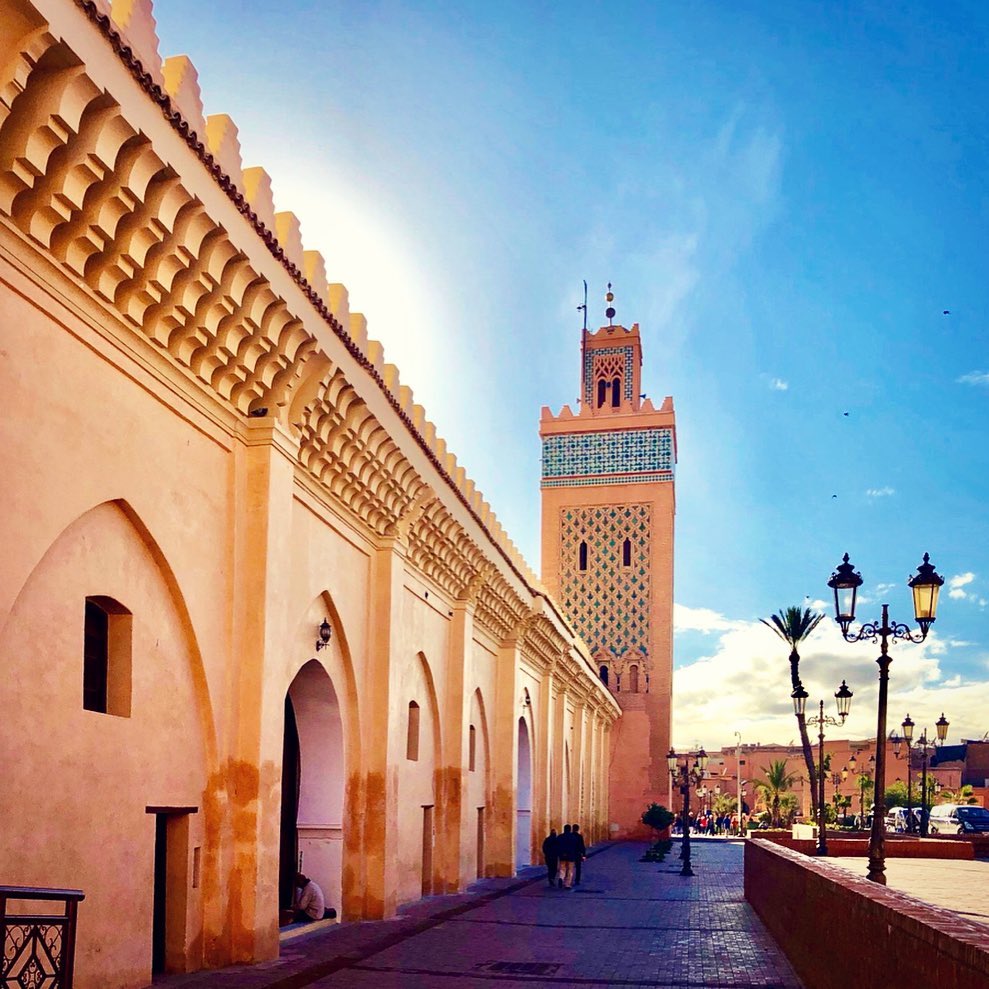
Moulay El Yazid Mosque · UNESCO World HeritageThere is a mosque in Marrakech that most tourists walk past without quite realizing what they are standing in front of. It is not the Koutoubia, whose minaret towers over Jemaa el-Fna and appears on half the postcards sold in the medina. This one sits deeper inside the old city, in the historic Kasbah district, and it rewards those who make the detour. The Kasbah Mosque, known locally as Moulay El Yazid Mosque (also written as Moulay Al Yazid Mosque) and sometimes called the Mansouria Mosque, is one of the most quietly magnificent structures in all of Morocco. Walk past it and you will feel the pull to stop and take a photograph. Its soaring walls, the intricate zellige frieze climbing the minaret, the storks nesting on the rooftop at dusk: this place has an effect on people.
A History That Spans Eight Centuries ↑ Top
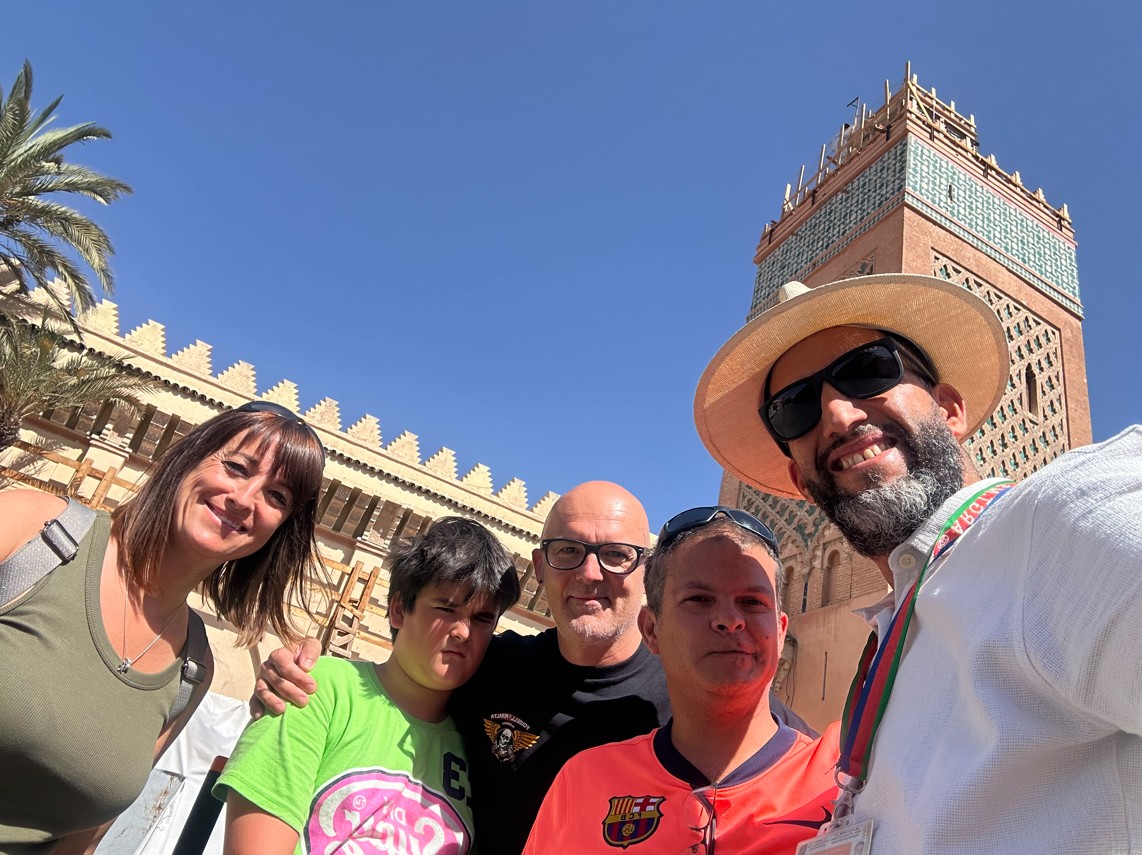
The story of this mosque begins with one of the most consequential rulers in Moroccan history. In 1185, the Almohad Caliph Yaqub al-Mansur ordered the construction of a grand mosque within the imperial Kasbah he was building in Marrakech. This Kasbah was not just a neighborhood it was the seat of a vast empire stretching from the Iberian Peninsula to present-day Libya. The mosque, completed around 1190 CE, was designed as the congregational Friday mosque for the caliph and his royal district, a parallel to the great Koutoubia which served the broader city.
For centuries the Kasbah Mosque held extraordinary prestige, rivaling the Koutoubia itself. Sultans, scholars and important figures sought to be buried in the cemetery growing to its south, and that cemetery eventually became the celebrated Saadian Tombs, now one of Marrakech’s most visited attractions.
The mosque’s history has not been without drama. In the second half of the 16th century, an enormous explosion at a nearby gunpowder store caused severe damage. The Saadi Sultan Moulay Abd Allah al-Ghalib (r. 1557–1574) undertook extensive repairs, carefully preserving the original Almohad form. Later, the Alaouite Sultan Sidi Muhammad Ibn Abd Allah (r. 1757–1790) carried out another major restoration, adding the ornate wooden cupola at the prayer hall entrance that can still be admired today.
Each era of rulers that inherited this mosque treated it with evident reverence. The fact that its original Almohad layout remains legible after eight centuries of repairs is a rare achievement in Islamic architecture.
Architecture: What Makes It Special ↑ Top
Architecturally, the Kasbah Mosque is a fascinating object to study from the outside, since non-Muslims are not permitted to enter as is standard across Morocco’s mosques. What you can see from the street is already striking. The exterior walls are high, imposing and crowned with merlons above rows of stone corbels. Large pointed horseshoe arches run along the facade, some now walled in, others framing the mosque’s four public gates.
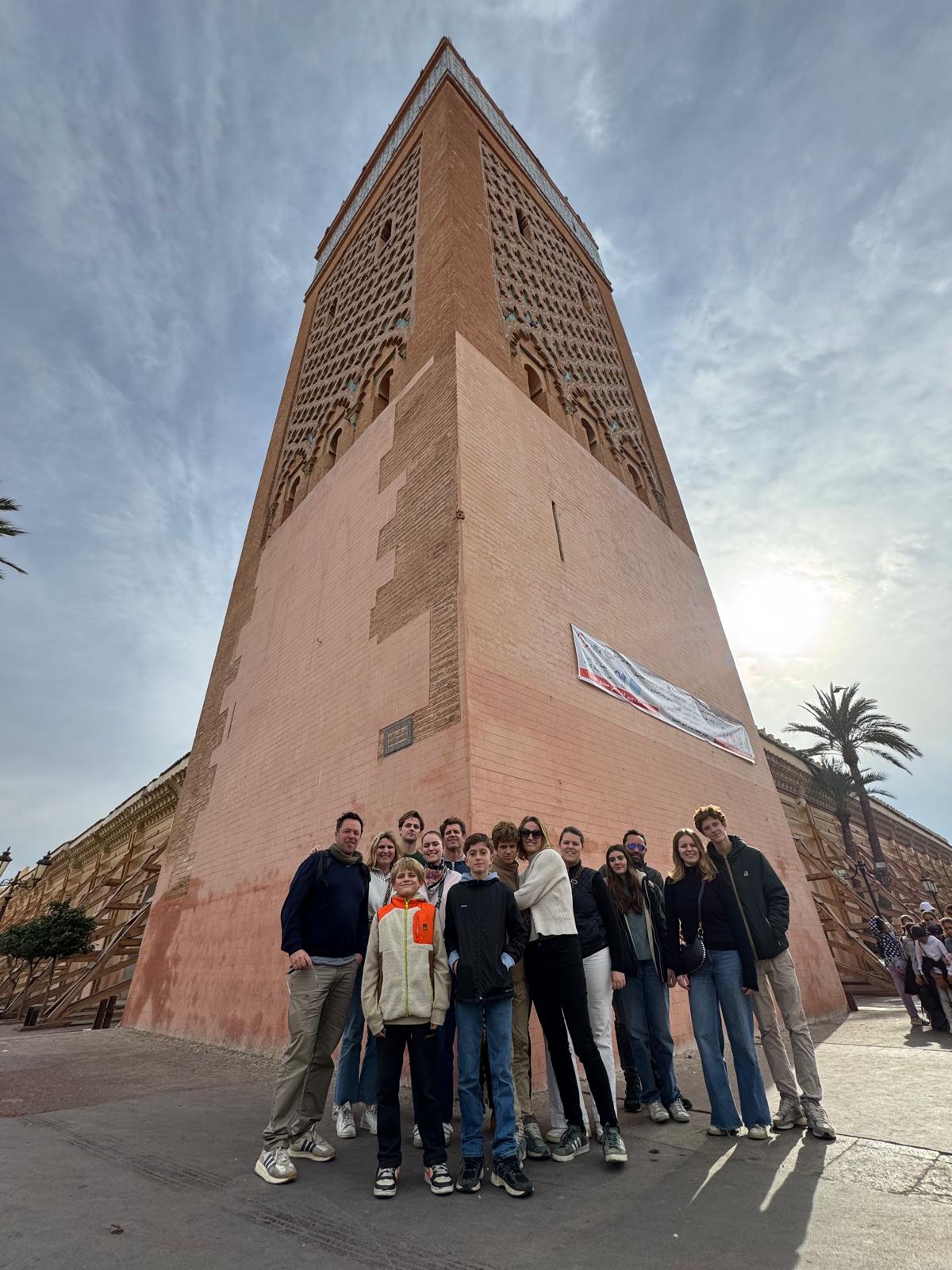
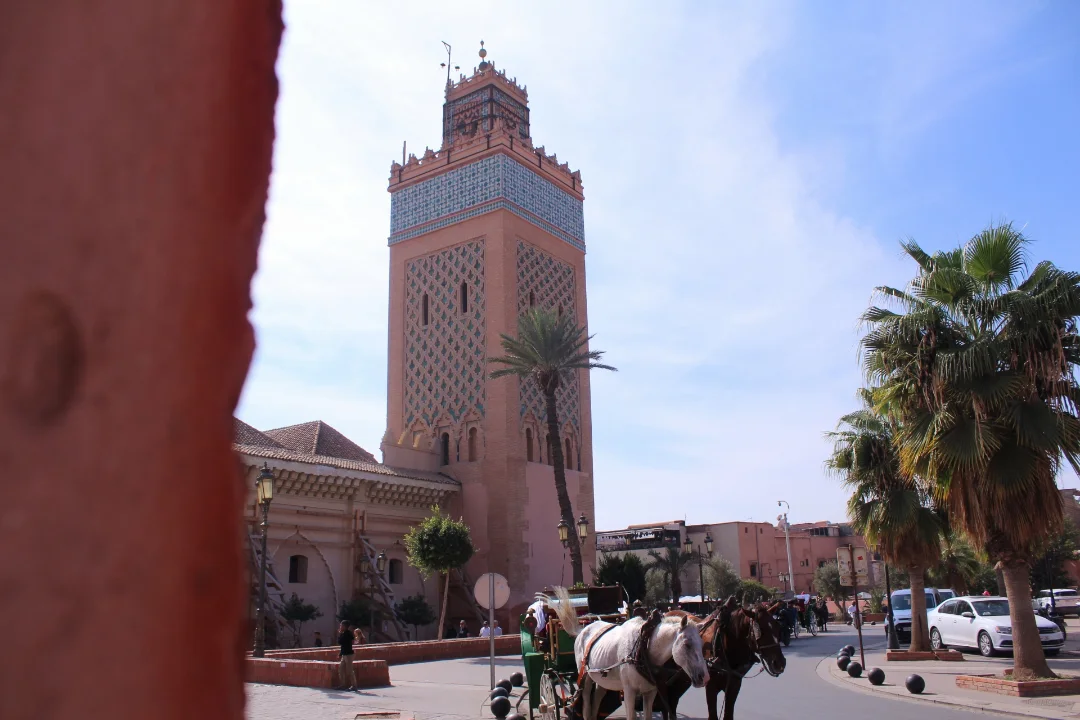
The minaret rises from the northwestern corner and is the feature that draws most eyes. Its square base measures roughly 8.8 metres per side, placing it in the classic Almohad tradition alongside the Koutoubia minaret in Marrakech, the Hassan Tower in Rabat, and the Giralda in Seville all built within the same generation. What distinguishes the Kasbah’s minaret is its decorative program: on each face, narrow pointed arches are topped by elaborate polylobed arches, with slender engaged columns between them that once bore coloured ceramic facing. The frieze of Moroccan zellige tile at the top still catches the light on clear mornings in a way that stops people mid-stride.
The mosque covers roughly 6,500 square metres, making it slightly larger than the Koutoubia. Its floor plan is unusual for the region, with a vast central courtyard subdivided into five distinct sections — a central rectangular space and four smaller courtyards at the corners. This arrangement gives the building an expansive, airy quality quite different from the typical single-courtyard mosque of the western Islamic world.
Current Restoration Works ↑ Top
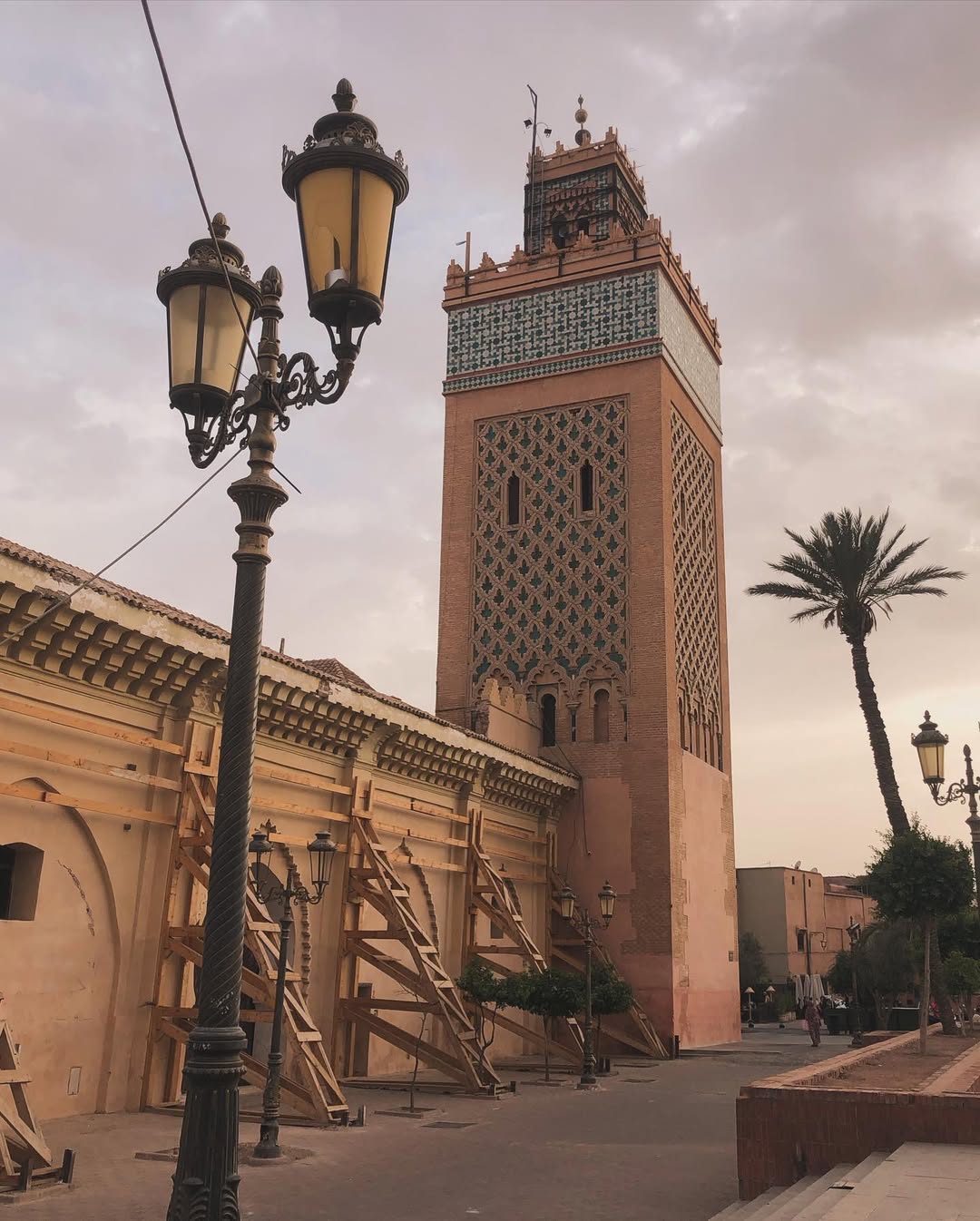
If you visit the Kasbah Mosque today, you will notice restoration work underway. The mosque is currently not accessible for its usual prayer routines due to these ongoing works, and scaffolding is present on sections of the exterior. This restoration is part of a broader effort to safeguard the historic mosques of the Marrakech-Safi region following the 2023 earthquake, which affected over 1,500 mosques across the region.
The Kasbah Mosque falls within the category of archaeological and historical monuments, meaning that works are being carried out according to international conservation standards. While this means some elements of the exterior are temporarily obscured, it is also a sign that serious care is being taken to preserve this 800-year-old structure for future generations.
From a visitor’s perspective, the mosque exterior and surrounding square remain fully accessible for photography and exploration. The works do not prevent you from experiencing the neighborhood, strolling along Rue de la Kasbah, or visiting the Saadian Tombs just steps away. If anything, the sight of active conservation work on a UNESCO monument is a story in itself.
Place Moulay El Yazid: The Square Around the Mosque ↑ Top
The mosque does not stand alone. Flanking its eastern side is Place Moulay El Yazid, a square that underwent significant renovation during the 2010s and has since become a pleasant open space where the pace of Marrakech life is noticeably calmer than in the main medina souks.
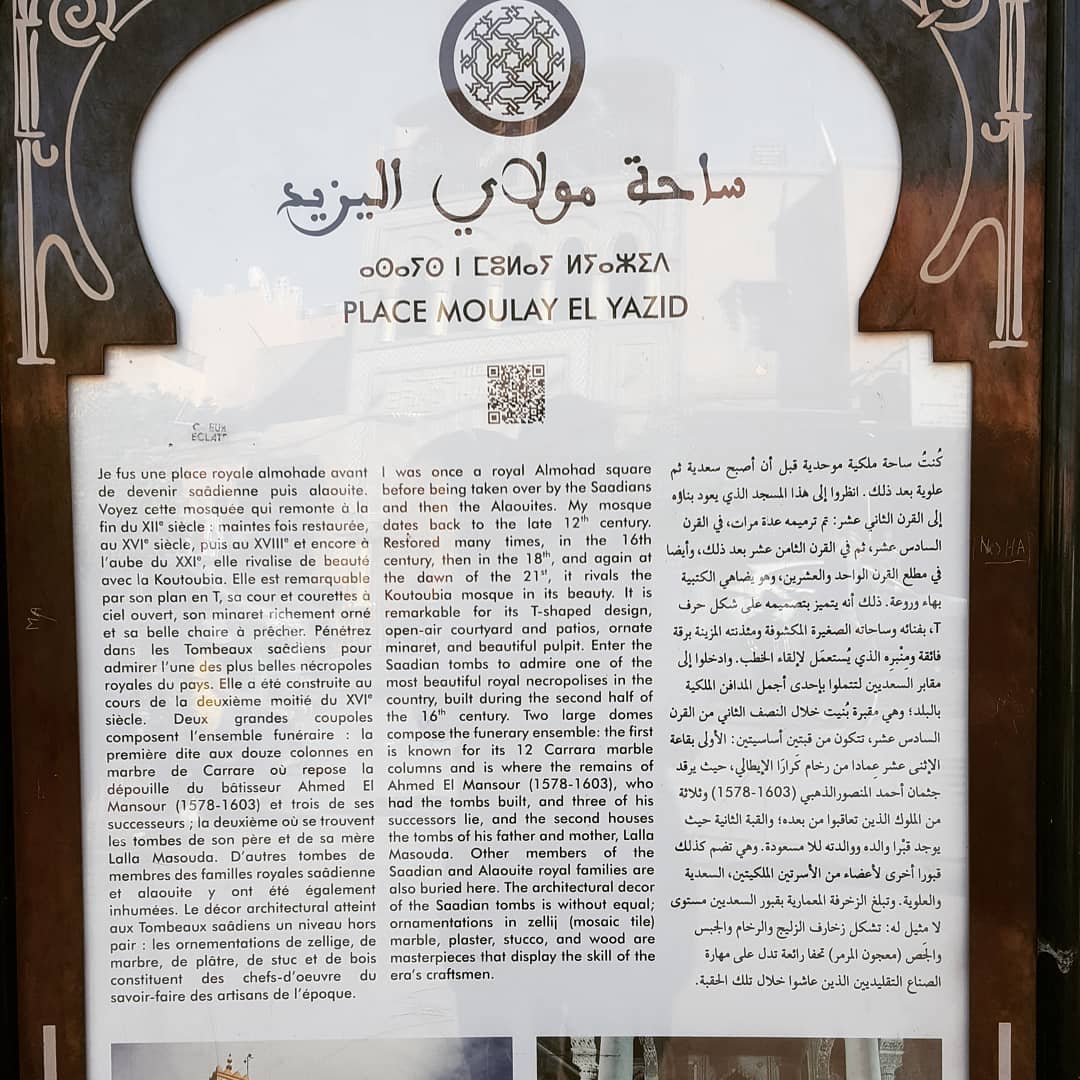
The square is lined with cafés and small restaurants, making it an ideal place to sit with a mint tea after visiting the Saadian Tombs. In the early morning and late afternoon, the light on the mosque’s minaret is particularly striking — this is the moment photographers come back for. The square carries the name of Sultan Moulay al-Yazid (r. 1790–1792), an Alaouite ruler who reigned for only two years but who has his own burial in the nearby Saadian Tombs.
The neighborhood around the square is one of the most authentic parts of Marrakech. Away from the intense commercial pressure of the central souks, the Kasbah district moves at a more human rhythm. Locals shop, children play, and the call to prayer echoes off centuries-old walls in a way that feels less performed and more genuine than in more touristy areas.
Practical Visitor Information ↑ Top
Kasbah Mosque at a Glance
The mosque sits on Rue de la Kasbah, one of the main streets running south from the medina toward Bab Agnaou. Non-Muslim visitors cannot enter this applies to all mosques in Morocco and is not specific to this one. The exterior, however, is entirely accessible and fully worth a long look. Dress modestly out of respect for the neighborhood and the context: covered shoulders and knees are appropriate. There is no entry fee to visit the square and exterior.
The best photographic light falls on the minaret in the hour before sunset, when the zellige frieze turns amber. Early morning visits have the advantage of an almost empty square.
When it comes to currency in Morocco, the Moroccan Dirham (MAD) is the only legal tender — the Kasbah cafés and surrounding shops only accept cash or local card payments, so it is worth having small bills on hand for mint tea and snacks around the square.
Things to Do in the Kasbah Area ↑ Top
The Kasbah Mosque is a natural anchor for a broader exploration of one of Marrakech’s most rewarding neighborhoods. Here is what the area has to offer:
Visit the Saadian Tombs
A narrow entrance just south of the mosque leads to the Saadian Tombs, a royal necropolis of extraordinary refinement. The mausoleums were sealed by Sultan Moulay Ismail in the 17th century and only rediscovered in 1917, which preserved their decoration in almost pristine condition. Entry costs 70 DH per adult. It is busy in the middle of the day; mornings are calmer.
Walk Through Bab Agnaou
A few steps from the mosque stands Bab Agnaou, the principal historical gate of the Kasbah and one of the oldest and most beautiful gates in Marrakech. Its horseshoe arch is carved with interlocking floral and geometric motifs in a style that predates even the mosque itself. Worth pausing in front of.
Horse-Drawn Carriage Ride (Caleche)
The Kasbah area is one of the places in Marrakech where you can sometimes find a traditional horse-drawn carriage, known locally as a caleche or koutchi. These carriages offer a slower, more atmospheric way to cover ground between the Kasbah and Jemaa el-Fna. They are not always available, particularly later in the evening or during busy periods, but if you spot one near the square it is an experience worth considering.
Shop for Authentic Moroccan Crafts
The shops along Rue de la Kasbah tend to be less pressured than those in the central souks. You will find leather goods, pottery, lanterns and textiles at prices that are negotiable but generally fairer than in the most heavily trafficked tourist corridors. If you want to arrive with a sense of what you are looking at — and avoid overpaying our Guide to Moroccan Crafts covers the main categories, what to look for in terms of quality, and the vocabulary of traditional Moroccan artisanship.
Want to explore the Kasbah properly, with all the context and none of the confusion? Our guided walking tour covers the mosque, Bab Agnaou, the Saadian Tombs and the neighborhood’s hidden corners led by a licensed local expert who grew up in the medina.
Book the Kasbah Marrakech Walking TourStaying Safe: Tips for the Kasbah ↑ Top
The Kasbah neighborhood is generally one of the calmer parts of the Marrakech medina. That said, a few things are worth keeping in mind as a visitor.
Unofficial guides: Around tourist sites like the Saadian Tombs and the mosque entrance, you may be approached by individuals offering to guide you or offering unsolicited help. Some of these people are simply friendly locals; others are unlicensed touts looking for payment. The safest approach is to politely decline and keep walking. Official licensed guides in Morocco carry Ministry of Tourism accreditation if you want a guided experience, book in advance with a reputable operator. We have put together a List of Common Tourist Scams in Morocco that covers exactly this type of situation and several others you should know about before arriving.
More broadly, both Morocco as a destination and Marrakech specifically are considered safe for tourists by international standards. Common-sense awareness, as in any busy city anywhere in the world, is all that is required.
Getting There ↑ Top
The Kasbah Mosque is a 15 to 20-minute walk south from Jemaa el-Fna. The simplest route takes you past the Koutoubia Mosque and south along Rue de la Koutoubia until it becomes Rue de la Kasbah. Continue straight and you will reach the mosque on your right. Bab Agnaou, the ornate gate, appears just before the main entrance to the Saadian Tombs the mosque is right there.
By taxi, simply tell the driver “Kasbah” or “Tombeaux Saadiens” either reference will bring you to within a very short walk. Agree on the price before departing and make sure you have Moroccan Dirhams in small denominations.
Frequently Asked Questions ↑ Top
What is the difference between Kasbah Mosque, Moulay El Yazid Mosque and Mansouria Mosque?
Can non-Muslims visit the Kasbah Mosque?
Is the Kasbah Mosque open at the moment?
How far is the Kasbah Mosque from Jemaa el-Fna?
Are horse-drawn carriage rides available near the Kasbah?
Is there a walking tour that covers the Kasbah Mosque?
What else is worth seeing near the Kasbah Mosque?
The Kasbah Mosque is not the most photographed monument in Marrakech, but it may be the one that stays with you longest. It has a weight that comes from genuine age and genuine history from the Almohad caliphs who commissioned it, the Saadi sultans who repaired it, and the generations of Marrakchis who have prayed inside it for 800 years. You cannot walk past without pausing, without reaching for a camera, without feeling that something here is worth a moment of your time. It is, simply put, one of those places that makes you grateful you came this way.