
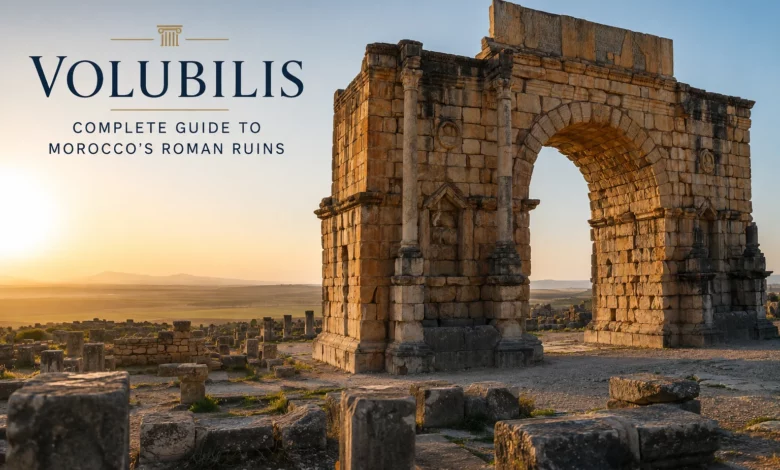
Volubilis sits on a ridge above the Khoumane valley, about thirty minutes past Moulay Idriss, and it is the best preserved Roman site in Morocco by a wide margin. Most visitors treat it as a stop between Fez and Meknes, in and out inside an hour, which is roughly the time it takes to walk to the far end of the site and back.
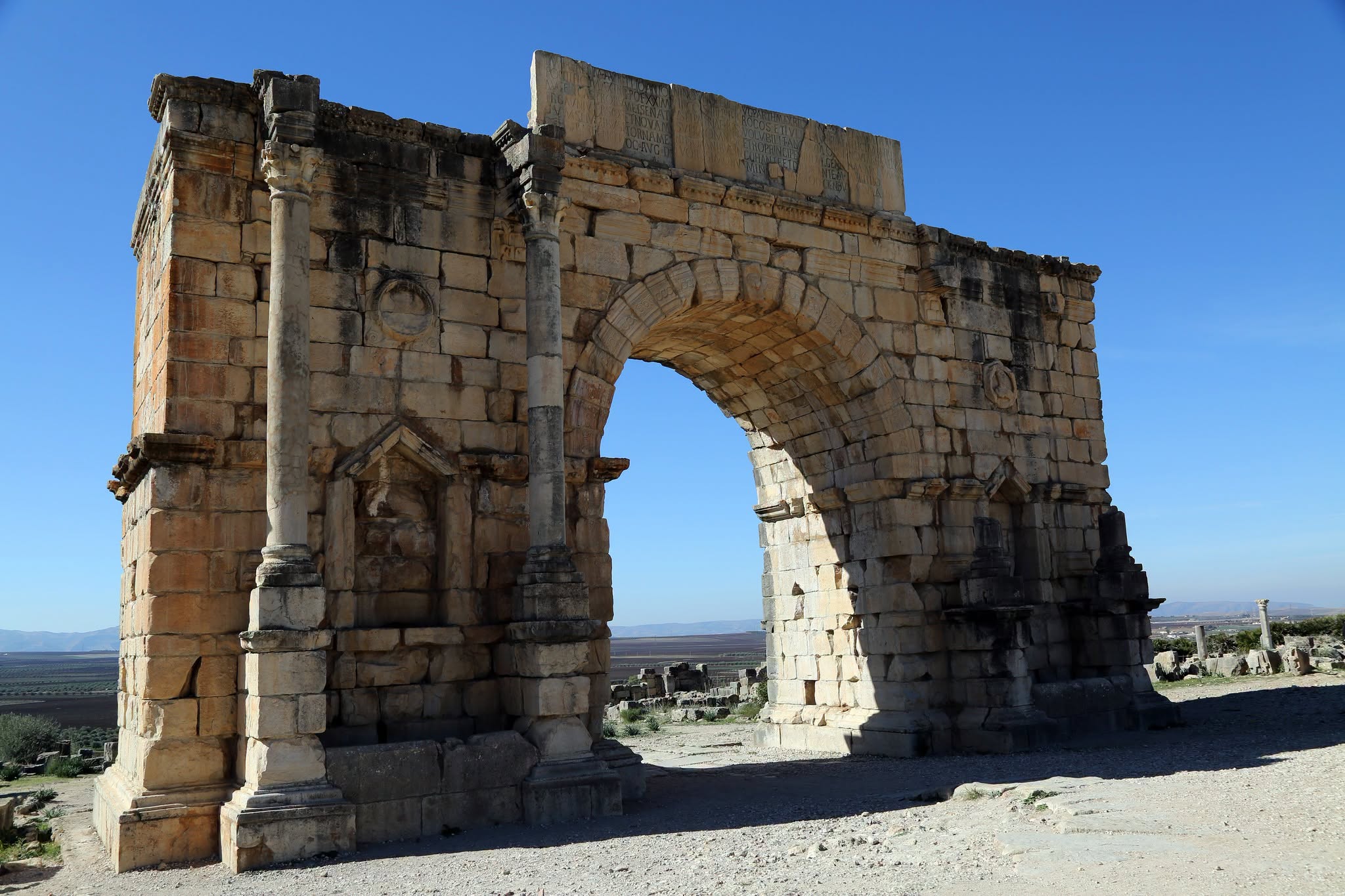
Volubilis is a Roman archaeological site about 30 km north of Meknes and the best preserved ruin of the period in Morocco: a triumphal arch, a basilica, a forum and several houses with their mosaic floors still in place. It is UNESCO listed, open daily from 8:30am, and worth two hours if you want to see the mosaics properly rather than glance at them.
Volubilis earns the detour if you are already spending a day around Fez or Meknes, especially paired with Moulay Idriss fifteen minutes down the hill. It is a harder sell as a standalone trip from somewhere like Chefchaouen: several hours of driving does not balance out against ninety minutes on site, and the ruins, well preserved as they are, remain a hilltop of stone with almost no shade.
- Duration
- 1.5 to 2 hours
- Best season
- October to April
- Entry fee
- 70 MAD adults, 30 MAD children
- Nearest town
- Moulay Idriss, 5 km
- Getting there
- Private driver, taxi or day trip
- Best for
- Roman ruins and mosaic detail
Before you goGetting to Volubilis and when to go Contents ↑
There is no bus to Volubilis and no way in on foot from anywhere useful. The closest railway stop is Meknes, reachable on Morocco’s train network, and from there you still need a taxi for the last half hour, since the line does not run any further north.
Most people see the site on a private day trip out of Fez or Meknes, usually paired with a stop in Moulay Idriss, where Idris I, founder of the Idrisid dynasty, is buried. A grand taxi from Meknes gets you there in under forty minutes for a fraction of an organised tour’s price; hiring a driver for the full day makes more sense once Moulay Idriss is added to the plan and you would rather have someone waiting than negotiate a return fare at the gate. If you are weighing that decision, we have laid out the trade-offs in more detail on hiring a reliable driver for a Morocco road trip.
October to April is the better half of the year here. There is almost no shade on the hilltop, and by June the stone holds heat well into the afternoon. Early morning, before the tour buses from Fez start arriving around ten, is when the light on the arch is worth photographing. Entry is 70 MAD for adults and 30 MAD for children, paid in cash at the gate; card machines are not reliable. Last checked: August 2026.
First lookThe Arch of Caracalla Contents ↑
The arch is what most photographs of the site show, and it earns that reputation on the approach rather than up close. It was raised between 216 and 217 AD by the town council, honouring the emperor Caracalla for granting the town’s residents Roman citizenship and easing certain taxes. Most of what stands today is a reconstruction from the 1930s, corrected again in the 1960s after the first attempt got some of the proportions wrong, a detail most day trips skip entirely.
The inscription across the top, cut into imported marble rather than the grey local stone used everywhere else on site, is still legible if you know roughly where to look. Stand on the far side and look back through the arch toward the Forum for the view that ends up on most of the site’s postcards.
The centreThe Forum, the Basilica and the Capitol Contents ↑
Past the arch, the Decumanus Maximus runs straight through what was the commercial heart of the town, lined with the bases of shops and a covered market. It ends at the Forum, where the Basilica’s row of arches is the second most photographed feature on site, helped along most years by a pair of storks that nest on one of the capitals.
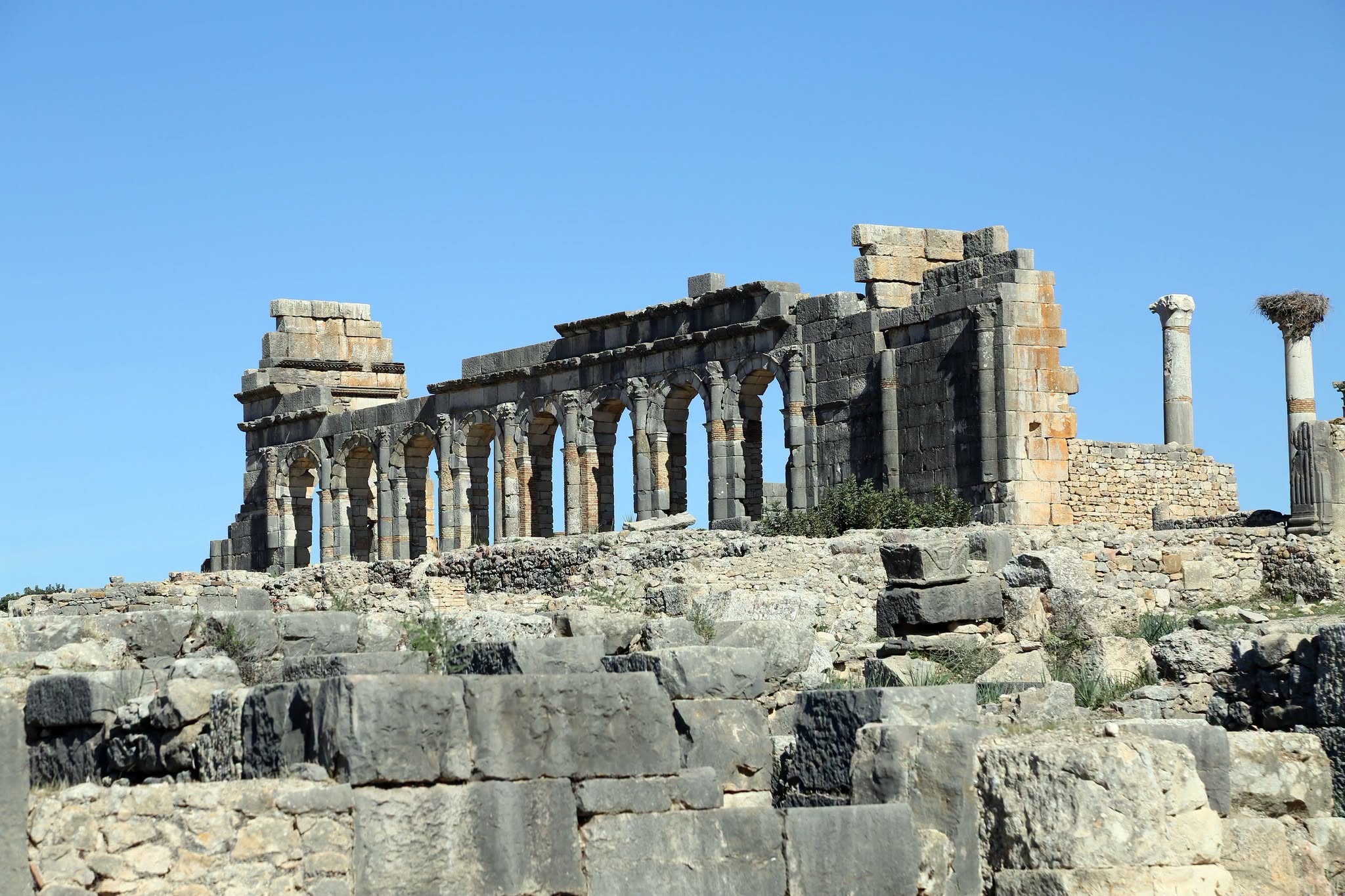
The Basilica served as the town’s law court and civic hall, standing next to the Capitol, a temple to Jupiter, Juno and Minerva that would have anchored the skyline of Roman Volubilis. Its columns, several of them re-erected during the restoration campaigns, are now the tallest thing standing on the hill, visible from the approach road long before the entrance gate.
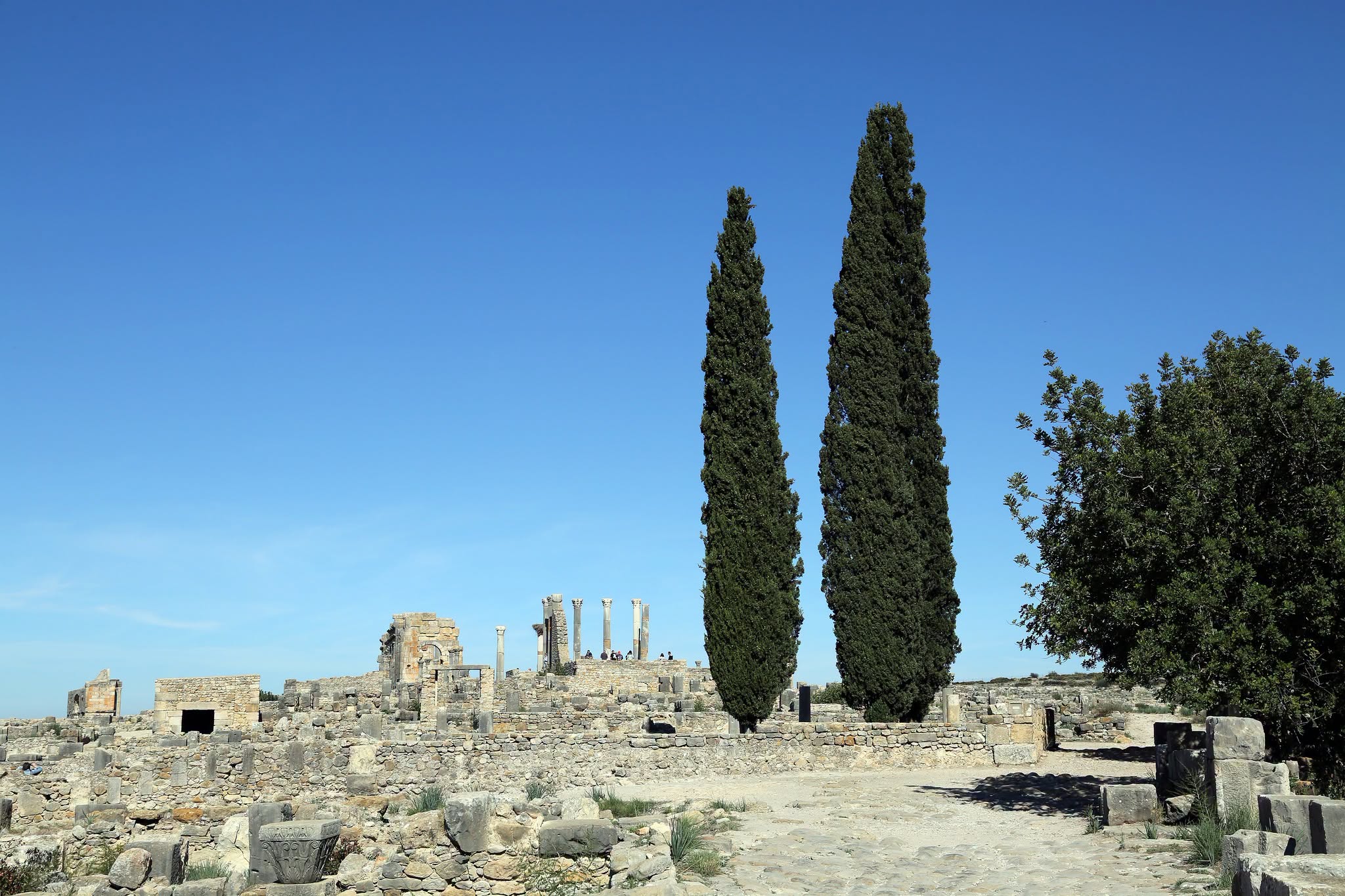
Past those cypress trees, a few minutes’ walk brings you to the House of Venus, once linked to King Juba II, where two of the site’s better mosaics survive in what was the dining room.
On footWalking the grid: gates and stonework Contents ↑
Volubilis was walled twice, once under the Romans and again, more roughly, in the third century as the empire’s grip on the region loosened. Several gates survive in fragments, most of them ordinary doorways rather than triumphal statements, cut from the same grey stone as everything else on site.
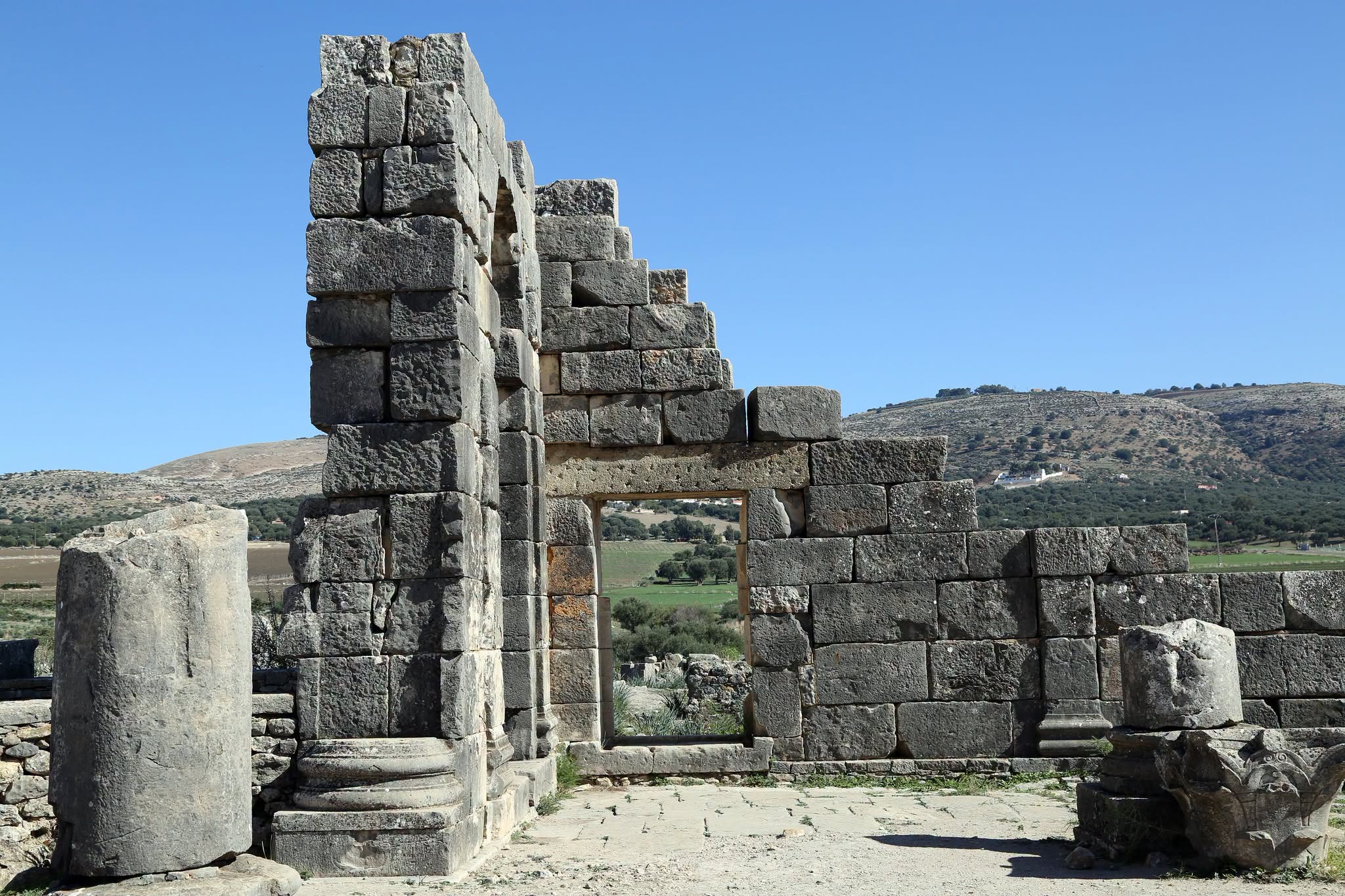
What is easy to miss on a fast visit is the stonework itself: column drums stacked without mortar, thresholds worn smooth by centuries of cart traffic, and capitals carved with acanthus leaves that still hold their shape. A few sit close enough to eye level to see the tool marks left by whoever cut them.
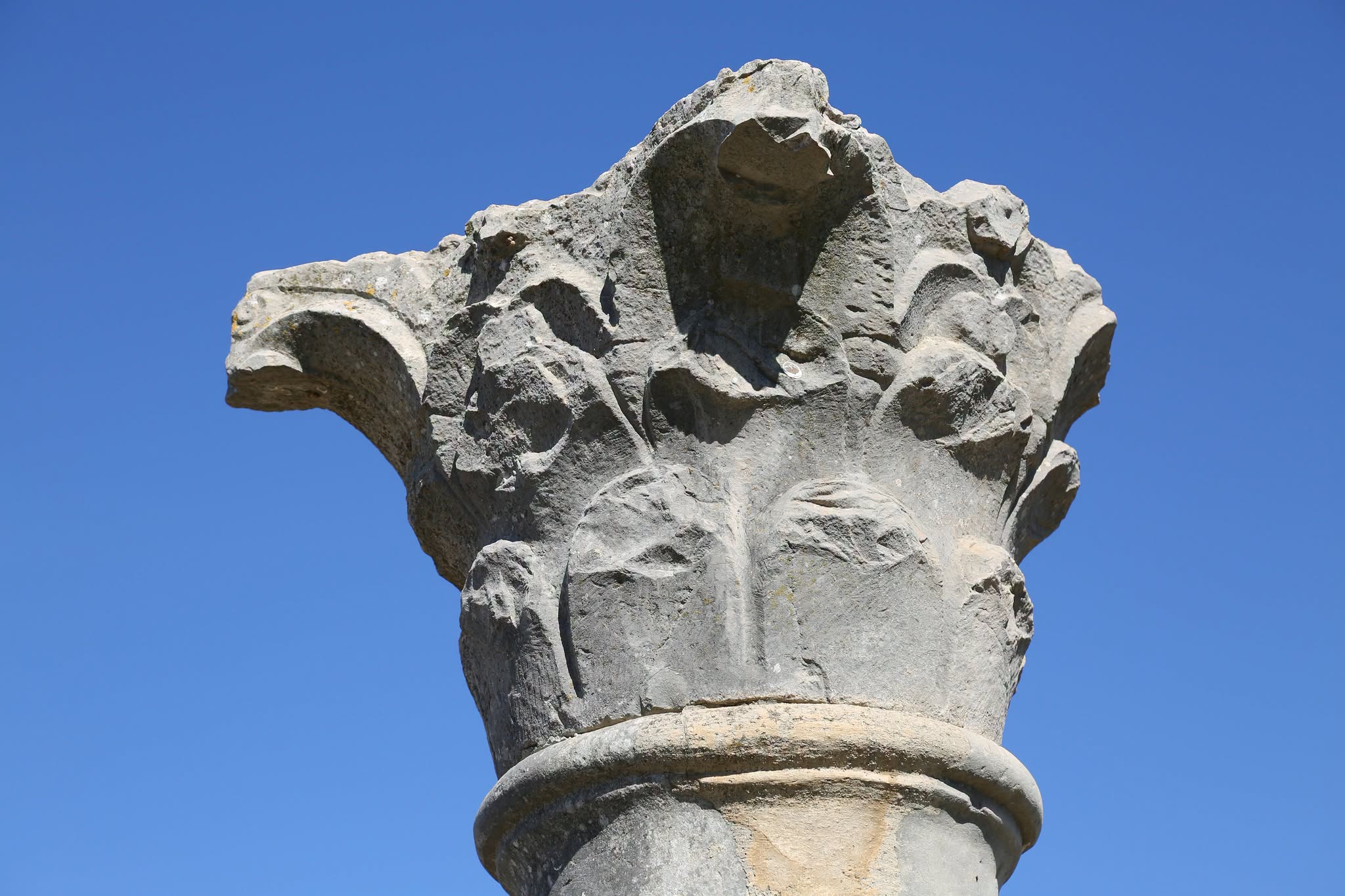
Bringing a proper camera rather than a phone changes what you get here, since the flat midday sun does the stonework no favours. We have covered the general rules for photographing Morocco elsewhere, and most of it applies just as well on a hilltop of Roman ruins.
UnderfootThe mosaics: daily life in stone Contents ↑
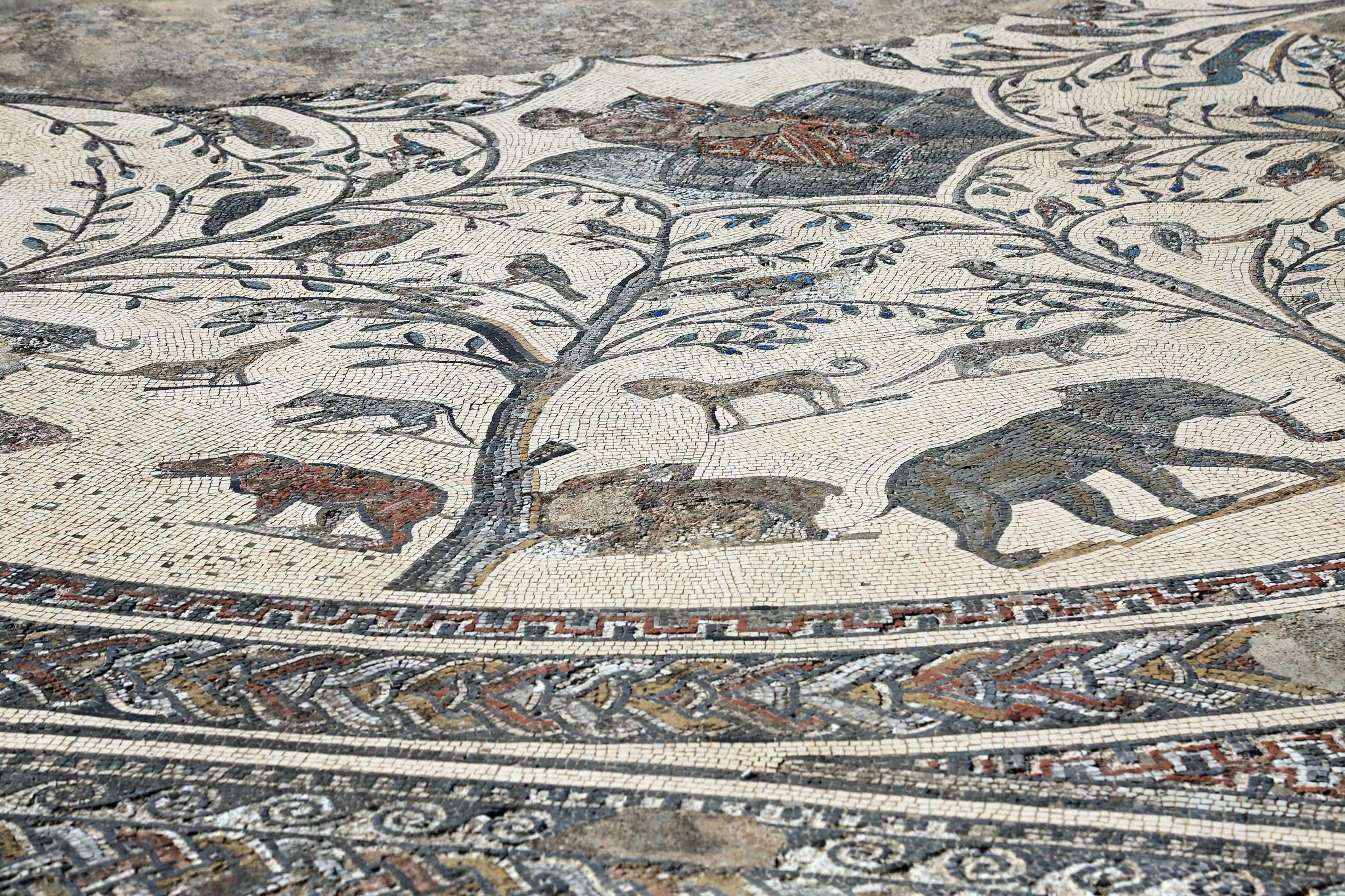
The mosaics are the reason serious visitors give Volubilis more than an hour. The House of Orpheus holds the largest of them, a floor built around Orpheus playing to a circle of animals, birds worked into the branches of a tree above him. It would have covered most of a dining room, laid out so guests reclining on couches around the edges could take it in without moving.
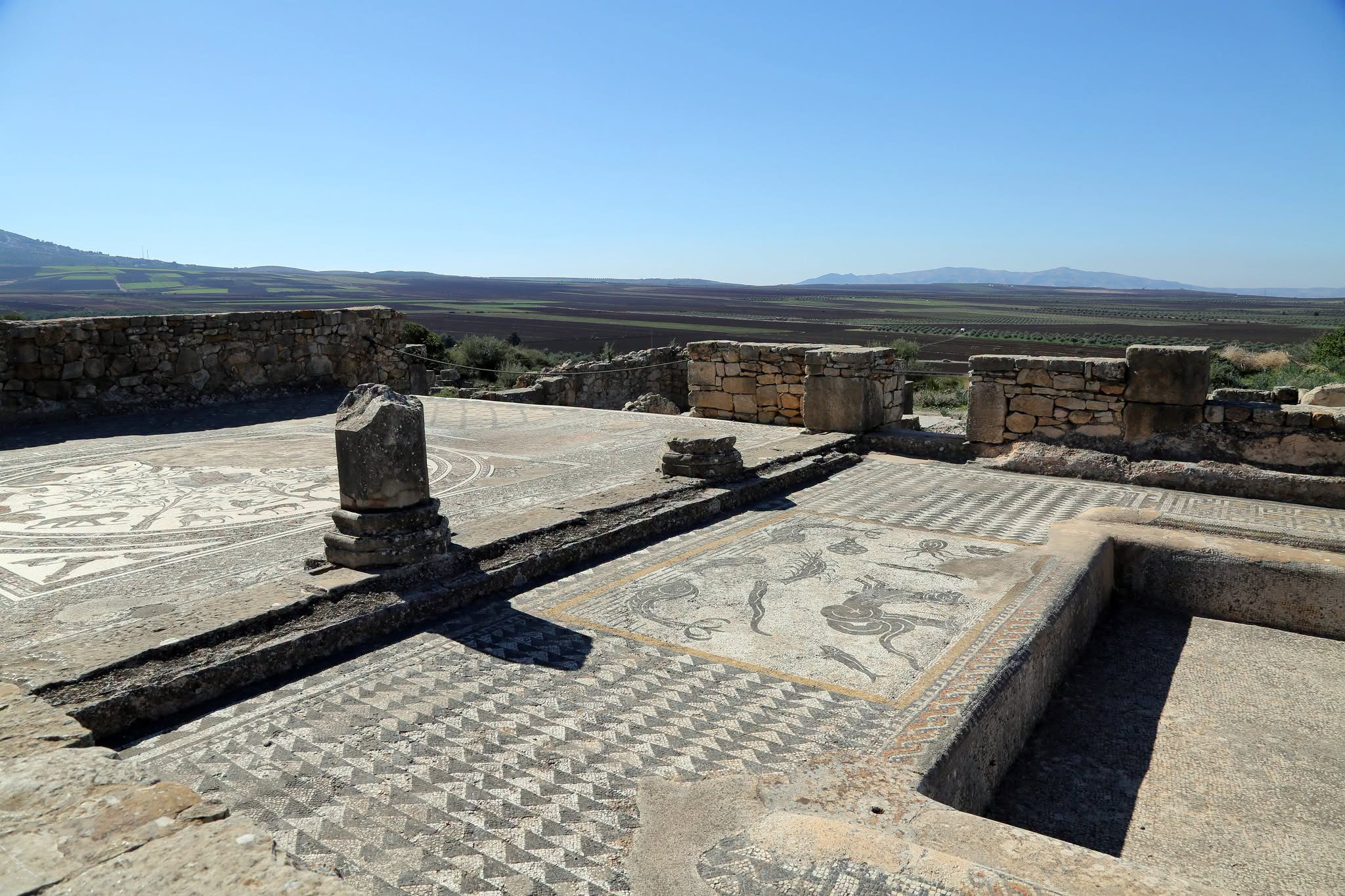
Not everything here is animals and myth. Nearby, a dolphin mosaic marks what was probably a small bathing area, and further along, the House of the Ephebus keeps an unfinished panel of Bacchus riding in a chariot pulled by panthers, abandoned mid pattern for reasons nobody has fully worked out. None of it sits behind rope the way a museum floor would; you walk within a metre or two of stonework that has outlasted the empire that made it, which is part of what makes the entry fee worth it even without a guide filling in the details.
If you do want the details filled in, hiring a licensed guide at the gate for around 200 to 300 MAD per group covers roughly ninety minutes, and it tends to pay for itself the moment someone explains which animal is which in the Orpheus mosaic.
Before you leaveMistakes worth avoiding Contents ↑
Card machines are unreliable at the ticket booth, and the nearest cash machine is back in Moulay Idriss, so arrive with enough dirhams for the entry fee and for a guide if you want one.
Footwear matters more than most visitors expect. Roman paving is uneven by design, and low thresholds catch open shoes more often than boots. Combined with a hilltop that offers essentially no shade, this is not a site to see in sandals with a single water bottle. Bring more water than feels necessary and something to cover your head; we have written more generally about what to wear in Morocco if you are still building out the rest of your kit.
The other common mistake is timing. Arriving after the Fez tour buses, usually mid to late morning, means sharing the Arch of Caracalla with several dozen people angling for the same photograph. An hour earlier avoids most of that, and so does visiting on a weekday if your itinerary allows it.
Fitting Volubilis into a longer route north
- A private, tailor-made route can combine Volubilis with Meknes, Moulay Idriss and Fez in a single day, timed around the light rather than a fixed bus schedule.
- It suits a dedicated day in the north better than a rushed add-on to a Marrakech-based loop; this stretch of the country holds its own itinerary rather than an afternoon detour.

Is Volubilis worth visiting if you only have one day in Fez?
Yes, if that day already includes Meknes or Moulay Idriss, since Volubilis sits close to both. On its own from Fez, it is a lot of driving for roughly ninety minutes on site, so most people pair it with at least one other stop rather than building the whole day around it.
How much time should I set aside at Volubilis?
Plan for at least ninety minutes, closer to two hours if you want to see the main mosaics properly rather than pass through. A guided visit runs about ninety minutes on its own, before any time spent wandering the quieter corners alone.
Can you visit Volubilis without a guide?
Yes, a guide is not required to enter, and the main structures, the arch, the Basilica, the Capitol, are straightforward enough to follow with a map. What you will miss is context on the mosaics, since most of them carry no signage explaining what you are looking at.
Is Volubilis usually combined with Meknes and Moulay Idriss?
Most day trips from Fez cover all three, since they sit within about forty minutes of each other. Moulay Idriss works well as a lunch stop, and Meknes’ medina fills out the rest of the afternoon if the day starts early enough.
Do I need to book Volubilis tickets in advance?
No. Tickets are sold at the gate, and the site rarely reaches anything close to capacity outside a handful of Fez tour buses arriving mid-morning. Bring cash, since card payment at the booth is not always reliable.
Heritage status and site details can be updated by UNESCO; the listing above reflects the record at the time of writing.