
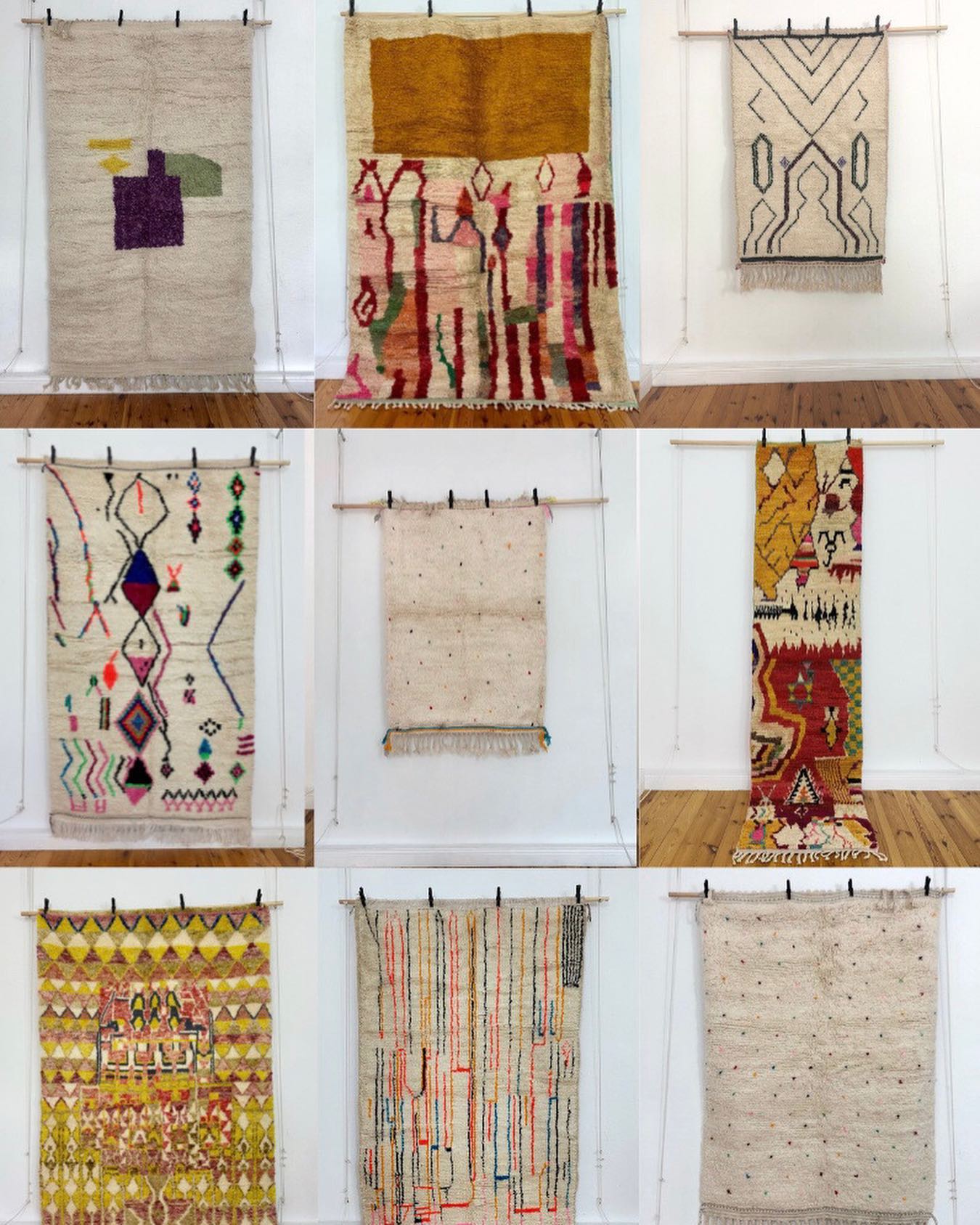
Moroccan rug shopping:
Authenticate a berber carpet
and negotiate like a pro
Everything you need before you step into a souk from reading the knots to reading the room.
Somewhere between your third cup of mint tea and your host’s fourth anecdote about his cousin’s import business, you will realize that buying a Moroccan rug is not a transaction. It is a performance, a ritual, a social event with its own unspoken rules. The carpets are extraordinary genuinely so. Hand-knotted Beni Ourain wool from the Middle Atlas, Azilal pieces woven with symbols that predate the written word, kilims that have been made the same way for five centuries. But the market for them is also one of the most pressured commercial environments a tourist will encounter. This guide gives you the knowledge to engage on equal terms: to spot the real from the imitation, to understand what you are looking at, and to negotiate without either being exploited or causing offense.
The Main Types of Moroccan Rugs ↑ Contents
Morocco produces a genuinely diverse range of carpet and rug traditions, each tied to a specific region, tribe, or weaving technique. Understanding the difference before you enter a shop gives you an immediate advantage, both in evaluating quality and in grounding any conversation about price.
The range of Moroccan rug traditions spans centuries and dozens of regional styles. Knowing the key types before you shop changes the entire dynamic of the encounter.
How to Authenticate a Berber Carpet ↑ Contents
The market contains everything from genuinely old, hand-knotted tribal pieces to machine-made reproductions imported from China or Turkey and sold as authentic Berber work. The difference in value can be tenfold. These practical tests work in a shop environment and require no specialist equipment.
Not all machine-made or partially machine-made rugs are worthless. Some are attractive, well-made, and sold honestly at prices that reflect what they are. The problem arises when a machine-made piece is presented as artisanal, hand-knotted, or antique, and priced accordingly. The tests above are about ensuring the price matches the reality, not about dismissing anything that isn’t tribal work.
Natural Dyes vs. Synthetic: How to Tell ↑ Contents
The dyes used in a rug affect both its value and its long-term appearance. Naturally dyed rugs are considered significantly more desirable by serious collectors, while synthetically dyed rugs are faster and cheaper to produce. The distinction matters when sellers describe a piece as “all natural” and price it accordingly.
Traditional Moroccan natural dyes include henna (orange-brown), saffron (yellow), indigo (blue), pomegranate rind (gold and tan), madder root (red and terracotta), and walnut shell (dark brown and black). These produce slightly muted, complex tones with an almost organic depth. Synthetic dyes, by contrast, tend toward vivid, saturated, almost electric hues that are consistent across the entire field of color.
Natural dyes fade gracefully over decades, developing what collectors call a patina. Synthetic dyes fade unevenly and often produce faded patches rather than a uniform mellowing. A rug with supposedly old natural dyes that shows perfectly even color throughout is a contradiction worth questioning.
The most reliable quick test is the spittle test: rub a dampened white cloth firmly on a section of colored pile. Some slight color transfer from natural dyes is normal and not a sign of poor quality. Heavy, bright color transfer, particularly of red or orange, often indicates cheap synthetic dye that has not been properly fixed and will bleed when washed.
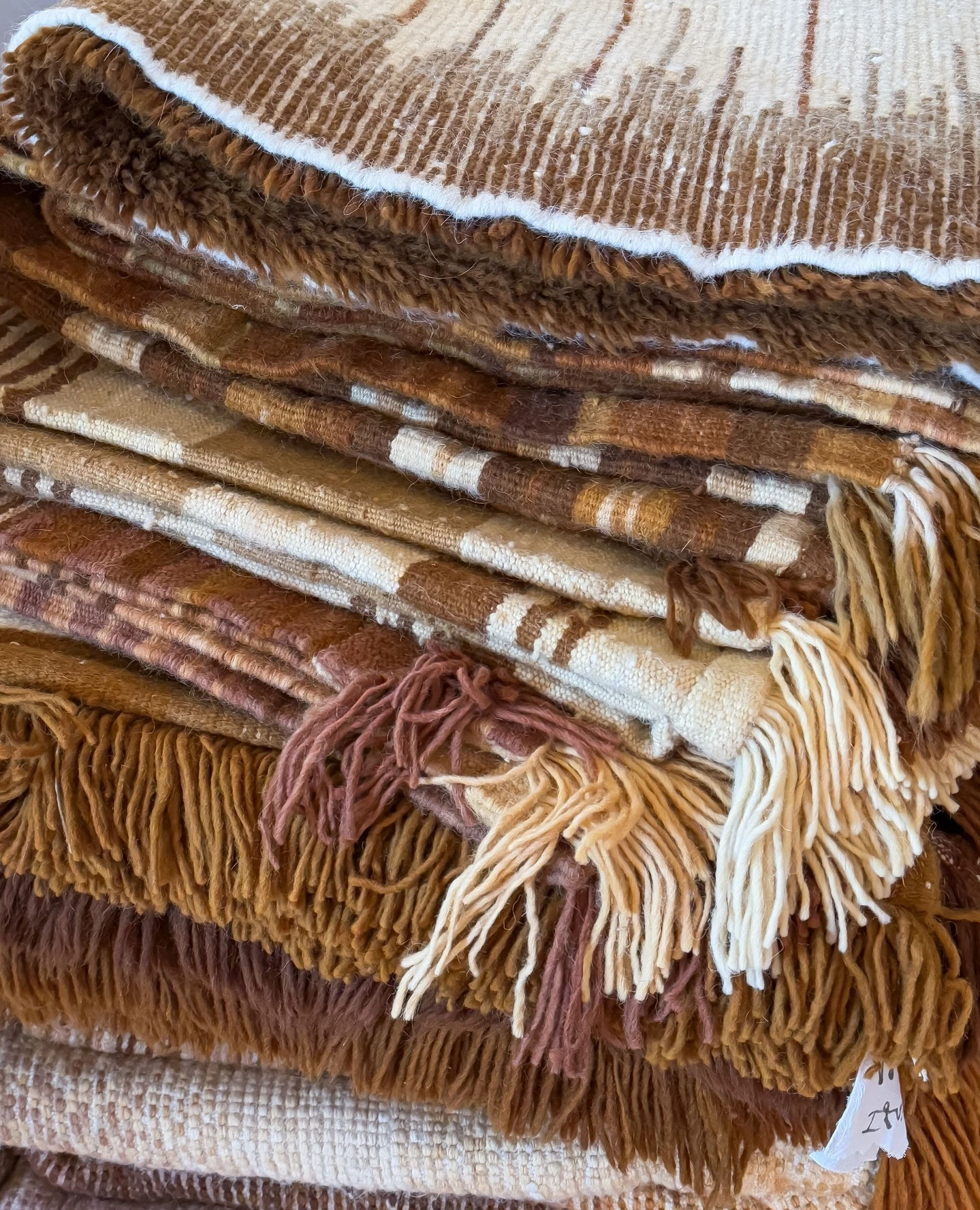
Natural dyes produce colors with a depth and warmth that synthetic alternatives cannot fully replicate. The slight tonal variations across a field of color are characteristic.
Understanding Price: What Drives Value ↑ Contents
Moroccan rug prices are not arbitrary, even when they feel that way. Several concrete factors determine what a piece is actually worth. Knowing them gives you a framework for evaluating whether a quoted price is reasonable or inflated.
| Factor | What to Look For | Impact on Price |
|---|---|---|
| Size | Measured in square meters. A 3x2m piece takes roughly 3x the time and materials of a 2x1m. | Linear: largest single driver of price |
| Knot Density | Count knots per 10cm along the warp. Rabati urban rugs: 80-120+. Tribal pile: 20-50. Higher = more time and skill. | High: doubles or triples value at same size |
| Wool Quality | Highland wool from older sheep is silkier and more durable. Ask if it is “laine de montagne” (mountain wool) or “laine d’agneau” (lamb wool, softer but less durable). | Medium-High |
| Natural Dyes | Plant and mineral-based dyes require more time and knowledge to apply correctly. A fully naturally dyed piece commands a meaningful premium. | Medium: roughly 20-40% over synthetic equivalent |
| Age | Genuine antique rugs (50+ years) are rare in medina shops. Most “old” pieces are 10-30 years. True antiques require documentation. | High when genuine; often fabricated |
| Regional Provenance | Beni Ourain and Azilal command a global premium. Zanafi and Boucherouite are undervalued relative to quality. | Variable: market-driven |
As a general orientation for 2024-2025 market prices in Moroccan dirhams: a small authentic Beni Ourain (1×1.5m) realistically starts around 1,500-2,500 MAD for a modern piece. A medium Azilal (2×1.5m) with natural dyes runs 3,000-6,000 MAD. Large, high-density Rabati urban carpets can reach 15,000-40,000 MAD for genuinely fine examples. If you are being quoted significantly above these ranges for equivalent pieces, the premium is either justified by exceptional quality or it is a tourist markup. If you are being quoted significantly below, examine the piece closely. Before any shopping trip, confirm you understand what currency Morocco uses and the current exchange rate, since quoted prices frequently shift between dirhams and euros mid-conversation as a disorientation tactic.
How to Negotiate Without Losing Ground ↑ Contents
Negotiation in Moroccan souks is not confrontational it is relational. The seller is not trying to defeat you; they are trying to find the highest price you will genuinely pay. Your task is not to win, but to establish your real limit and hold it patiently. The following sequence works consistently.
Familiarizing yourself with the broader landscape of commercial pressure tactics used in Moroccan tourist environments is genuinely useful preparation. The complete guide to tourist scams in Morocco covers the specific scenarios you are most likely to encounter, including the rug-shop dynamics described in the next section.
Red Flags and Tactics to Know ↑ Contents
The rug business in Moroccan tourist cities operates a number of well-documented pressure tactics. Knowing them in advance removes their power entirely. None of them represent dishonesty unique to Morocco; they are universal sales techniques applied in a specific cultural context. The appropriate response to any of them is calm, unhurried distance.
Where to Buy in Morocco ↑ Contents
Geography matters when buying rugs in Morocco. Prices and authenticity vary significantly depending on where in the country you shop. As a general rule, the closer you buy to the region of origin, the better the price and the more likely the piece is genuinely local.
Marrakech has the highest volume of rug sellers and the most competitive prices, but also the most tourist-oriented merchandise. The Ensemble Artisanal, a government-operated craft center, operates with fixed prices and no negotiation, which makes it a useful benchmarking tool even if you ultimately buy elsewhere. The souks near the Dyers’ Quarter (souk Semmarine and souk des Tapis) have the widest selection.
Azilal is the origin point for Azilal-style rugs and buying there or in nearby villages eliminates the entire chain of intermediaries. The quality available directly from weavers is often significantly higher than what reaches Marrakech. If you are traveling through the High Atlas, this detour pays for itself.
Midelt and Khenifra in the Middle Atlas are the heartland of Beni Ourain production. Rugs here are sold by the women who make them or by first-generation intermediaries, and the prices reflect that proximity.
Fes is the center of Rabati-style urban carpet production and has established workshops where you can watch the knotting process firsthand and buy directly from the producer. The major cities of Morocco each have their own textile character, and knowing which city produces which type before you arrive allows you to plan accordingly.
Shipping and Customs: Getting It Home ↑ Contents
A rug purchased in Morocco needs to reach your home country without incident. The logistical considerations are manageable but worth planning in advance.
Carry-on and check-in baggage. Small and medium rugs (up to roughly 2×1.5m) can be rolled tightly and checked as oversized luggage or strapped to a suitcase. Carriers charge variable fees for oversized bags; confirm with your airline before departure. A tightly rolled medium rug typically weighs 4-8 kg.
International shipping from Morocco. Maroc Poste (Moroccan postal service) offers international shipping that is affordable but slow, with variable reliability for high-value items. DHL, FedEx, and TNT all operate in Morocco and offer tracked, insured shipping that is significantly more expensive but appropriate for a rug worth several hundred or several thousand euros. Expect 5-10 business days for Europe, 7-14 for North America.
Customs duties. Most countries allow personal import of handicrafts up to a certain value without duty. In the EU, items under 150 EUR enter without import duty (VAT may still apply). In the US, the personal exemption is $800. A genuine Berber rug is classified as a handmade textile and is generally treated favorably at customs. Keep your purchase receipt; it establishes the declared value and confirms origin.
If the seller offers to ship for you, the safest procedure is to photograph both the rug and the packaging before it leaves your sight, retain all shipping documentation, and use only internationally tracked services. The risk of substitution a cheaper rug sent in place of the one you purchased is real enough to warrant these precautions.
Frequently Asked Questions ↑ Contents
What is the difference between a Berber rug and a Moroccan rug? ▾
The terms are often used interchangeably but they are not identical. “Moroccan rug” covers the full range of carpet traditions produced in Morocco, including urban styles like the Rabati. “Berber rug” refers specifically to textiles made by Amazigh (Berber) communities, which include tribal styles like Beni Ourain, Azilal, Boucherouite, and Zanafi. All Berber rugs are Moroccan rugs; not all Moroccan rugs are Berber. The distinction matters when evaluating quality and provenance claims.
How do I know if a rug is genuinely old? ▾
Genuine antique rugs are rare in typical souk shops and should be approached with significant skepticism without proper documentation. Signs of natural age include even fading across the entire surface (not just in sun-exposed areas), slight brittleness at the edges of pile fibers, a worn but uniform patina on the back, and natural color mellowing rather than the sharp, vivid tones of a recent synthetic dye. Artificially aged rugs are common; they are washed with chemicals or left in sunlight to simulate fading. If a seller claims significant age and prices accordingly, ask for documentation. If none is available, price the piece as a modern item.
Is it acceptable to bargain aggressively in rug shops? ▾
Negotiation is entirely expected and no offense is taken by measured counter-offers, even significant ones. What is considered rude is not the level of your counter-offer but the manner of delivery. A low offer made calmly and respectfully is received differently than the same offer made dismissively or with mockery. The practice of negotiation in Moroccan commercial culture is a social ritual; participating in it correctly patiently, without aggression, and with genuine respect for the craft is appreciated even when the deal does not close.
What do the symbols on Berber rugs mean? ▾
Berber textile symbolism is a complex and partially contested field. Many symbols are clan or family-specific and do not have universally agreed meanings. Common recurring motifs include the diamond lozenge (often associated with the eye, femininity, or protection), zigzag lines (representing water or serpents), and cross-like forms (sometimes linked to the cardinal directions or stars). Sellers will frequently offer confident interpretations; these are often simplified or invented for tourist consumption. The honest answer from any serious scholar is that many meanings are local, contextual, or simply lost to time.
Should I buy from a cooperative versus a private shop? ▾
Legitimate women’s cooperatives, particularly in rural areas like Azilal, Ouarzazate, and the Souss-Massa valley, offer authentic pieces at fair prices with transparent proceeds going directly to the makers. These are among the best places to buy in Morocco. However, “cooperative” is also used as a label by commercial operations that have no cooperative structure; the word alone does not guarantee authenticity or ethical trading. Verify that the space actually shows weaving in progress or has demonstrably local production, rather than simply using the label.
How do I care for a Moroccan wool rug after bringing it home? ▾
Natural wool pile rugs should be shaken rather than beaten, vacuumed on low suction without a rotating brush head, and dry-cleaned for any significant soiling. Spot cleaning with cold water and mild soap is acceptable for small stains. Avoid extended direct sunlight exposure, which will fade natural dyes unevenly. Flat-woven kilims are more robust and many can be hand-washed in cold water and air-dried flat. Boucherouite pieces with mixed fabric content should be spot-cleaned only. A rug pad underneath is worth the investment as it prevents slippage and reduces wear on the foundation fibers.
The finest Moroccan rugs are not cheap, and they should not be. A hand-knotted Beni Ourain from a skilled weaver in the Middle Atlas represents weeks of work, generations of transmitted technique, and materials sourced from a specific landscape. Paying fairly for that is not naivety; it is judgment.
The goal of preparation is not to extract the lowest possible price. It is to ensure the price you pay corresponds to what you are actually receiving. An authentic, well-made Moroccan rug bought at a fair price is one of the most durable and rewarding souvenirs you can carry out of the country. A machine-made imitation bought at a price that seemed like a triumph is likely to remind you of that transaction every time you look at it.
Go slowly. Handle many pieces before committing. Ask questions and notice the quality of the answers. The knowledge in this guide gives you the tools; the rest is patience and attention, which are, as it happens, the same qualities that go into making the rugs worth buying in the first place.
For a broader picture of what to expect navigating commercial environments in Morocco, the guide to common tourist scams in Morocco is worth reading before your trip. And if you are still building your itinerary, a look at Morocco’s geography and regions will help you plan which weaving traditions you are most likely to encounter along your route.

Can you provide guidance to help me choose a suitable rug?
Thank you moroccantraveltrips! These are super helpful tips for buying a rug on your own in Morocco. I would have loved to see some rug examples with prices on your website though!