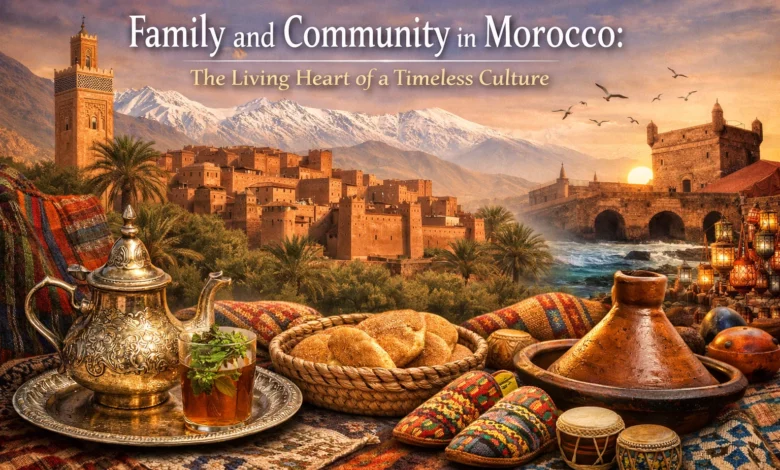
Family and Community in Morocco:
The Living Heart of a Timeless Culture
Beneath the golden light of every Moroccan medina, behind every carved cedar door, life revolves around something deeper than any landmark or souvenir — it revolves around people.
When travelers first set foot in Morocco, they are often captivated by the sensory richness of its imperial cities — the call to prayer drifting over labyrinthine alleys, the scent of cumin and rose water mingling in the souks, the kaleidoscope of hand-painted tilework. But spend more than a few days here and something less obvious begins to reveal itself: the extraordinary warmth and cohesion of family and community in Morocco. It is not just a cultural trait — it is the very architecture of Moroccan life.
Morocco is a country where the idea of the individual is always understood in relation to something larger — the family, the neighborhood, the tribe, the nation. This is not merely a legacy of tradition; it is a living, breathing reality that shapes everything from how meals are prepared to how business decisions are made, from wedding ceremonies that last three days to the quiet ritual of tea shared between neighbors every afternoon.
“In Morocco, you are never truly alone — the family is the first community, and the community is the extended family.”
The Moroccan Family Unit: A Multigenerational Bond
At the center of Moroccan society sits the family — not simply the nuclear unit familiar to many Western visitors, but a broad, multigenerational network that includes grandparents, uncles, aunts, cousins, and in-laws, all woven together by shared obligations, deep affection, and a strong sense of collective identity.
It remains common, particularly outside the largest urban centers, for multiple generations to share the same home or to live within walking distance of one another. Grandparents are not placed in care facilities — they are central figures in the household, consulted for wisdom, honored at every family gathering, and present in the daily rhythms of life. Children grow up surrounded by relatives at every turn, learning early that responsibility and loyalty extend far beyond their own household.
This structure creates a remarkable social safety net. When illness, financial hardship, or personal crisis strikes, the family mobilizes. There is no need to navigate bureaucratic systems alone when brothers, sisters, and cousins can offer practical support within hours. This deeply human network is one reason why family and community in Morocco are so resilient, even in the face of rapid modernization.
The Role of the Father and Mother
Traditionally, the father has held the role of provider and protector, the anchor of the household’s public identity. Yet any honest look at Moroccan domestic life will quickly reveal that the mother is equally — if not more — central to its daily functioning. She manages the home with extraordinary skill, preserves culinary traditions passed down through generations, mediates disputes between siblings, and often serves as the emotional compass of the entire family.
This balance is shifting in contemporary Morocco, particularly in cities like Casablanca, Rabat, and Fes, where women increasingly occupy professional roles and public life. Yet even as gender dynamics evolve, the mutual respect and the centrality of parental authority remain defining features of Moroccan family culture.
Children: Cherished and Celebrated
Children hold a place of extraordinary warmth in Moroccan culture. The birth of a child — particularly the first — is an occasion for communal celebration, with rituals such as the aqiqa (the naming ceremony) bringing extended family together to give thanks and welcome the new soul into the community. Children are rarely left to entertain themselves in isolated bedrooms; they are part of the family’s social life, present at dinners, celebrations, and even business conversations from a very young age.
Moroccan Hospitality: When Community Means Welcoming Strangers
One of the most striking expressions of the communal spirit in Morocco is its legendary hospitality — d-diyafa in Darija, the Moroccan dialect of Arabic. The concept goes far beyond offering a comfortable guest room. To welcome a guest in Morocco is a moral and cultural duty, a source of pride, and an extension of the very values that bind families and communities together.
Visitors who have been invited into a Moroccan home — something that happens with surprising frequency for curious, respectful travelers — often describe the experience as transformative. Tables that seemed modest suddenly expand with dishes: harira soup, pastilla, tagine, couscous with seven vegetables, a cascade of sweets with mint tea. The question is never whether there is enough food; it is always whether the guest has eaten enough.
This hospitality is not performative. It is a natural overflow of a culture in which generosity toward others — especially toward those who are far from home — is considered among the highest of virtues. If you are wondering whether Morocco is safe and welcoming for tourists, the answer is almost invariably yes — and this warmth is inseparable from the family-centered values that define Moroccan society.
Key Elements of Moroccan Community Life
- The Mosque: Far more than a place of prayer, the neighborhood mosque anchors social life, hosts community meetings, and remains a reference point for collective identity.
- The Hammam: The traditional bathhouse serves as a social institution — a place to meet neighbors, share news, and maintain community bonds across generations.
- The Souk: Weekly markets bring villages together in a dance of commerce, conversation, and connection that has remained remarkably consistent for centuries.
- The Moussem: Annual festivals celebrating local saints bring entire regions together in music, prayer, trade, and collective joy.
- The Derb: The narrow residential streets of the old medinas form micro-communities where neighbors share entrances, celebrate weddings together, and support one another through difficulty.
Ramadan and the Collective Rhythm of Faith
Nowhere is the communal character of Moroccan life more powerfully on display than during the holy month of Ramadan. The entire country moves to a shared rhythm: the stillness of the fasting hours, the anticipation building as sunset approaches, and then the extraordinary burst of life at the sound of the cannon — l-madfa — that signals the time to break the fast.
Iftar, the evening meal that breaks the fast, is almost always a family affair. Plates of harira, chebakia, dates, and msemen appear on the table as families gather — often the largest gathering of the week. After the meal, the streets come alive in a way that surprises first-time visitors: children playing late into the night, neighbors sitting outside on plastic chairs, the sound of Quran recitation drifting from nearby mosques, mtaqa (traditional orchestra) music echoing through the alleys of the old city.
Ramadan reveals something essential about family and community in Morocco: the country is most fully itself when it is gathered together.
“The derb — the intimate alley of the old medina — is not just architecture. It is a living metaphor for how Moroccans understand community: close, protective, and always open to those who belong.”
Moroccan Weddings: Community as Celebration
If you want to understand the depth of community life in Morocco, attend a traditional wedding — or at least pass by one. Moroccan weddings are three-day events that involve not just the immediate families but the entire neighborhood, extended clan, and sometimes the whole village. The bride’s procession through the streets — carried on an amaria (a decorated litter) to the sound of Andalusian music or Gnawa drumming — is a public ceremony, a moment in which the whole community bears witness.
The sheer scale of preparation — the embroidered kaftans, the elaborate henna ceremony, the couscous prepared in enormous pots for hundreds of guests — reflects a culture that measures celebration in collective terms. Joy, in Morocco, is always most meaningful when shared.
Urban and Rural Community Life: Two Faces of the Same Value
Morocco’s rapid urbanization over the past few decades has changed many things, but it has not erased the communal spirit. In the country’s major cities, family networks adapt rather than dissolve. Cousins become flatmates; the weekly family couscous lunch on Friday remains a near-sacred institution even among young professionals; WhatsApp groups keep extended families in constant contact across distances that would once have required weeks of travel.
In rural Morocco — in the Rif mountains, the Souss plains, the pre-Saharan oases — the communal structures are even more visible. The village council, the collective management of water resources, the cooperative harvesting of argan nuts or olives — all reflect a culture in which the idea of doing something entirely alone is, in many ways, foreign. People know their neighbors, their neighbors’ parents, and often their neighbors’ grandparents. This density of human connection is something that many visitors, arriving from more atomized societies, find profoundly moving.
Practical Considerations for Travelers Exploring Moroccan Community Life
Engaging with authentic family and community culture in Morocco requires a spirit of openness and a few practical preparations. If you are invited to a home or a community celebration, a small gift — sweets, pastries, or something for the children — is always appreciated. Dress modestly out of respect for local customs, particularly in more traditional neighborhoods and rural areas. And learn even a few words of greeting in Darija or Fusha (Modern Standard Arabic): Merhba bik (welcome) or Shukran (thank you) — the effort will be rewarded with wide smiles and instant warmth.
Before your journey, it helps to understand the basics of daily life in Morocco. Knowing what currency Morocco uses — the Moroccan Dirham (MAD) — will help you navigate local markets and community events with ease. And if you are still deciding where this extraordinary country sits on the map, a quick look at where Morocco is located will give you a geographic sense of how North Africa, the Mediterranean world, and the Sahara converge in one place.
The most meaningful experiences of family and community in Morocco do not happen in curated tourist attractions — they happen in the flow of ordinary daily life, in teahouses and market stalls, on the steps of mosques at dusk, in the laughter spilling from a family courtyard. The key is knowing how to access these moments — and that is where a knowledgeable local guide becomes invaluable.
Book Your Experience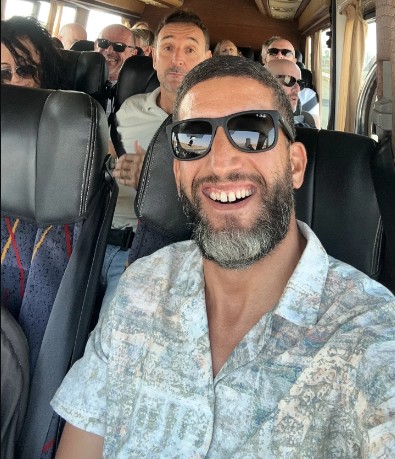
Book Directly via WhatsApp
Want to experience authentic family and community life in Morocco beyond the guidebooks? Connect directly with Mouhssine, a licensed Moroccan tour guide with over 15 years of experience crafting meaningful, human encounters across the country’s most vibrant cities and communities.
Chat on WhatsApp Licensed Guide · No Réf. 2898 · +212 671 437 971