Marrakech Desert Tours:
The Complete Planning Guide
Choose the right destination, cross the Atlas Mountains, compare the best tour types, and arrive fully prepared — for a journey that genuinely stays with you.
Why Marrakech Desert Tours Are Unlike Any Other ↑ Back
There is a particular quality of silence that exists only in the Sahara. It arrives around midnight, when the last fire has dimmed and the dunes have absorbed the warmth of the day, leaving the sky impossibly clear and the world impossibly still. Marrakech desert tours offer the rare privilege of moving from one of the world’s most vibrant cities to one of its most humbling landscapes — all within a single day’s drive.
Morocco occupies a unique position on the world map: it is the only country where travelers can stand on Atlantic beaches, walk through medieval medinas, cross snow-capped Berber mountain passes, and sleep beneath the stars of the Sahara — all within the span of a week. If you are still asking yourself where Morocco is and what makes it so extraordinary as a destination, that curiosity alone suggests this country will far exceed your expectations.
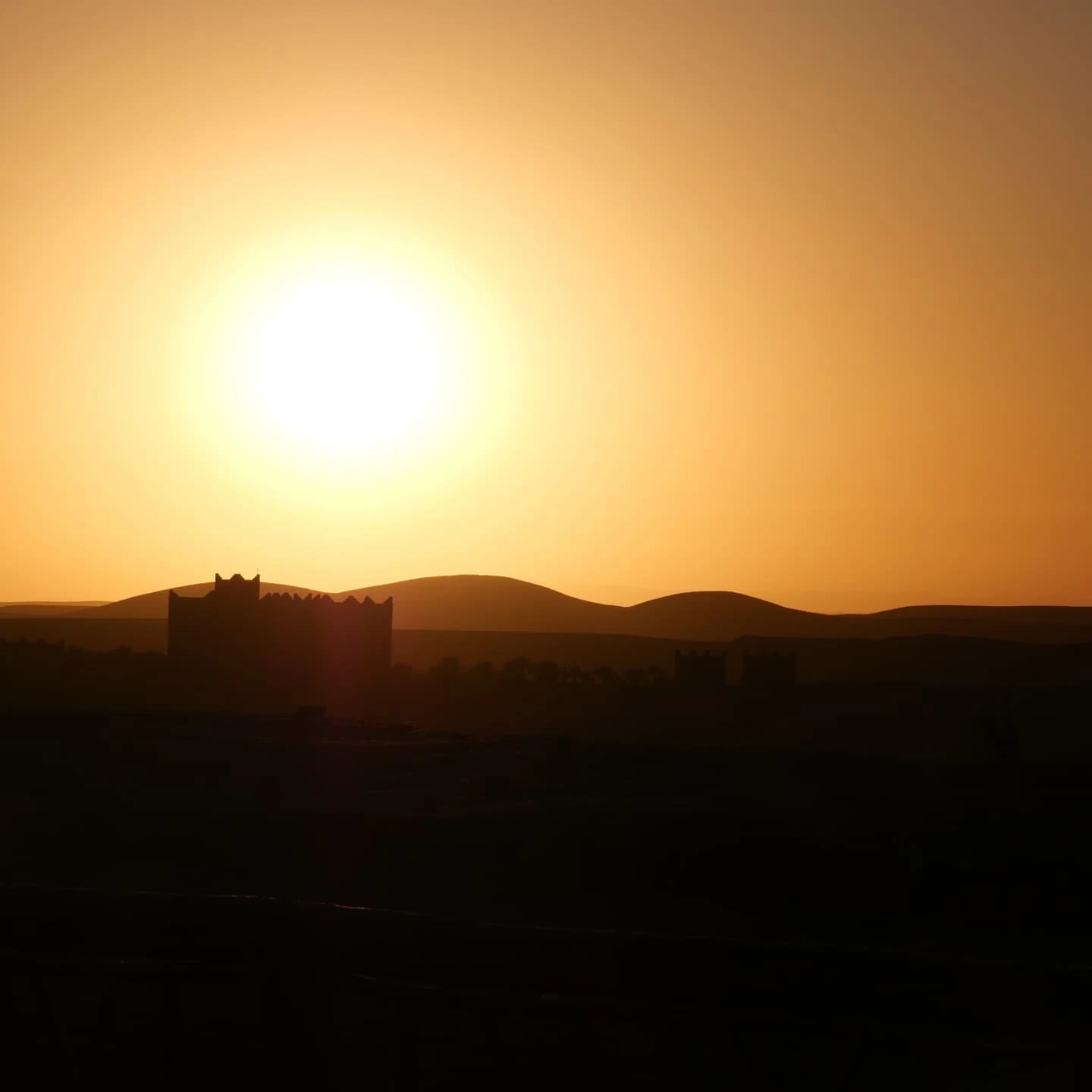
The Sahara at first light — a sight no photograph quite prepares you for.
But planning that journey requires more than booking a seat on a shared minivan. The choice of destination, the format of the tour, the timing of the trip, and the quality of your guide will determine whether you return with a story worth telling — or merely a collection of photographs that fail to capture what you felt. This guide exists to make that difference.
Merzouga vs. Zagora vs. Agafay: Choosing Your Desert ↑ Back
Morocco presents travelers with three genuinely different desert experiences at three very different distances from Marrakech. Each serves a different kind of traveler and a different kind of schedule.
Erg Chebbi — Merzouga
The iconic golden dunes rising up to 150 m above the Saharan plain. This is the true, vast, cinematic Sahara — one of Morocco’s largest erg formations, with a scale that smaller deserts simply cannot replicate.
Min. stay: 3 days recommended
Most Authentic SaharaErg Chigaga — Zagora
A genuine dune field, smaller in scale but remote and wild. The surrounding Drâa Valley palm groves and kasbahs add a distinctly different visual character. Fewer tourists than Merzouga village.
Min. stay: 2 days comfortable
Best Mid-Range ChoiceAgafay Desert
A rocky, lunar plateau — not the Sahara, but dramatic and scenic with exceptional luxury camp infrastructure. The Atlas Mountains backdrop makes it genuinely beautiful for short escapes.
Min. stay: Day trip or overnight
Best for Short Stays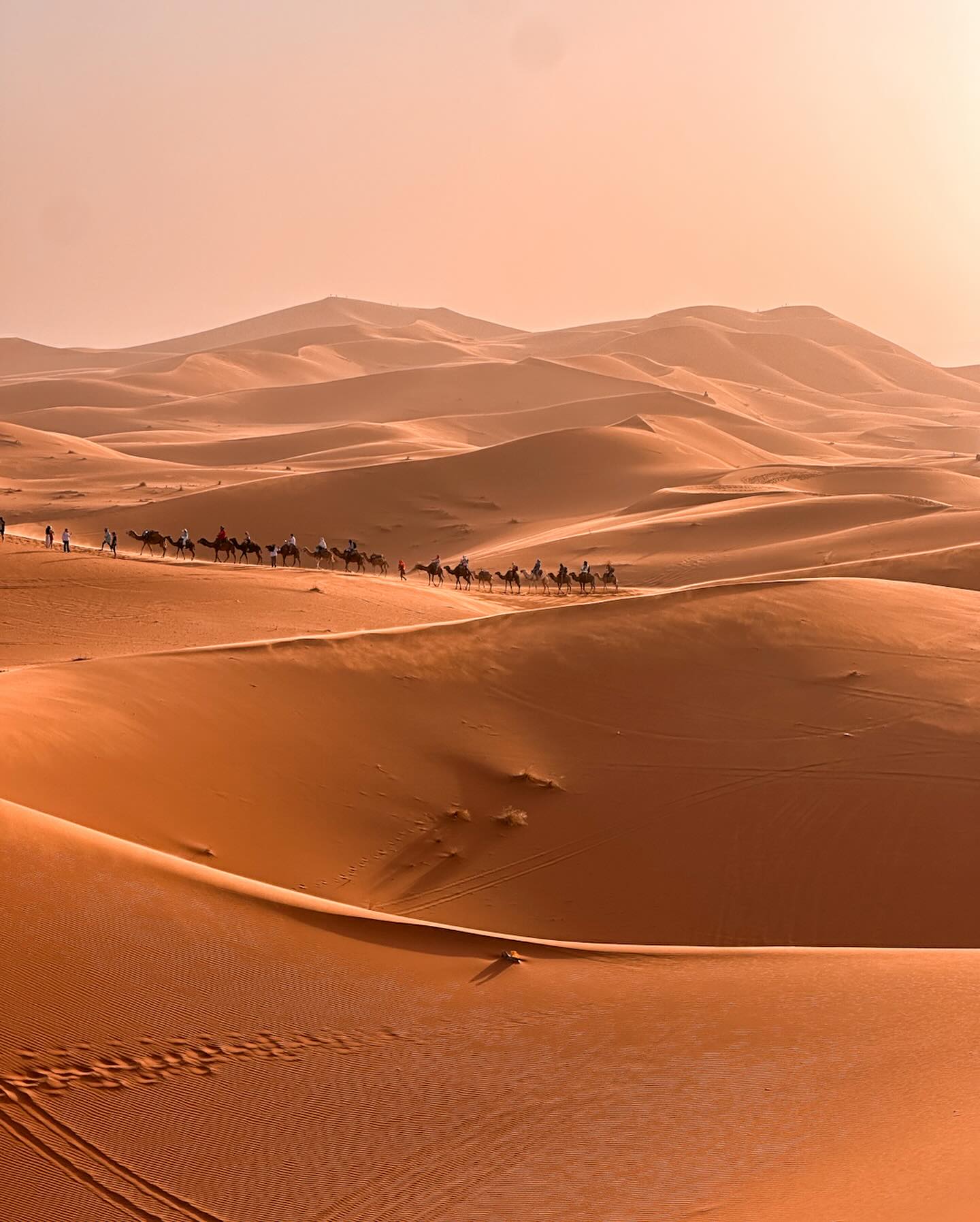
Erg Chebbi, Merzouga — the real Sahara
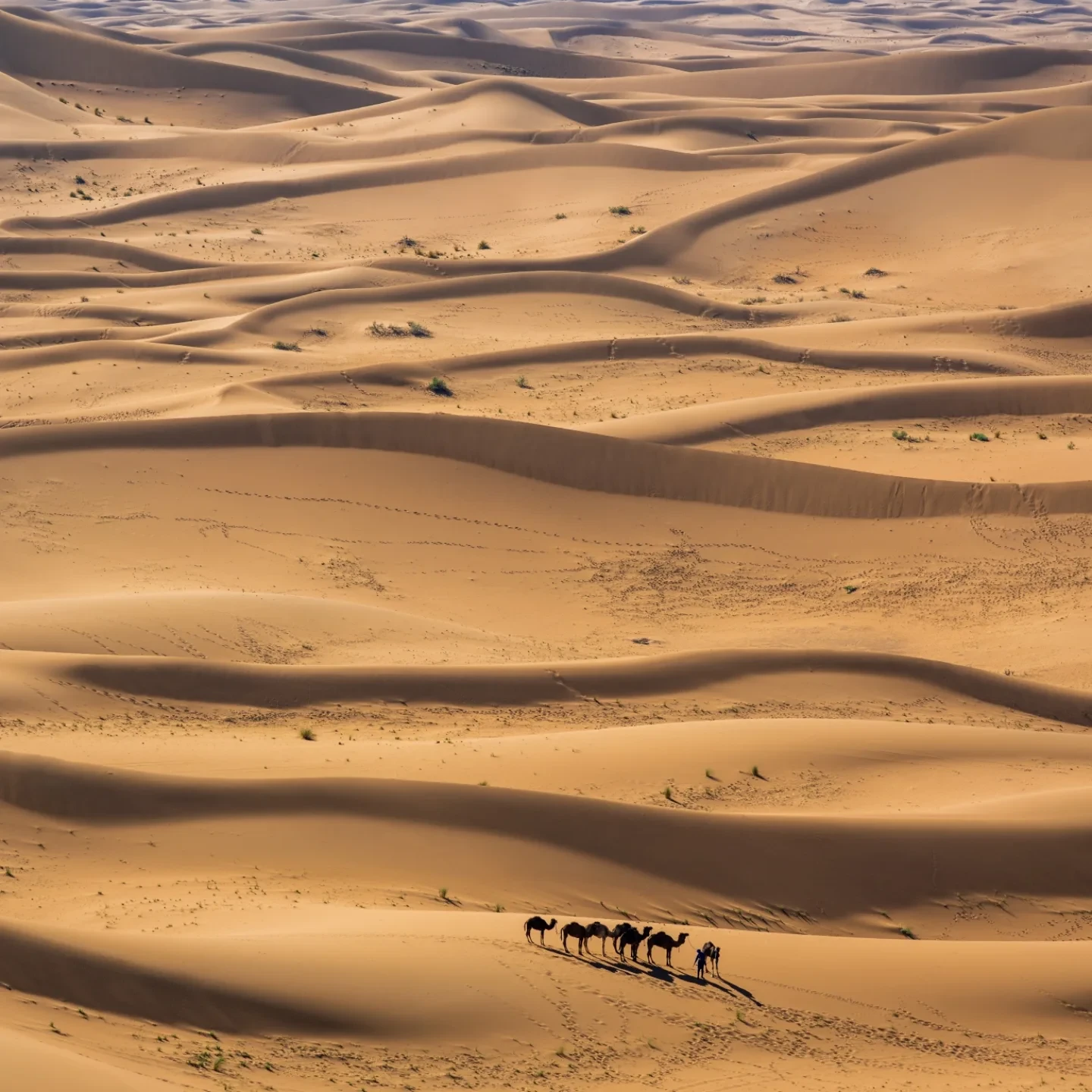
Erg Chigaga, Zagora region
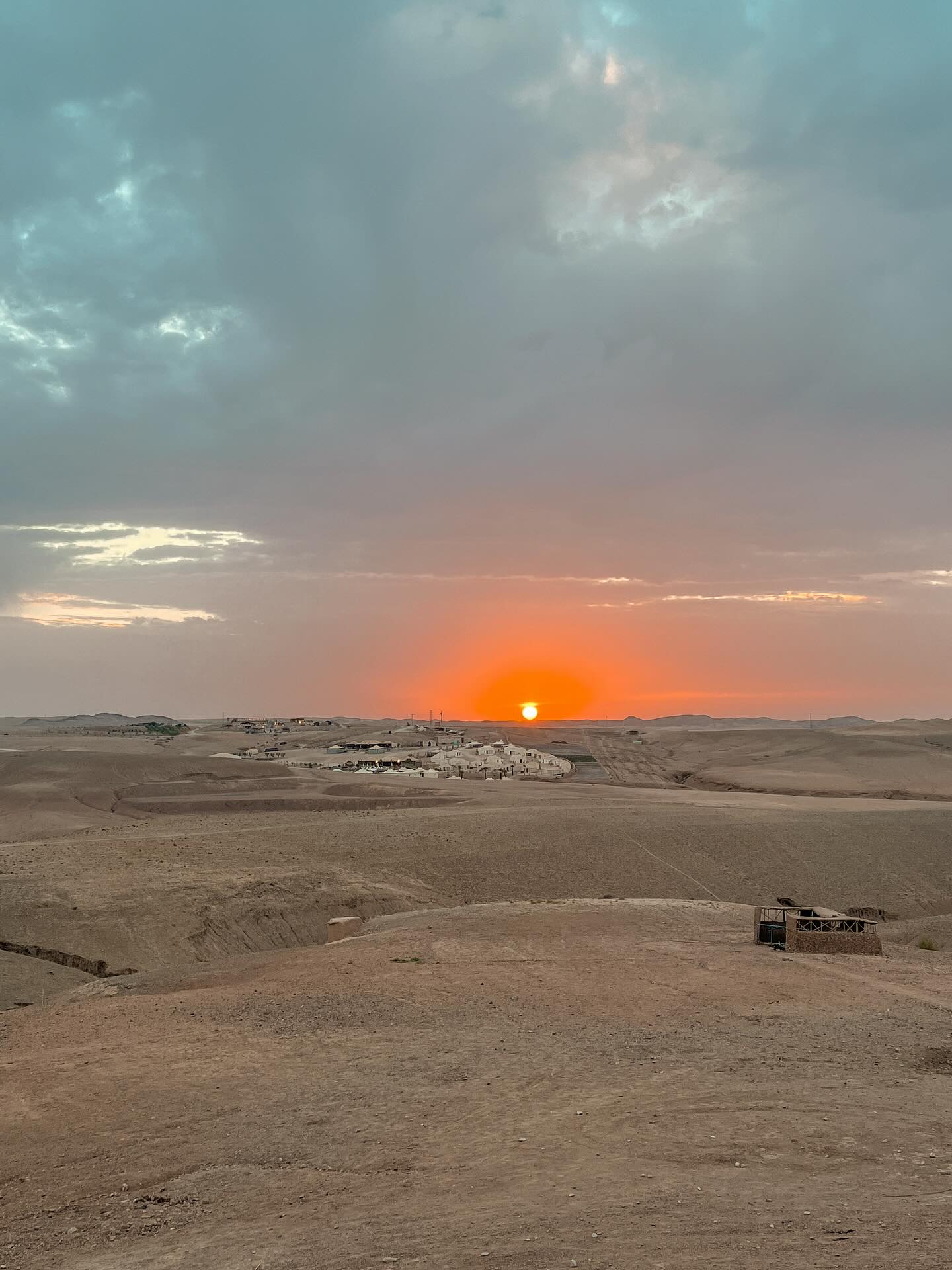
Agafay Desert — 55 km from Marrakech
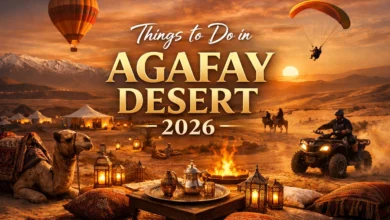
The things to do in Agafay Desert — from quad biking across the plateau to stargazing dinners at luxury camps — make it one of the most accessible and refined short escapes from the city. But it belongs in a separate category from the Sahara, a distinction explored in detail below.
Zagora vs. the Real Sahara: An Honest Comparison ↑ Back
This is the question most travel articles gloss over with a diplomatic “both are beautiful.” It deserves a far more direct answer — because the difference between Zagora and the real Sahara (Erg Chebbi near Merzouga) is significant, and understanding it before you book could completely change your experience.
What “the Real Sahara” Actually Means ↑ Back
The Sahara is the world’s largest hot desert, stretching across eleven countries from Morocco’s eastern border to the Red Sea. Within Morocco, it manifests most dramatically at Erg Chebbi — a massive field of wind-sculpted dunes near the village of Merzouga. These dunes reach heights of up to 150 metres, forming a shifting landscape of extraordinary scale: rippled ridgelines that change shape overnight, valleys between peaks deep enough to swallow entire caravans, and a silence so complete it becomes its own sound.
This is what travelers who picture “the Sahara” are actually imagining: an ocean of golden sand vast enough to walk for hours without seeing another person, deep enough to absorb every sound, and clear enough at night to reveal the full sweep of the Milky Way from horizon to horizon. Erg Chebbi delivers that experience. Fully, and without reservation.
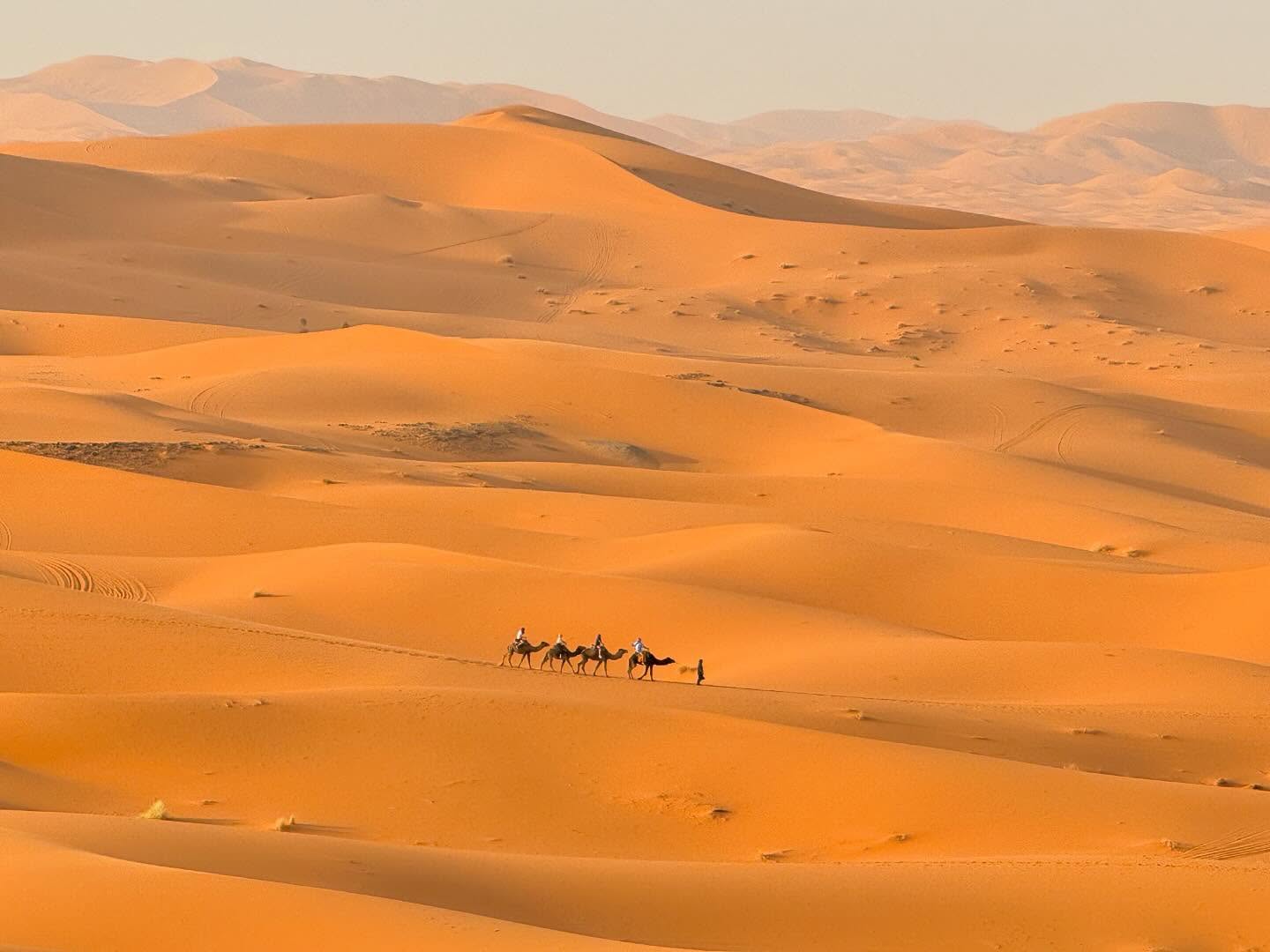
The scale of Erg Chebbi cannot be captured in a single photograph — it must be walked to be understood.
What Zagora Actually Offers ↑ Back
Zagora itself is a town in the Drâa Valley, approximately 370 km south of Marrakech. The desert experience associated with “Zagora tours” most often refers to Erg Chigaga — a remote dune field located another 60 km beyond the town, accessible only by 4×4 across an unpaved piste. Erg Chigaga is authentic, wild, and genuinely beautiful. But it is significantly smaller than Erg Chebbi, and its dunes — reaching 40 to 50 metres — do not replicate the monumental scale of the great Saharan erg.
A further complication: many budget Zagora tours skip Erg Chigaga entirely and instead stop at Erg Lihoudi, a modest cluster of small dunes just outside the town itself — perhaps 20 to 30 metres high. These dunes photograph adequately, but they are emphatically not the Sahara in any meaningful sense. A traveler who arrives expecting the vast grandeur of the great ergs and finds Erg Lihoudi will feel — not unreasonably — that they have been misled. Always ask your tour operator precisely which dunes are included, and how you will access them.
Zagora vs. Merzouga: A Detailed Side-by-Side ↑ Back
| Criteria | Zagora / Erg Chigaga | Merzouga / Erg Chebbi |
|---|---|---|
| Distance from Marrakech | ~370 km (5–6 hrs driving) | ~560 km (8–10 hrs driving) |
| Dune height | 40–50 m (Erg Chigaga) / ~20 m near town | Up to 150 m — among Morocco’s tallest |
| Dune field scale | Moderate — walkable across in a few hours | Vast — requires camel or 4×4 to explore fully |
| Tourist density | Lower — especially at Erg Chigaga | Moderate near village; remote further in the erg |
| Accessibility | Erg Chigaga: 4×4 or camel (60 km from town) | Dunes begin immediately at the village edge |
| Minimum trip duration | 2 full days from Marrakech | 3 full days from Marrakech (recommended) |
| Scenic route highlights | Drâa Valley palmeraie, rose fields, Agdz Kasbah, Tamegrout | Aït Benhaddou, Dadès Gorges, Todra Gorge, Skoura oasis |
| Camel trekking depth | Good — modest dune field allows easy access | Outstanding — multi-hour treks into deep erg possible |
| Stargazing quality | Excellent (low light pollution) | Outstanding — darker skies, more remote horizon |
| Photography potential | Good — intimate textures, golden oasis light | Exceptional — monumental scale, classic Saharan imagery |
| Wildlife & nature | Desert foxes, migratory birds in Drâa Valley | Fennec fox, horned viper, Saharan sparrow, sand dune scorpion |
| Best suited for | Travelers with 2 days; those prioritizing solitude over scale | Travelers seeking the complete, iconic Saharan experience |
And Where Does Agafay Fit? ↑ Back
Agafay Desert — despite being marketed as a “desert near Marrakech” — is categorically not the Sahara, nor a dune desert of any kind. It is a scenic rocky limestone plateau approximately 55 km from the city, with the snow-capped Atlas Mountains as its backdrop. It is not in the same category as Merzouga or Zagora, and no serious comparison should imply otherwise. That said, the things to do in Agafay Desert — horseback riding, quad biking, luxury glamping, hot air ballooning, and sunset dinners — make it one of the finest short-break destinations in all of Morocco for travelers with limited time.
Best Marrakech Desert Tours: Which Type Suits You? ↑ Back
Not all Marrakech desert tours share the same format — even when they share the same destination. The choice between a private custom tour, a classic 3-day circuit, a luxury expedition, or a quick escape shapes your experience as much as the destination itself. Here is an honest breakdown of the six main tour formats and the traveler each one genuinely serves.
Private Custom Desert Tour
A fully tailored itinerary with a licensed guide, private 4×4, and the flexibility to stop wherever the landscape demands it. Accommodation ranges from boutique riads en route to authentic luxury desert camps. Includes camel trek at sunset, stargazing, Berber breakfast in the dunes, and a return route through different landscapes. This is the definitive way to experience the Sahara.
Classic 3-Day Sahara Circuit
The most popular format for first-time visitors. Depart Marrakech via Aït Benhaddou and the Dadès Gorges, overnight in a guesthouse en route, arrive at Erg Chebbi for sunset camel trek and one night in a desert camp, return via Ziz Valley and Midelt. Balanced, rewarding, and comprehensive — the gold-standard short desert journey.
Extended Atlas & Sahara Expedition
For the discerning traveler who refuses to rush. Includes deep exploration of the High Atlas villages, overnight in Aït Benhaddou, two nights in the Sahara (one night deep in the erg by camel), the historic city of Fes, or the Drâa Valley oases on the return. The complete southern Morocco experience, without compromise.
Quick Escape: 2-Day Zagora Tour
Designed for travelers with limited time who still want a genuine sand dune overnight. Departs Marrakech early morning via the Tizi n’Tichka pass and the Drâa Valley, arrives Zagora for an afternoon dune excursion, overnight in a desert camp, and returns the following day via rose valleys and palm groves. Confirm Erg Chigaga is included — not just the small dunes near town.
Agafay Luxury Day Trip
The closest desert escape from Marrakech — under one hour by car. A quad bike or horseback ride across the Agafay plateau, followed by a gourmet dinner at a luxury desert camp with Atlas Mountains views. Optional hammam and overnight glamping under the stars. A genuinely refined experience for travelers with one free day.
Sahara Photography Expedition
Crafted for photographers who want the dunes at optimal light: pre-dawn blue hour, golden sunrise from a high ridge, the Milky Way at 2 a.m. Two or more nights in the erg, timed camel treks, and guide expertise on the best dune ridgelines for each hour of natural light. One of Morocco’s most extraordinary specialist experiences.
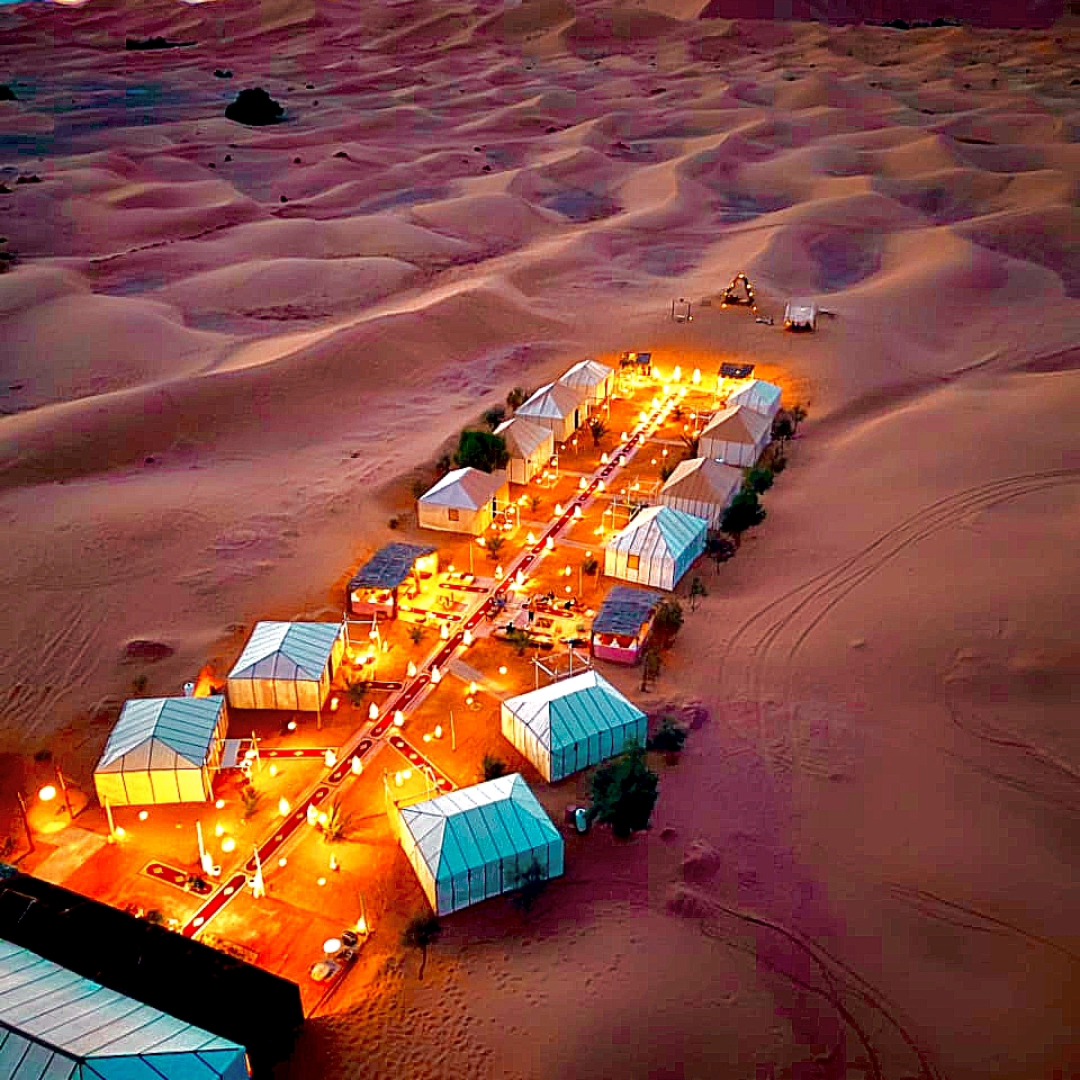
A well-chosen desert camp is as significant a part of the experience as the dunes themselves.
The Journey: Crossing the Atlas Mountains ↑ Back
The road from Marrakech to Merzouga does not simply connect two destinations — it passes through one of the most extraordinary sequences of landscapes in North Africa: the High Atlas Mountains, the UNESCO World Heritage kasbah of Aït Benhaddou, the Dadès and Todra gorges, and the pre-Saharan palm oases of Skoura and Drâa. For discerning travelers, this is precisely why an Atlas Mountains and Sahara tour is always recommended over flying directly to a desert gateway city.
Distance from Marrakech to Merzouga ↑ Back
The distance from Marrakech to Merzouga is approximately 560 kilometres via the main route through Ouarzazate, requiring 8 to 10 hours of driving with reasonable stops. The road is well-maintained on the principal arteries, though sections near the erg can be unpaved. A private vehicle with a knowledgeable driver is strongly preferable over shared transport — not for comfort alone, but because it enables the spontaneous stops that transform the journey itself into a highlight. Understanding Morocco’s geography helps enormously in appreciating just how much ground and landscape you cover on this drive.
The Tizi n’Tichka Pass ↑ Back
Departing Marrakech, the road climbs immediately into the Tizi n’Tichka pass — at 2,260 metres, the highest paved mountain pass in North Africa. The ascent through cedar forests and Berber villages, with the ochre rooftops of Marrakech receding far below, is breathtaking. In winter this pass can close with snow and ice; in spring and autumn it is at its most beautiful, with wildflowers lining the shoulders and meltwater streams catching the morning light.
Beyond the pass, the landscape transforms dramatically into a world of ochre palm valleys, fortified kasbahs, and the first hints of the desert palette — dusty rose, burnt sienna, deep shadow. By the time you reach Ouarzazate, Morocco’s gateway to the south, the air has already changed. The vegetation has thinned. The sky has expanded. You are no longer in the Morocco of medinas and street vendors.
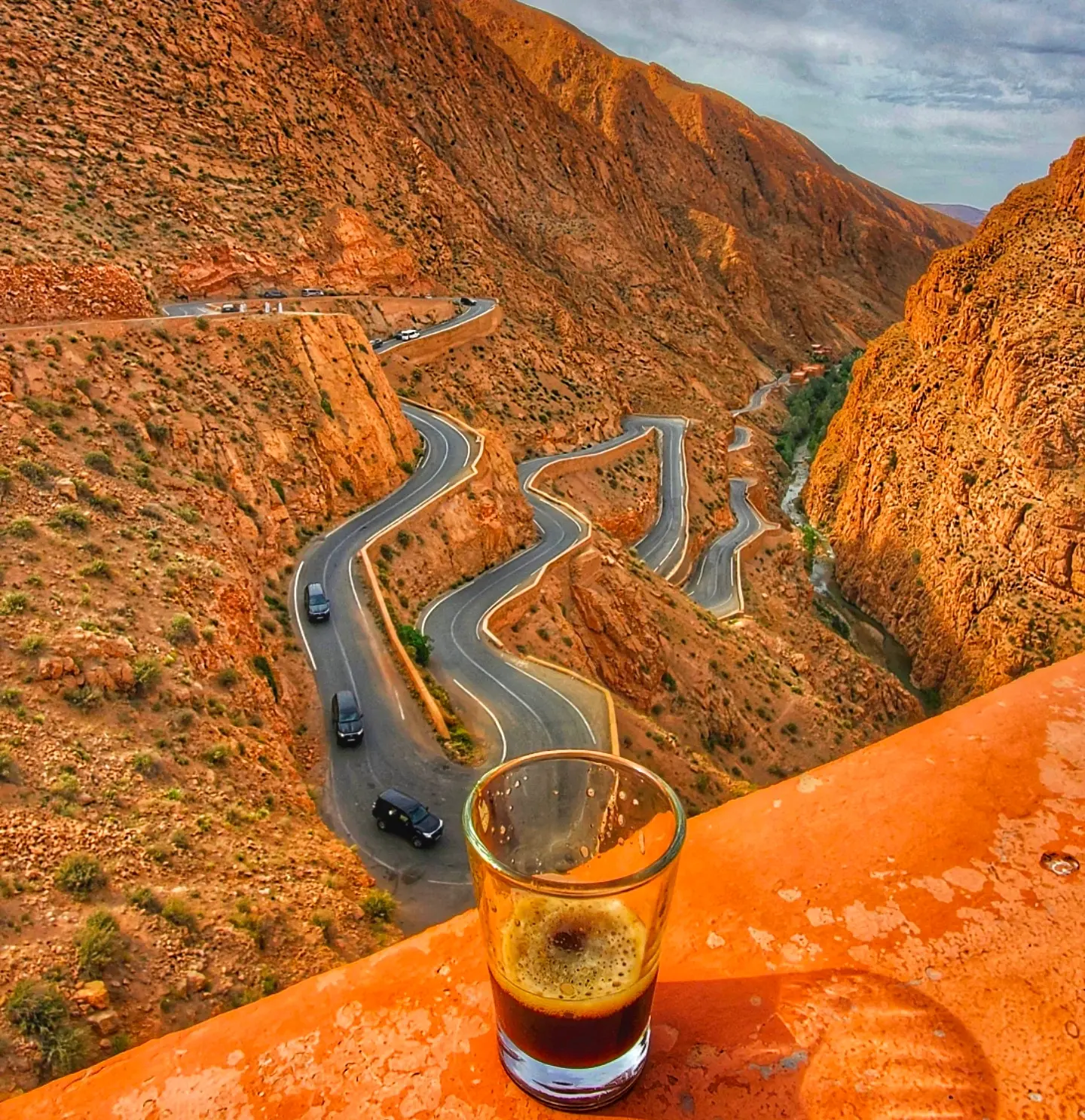
The Tizi n’Tichka pass — crossing the High Atlas is as much a part of the experience as the desert itself.
Best Time to Visit the Marrakech Desert Region ↑ Back
Timing is, quite simply, everything when planning a desert tour from Marrakech. The Sahara is a place of extremes — temperatures in July can exceed 48°C at midday, while winter nights in December can fall below freezing in the high dunes. Understanding the seasonal rhythm is essential to matching your expectations with what the desert actually delivers.
| Season | Months | Desert Temp. | Conditions | Rating |
|---|---|---|---|---|
| Spring | March – May | 20–35°C days / 10–18°C nights | Warm days, cool nights, wildflowers in the Atlas. Ideal dune conditions. Superb photography light. | Best Time |
| Autumn | Sept – Nov | 22–38°C days / 12–20°C nights | Excellent light, very comfortable temperatures, fewer crowds. Date harvest season in the southern oases. | Best Time |
| Winter | Dec – Feb | 5–22°C days / 0–8°C nights | Cold nights require thermal layers. Tizi n’Tichka may close with snow. Exceptional atmospheric clarity and dramatic desert light. | With Preparation |
| Summer | June – Aug | 38–48°C days / 22–28°C nights | Extreme midday heat. All activity limited to very early morning and evening. Not recommended for most travelers. | Avoid |
The best time to visit Marrakech desert destinations is unambiguously October through November and March through May. These months deliver the most photogenic desert light — the Saharan sun at an angle that sculpts the dunes gold and amber rather than washing them flat at midday — and temperatures that are comfortable for daytime exploration and for sleeping in a desert tent without the weight of a full winter kit.
What to Pack for a Sahara Desert Tour ↑ Back
The question of what to pack for a Sahara desert tour from Marrakech catches many first-time visitors off guard. The desert rewards thoughtful preparation and punishes improvisation. You need less than you think — but what you bring must be right.
- Lightweight, loose, long-sleeved tops for sun protection
- Convertible trousers or lightweight linen pants
- Quality fleece or down jacket for cold nights
- Traditional tagelmust (turban) or wide-brim hat
- Closed-toe shoes for dune climbing
- Sandals or flip-flops for camp evenings
- Thermal base layer if visiting in winter
- SPF 50+ broad-spectrum sunscreen
- Wrap-style UV-protection sunglasses
- SPF lip balm (desert air is very drying)
- After-sun lotion or aloe vera gel
- Fragrance-free moisturiser
- Electrolyte tablets or sachets
- Personal medications with extra supply
- Imodium, rehydration salts, antihistamines
- Small personal first-aid kit
- Headlamp with spare batteries
- Biodegradable wet wipes (showers limited)
- Microfibre towel
- Sealable zip-lock bags for electronics
- Portable power bank (essential — no mains in the erg)
- Universal adaptor (Type C/E in Morocco)
- Offline maps downloaded before departure
- Wide-angle lens for dune landscapes
- Multiple lens cloths — sand is relentless
- Star photography app (Milky Way is unmissable)
Plan Your Tour with a Licensed Moroccan Guide ↑ Back
The quality of your desert experience is directly proportional to the quality of your guide. Morocco’s Ministry of Tourism issues official licenses to professionals who meet rigorous standards of local knowledge, language proficiency, and professional conduct. Booking with a verified licensed guide is not a formality — it is the most consequential decision you will make in planning your trip.
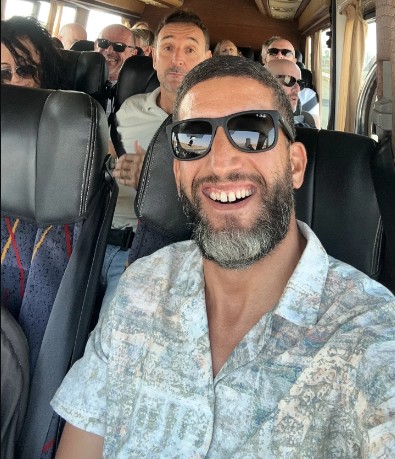
Mouhssine specializes in fully private, custom desert tours from Marrakech — Merzouga, Zagora, Agafay, and the Atlas Mountains. Every itinerary includes private transfers, hand-picked accommodation, camel treks, and cultural experiences tailored to your group’s interests and pace. All logistical details are handled — you simply arrive and experience.
Merzouga (Erg Chebbi) is the right choice if you have 3 or more days and want the most dramatic, large-scale Saharan experience — dunes up to 150 metres, vast enough to walk for hours without encountering another traveler. Zagora (Erg Chigaga) suits travelers with only 2 days who still want authentic sand dunes. Be aware that some budget Zagora tours only visit the small Erg Lihoudi dunes near town (only 20–30 m high) rather than the more remote Erg Chigaga — always confirm which dune field is included. For travelers with just one day, Agafay Desert near Marrakech is beautiful and accessible, but it is a rocky plateau rather than sand dunes.
The real Sahara in Morocco most accurately refers to Erg Chebbi near Merzouga — a vast field of golden dunes up to 150 m high, with the scale and remoteness most travelers imagine when they picture the Sahara. Zagora-based tours typically access Erg Chigaga (dunes of 40–50 m, 60 km outside the town via 4×4), or occasionally the much smaller Erg Lihoudi dunes near the town itself. Zagora via Erg Chigaga is a genuine and wild desert experience — but it is smaller in scale and does not replicate the monumental sweep of the great ergs. If towering horizon-filling dunes are your vision, Merzouga is the right destination. If you value remoteness over sheer scale and have only two days, Zagora (Erg Chigaga) is a legitimate and beautiful choice.
The distance from Marrakech to Merzouga is approximately 560 kilometres via Ouarzazate and the Drâa-Tafilalet region. Driving time is typically 8–10 hours without extended stops. Most organized tours break this over two days, overnighting in the Dadès Gorges or Tinghir — allowing time to visit Aït Benhaddou UNESCO kasbah, the Skoura palm grove, and the Todra Gorge along the route, and ensuring you arrive at the desert genuinely refreshed.
The best time to visit Marrakech desert destinations is spring (March–May) and autumn (September–November). These months offer comfortable daytime temperatures of 20–35°C, cool nights, superb desert light for photography, and manageable Atlas mountain crossing conditions. Summer (June–August) should be avoided due to extreme heat exceeding 45°C in the Sahara. Winter visits are rewarding for those prepared for cold nights and potential Atlas pass closures.
Essential packing for a Sahara desert tour includes: lightweight long-sleeved clothing for sun protection; a fleece or down jacket for cold desert nights; SPF 50+ sunscreen and UV sunglasses; a turban or wide-brim hat; closed-toe shoes for dune climbing; a headlamp; a portable power bank; electrolyte supplements; and sealable bags to protect cameras and electronics from fine desert sand. Carry a 30–40L personal backpack with overnight essentials separate from your main luggage, which may be inaccessible while you are in the erg.
For first-time visitors with 3 days, the Classic 3-Day Sahara Circuit to Merzouga — ideally as a private tour — is the most satisfying choice. It covers the Atlas Mountains crossing, the most iconic landscapes of southern Morocco, and delivers a full night among the great dunes of Erg Chebbi. For those with only 2 days, a private 2-Day Zagora tour (Erg Chigaga) still delivers a genuine desert overnight. Always book with a guide who holds a verifiable Moroccan Ministry of Tourism license.
Yes — an Atlas Mountains and Sahara tour is genuinely memorable for families with children. Choose a private vehicle for flexibility, travel in spring or autumn to avoid extreme temperatures, and select a 2-day Zagora format or an Agafay overnight for younger children who may not manage the longer drive to Merzouga. Short camel rides, sleeping in a Berber-style camp tent, and a sky full of Saharan stars tend to be among the most vivid childhood memories families carry home from Morocco.
The Sahara does not reward haste. It rewards those who arrive with clarity about where they are going, prepared for what they will find, and accompanied by someone who genuinely knows the land. Plan thoughtfully — and the desert will give you something you carry for the rest of your life.