
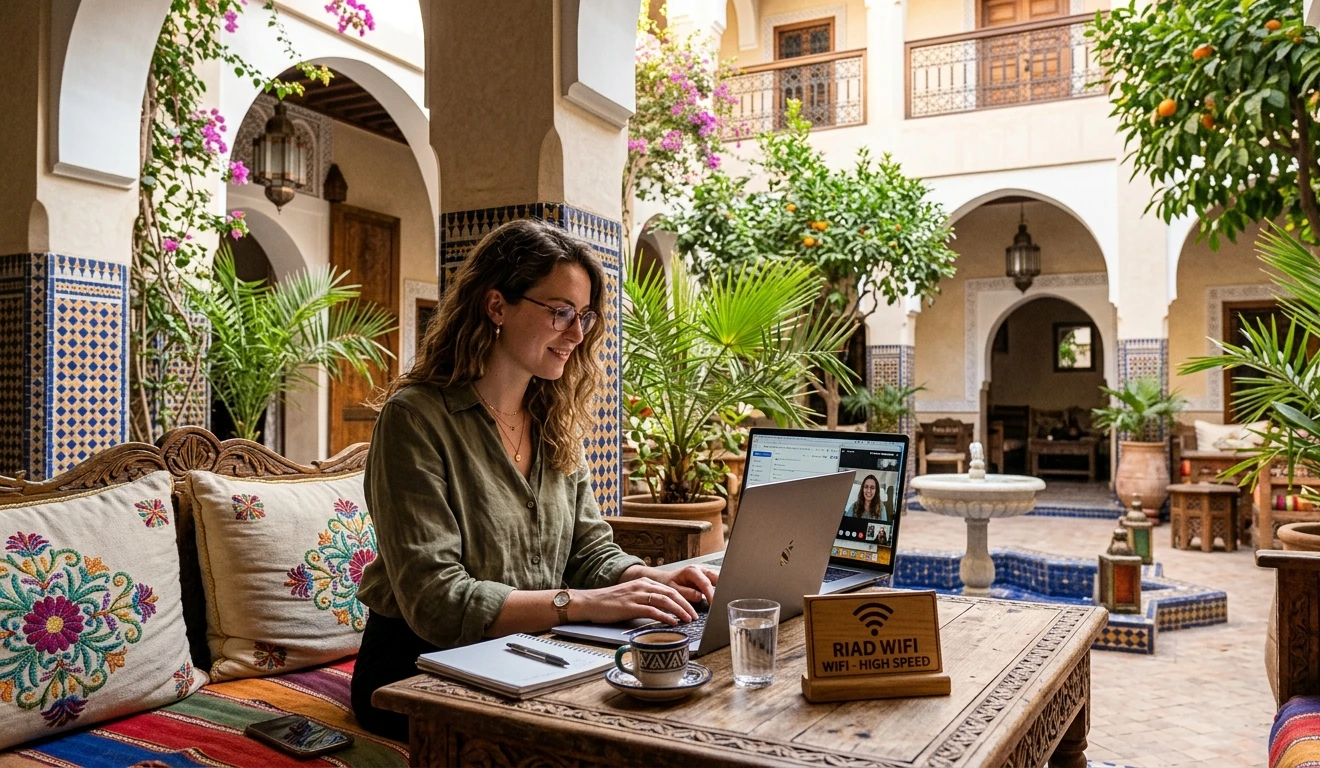
Is WiFi Good in Morocco?
A real-world look at internet quality, connectivity tips, and what to expect across cities, riads, and the Sahara.
Booking a trip to Morocco and wondering whether you’ll be able to stay connected? You’re not alone. Internet connectivity is one of the most common questions travelers ask before landing in Casablanca or Marrakech — and the honest answer is more nuanced than a simple yes or no.
Morocco has invested significantly in its digital infrastructure over the past decade. The country now has a rapidly expanding 4G network, decent broadband coverage in urban centers, and a growing number of co-working spaces catering to remote workers. That said, WiFi quality varies enormously depending on where you are and what you’re using it for.
The Big Picture: Internet in Morocco ↑
Morocco sits in an interesting middle ground when it comes to internet development. According to the Agence Nationale de Réglementation des Télécommunications (ANRT), fixed broadband penetration has crossed 50 % of households in urban Morocco, while 4G coverage reaches well over 90 % of the population. These are impressive numbers for a developing economy — and they matter to anyone planning to work or stay connected while traveling.
Three main operators share the market: Maroc Telecom, Orange Maroc, and inwi. Each offers both mobile data SIM cards for tourists and home or business internet plans. Competition between these three has driven prices down and improved reliability considerably over the past few years.
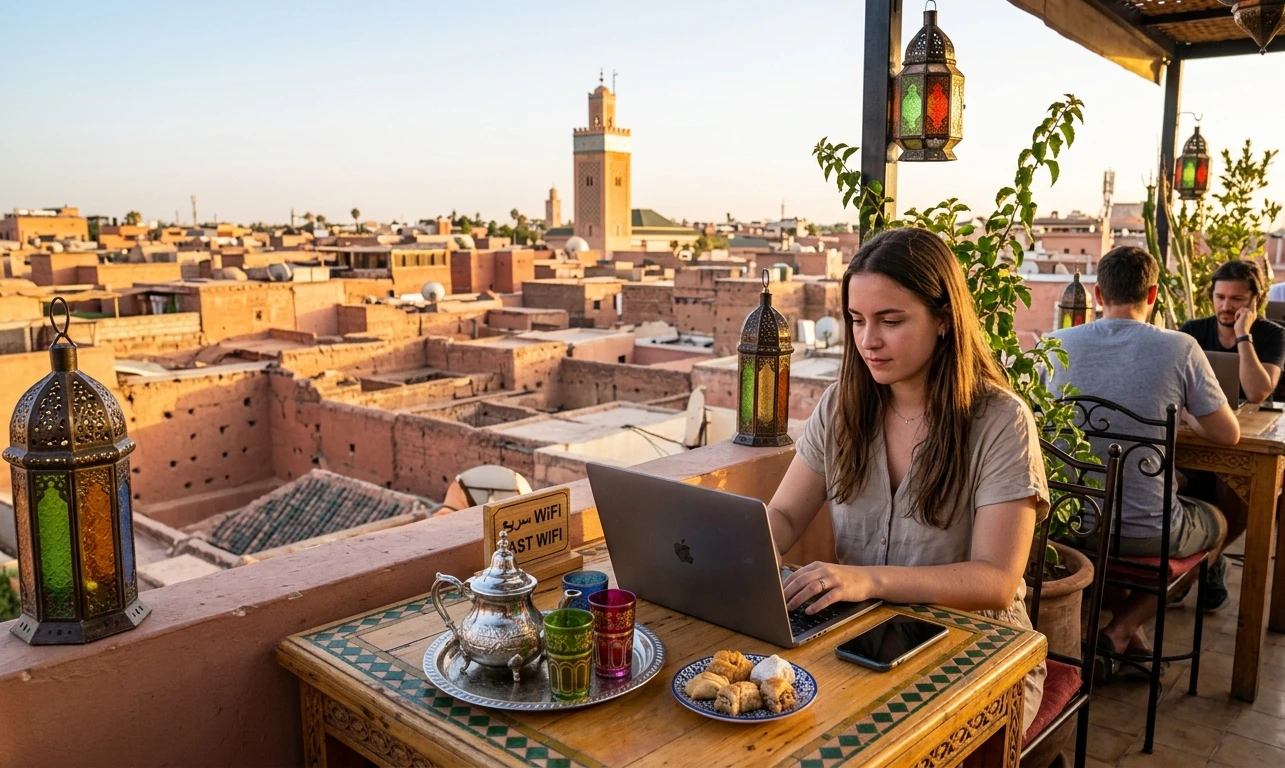
Many cafés in Marrakech and Fès offer surprisingly solid WiFi — perfect for a quick work session over mint tea.
WiFi Quality by City ↑
Casablanca
Morocco’s economic capital has the best internet infrastructure in the country. Fiber-optic connections are increasingly common in offices and upscale apartments, and most hotels — even mid-range ones — offer speeds suitable for video conferencing. Expect download speeds ranging from 20 to 80 Mbps in well-connected properties. Business districts like Maarif and Gauthier are particularly well-served.
Marrakech
As the kingdom’s tourism powerhouse, Marrakech has made WiFi a priority. Riads in the medina and hotels in Guéliz almost always advertise WiFi, though the quality inside thick-walled, centuries-old riads can be patchy. Rooftop cafés around Djemaa el-Fna frequently offer free WiFi, and a small but growing number of co-working spaces have opened near Guéliz and Hivernage to cater to the remote-work crowd.
Fès
Fès presents a similar picture to Marrakech. The old medina’s labyrinthine architecture can weaken signals, so don’t be surprised if your riad offers weak WiFi deep inside its courtyard. The Ville Nouvelle district (newer part of the city) fares much better. Mobile 4G data can be a lifesaver in Fès when you need reliable connectivity on the go.
Agadir & Essaouira
These coastal cities are popular with surfers, families, and increasingly digital nomads. Agadir in particular has solid WiFi infrastructure in its hotel zone, while Essaouira — despite its laid-back, artistic atmosphere — has improved connectivity markedly. Several wind-battered cafés near the ramparts now offer surprisingly usable connections.
Chefchaouen & the North
The “Blue City” has become an Instagram magnet, and connectivity here has followed the tourist boom. Most guesthouses and cafés now offer WiFi. Tangier, as a gateway city with strong European ties, has good infrastructure overall.
Merzouga & the Sahara
Be realistic here. Deep in the desert near Erg Chebbi, connectivity is limited. Most desert camps offer little to no WiFi, and mobile data can be weak or absent. If you need reliable internet, download offline maps, audiobooks, and entertainment before you head south. Embracing the disconnect is actually part of what makes the Sahara so special.
Chefchaouen’s popularity has driven improvements in local WiFi — good news for digital nomads who want a scenic backdrop.
WiFi in Hotels, Riads & Cafés ↑
Almost every hotel, riad, and guesthouse in Morocco now advertises free WiFi. The reality, though, can be hit or miss. Here’s a realistic breakdown:
- International chain hotels (Marriott, Hilton, Mövenpick): Consistently fast and reliable. Expect 30–100+ Mbps with solid uptime.
- Boutique riads: Highly variable. A stylish riad with thick earthen walls may struggle to distribute a signal to every room. Always ask for the router location when you check in — the rooftop or courtyard are usually the sweet spots.
- Budget hostels: Functional but shared among many users, so speeds can slow considerably during peak hours in the evening.
- Café culture: Morocco’s café scene is vibrant, and many establishments — especially in tourist zones — offer free WiFi to attract customers. Quality varies from barely functional to impressively fast.
Mobile Data vs. Public WiFi ↑
Here’s the thing: in Morocco, buying a local SIM card is one of the smartest moves you can make on day one. It gives you independence from patchy hotel WiFi and turns your phone into a personal hotspot wherever there’s 4G coverage.
SIM cards are available at the airport, telecom shops, and many convenience stores. Maroc Telecom, Orange, and inwi all offer tourist-friendly data packs. A plan with 20–50 GB of data typically costs between 50 and 120 Moroccan dirhams (MAD) — roughly €5–12 — making it incredibly affordable.
Related Guide Best SIM Card in Morocco for Tourists — full comparison of Maroc Telecom, Orange & inwi plans4G speeds in Morocco’s urban areas frequently hit 20–40 Mbps, which is more than enough for remote work, video calls, and navigation. In rural zones speeds drop to 3G or even Edge in some spots, but the coverage footprint continues to grow year on year.
Morocco as a Digital Nomad Destination ↑
Morocco has emerged as one of Africa’s most appealing digital nomad destinations — and internet quality plays a central role in that reputation. The combination of affordable living costs, visa-friendly entry for most Western nationalities, a rich cultural experience, and improving connectivity makes cities like Marrakech, Casablanca, and Agadir genuinely viable bases for remote workers.
Co-working spaces have proliferated in the past few years. Marrakech alone has several well-reviewed options, often housed in stunning converted riads complete with rooftop terraces. You’ll find fiber-speed internet, dedicated desks, printing facilities, and a community of like-minded international professionals.
Related Guide Digital Nomad in Morocco — everything about visas, co-working spaces, costs, and neighborhoods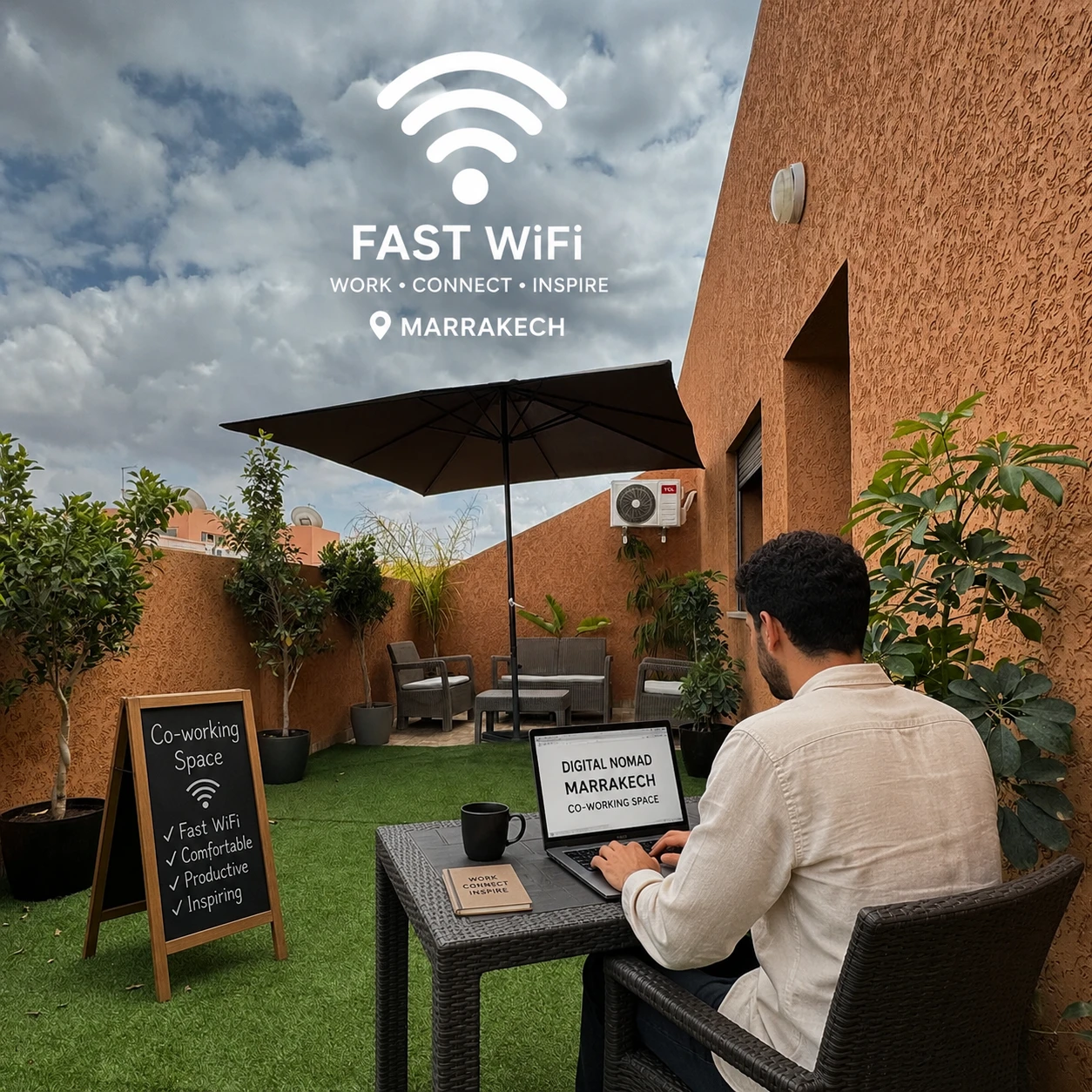
Co-working spaces in Morocco’s major cities now offer fiber-speed internet and all the amenities a remote worker needs.
Practical Tips for Reliable Connectivity in Morocco ↑
- Buy a local SIM at the airport. Mohamed V in Casablanca and Menara in Marrakech both have telecom counters in the arrivals hall. It takes minutes and provides immediate independence.
- Test your accommodation’s WiFi on arrival. Ask the front desk to run a quick speed test (fast.com works without any app). If speeds are poor, know where the nearest café with reliable WiFi is.
- Use a VPN. Some VoIP services and video streaming platforms can experience restrictions. A reputable VPN ensures both security on public networks and access to all your usual apps.
- Download offline essentials. Google Maps offline packs, Spotify playlists, and PDF guides can get you through connectivity dead zones without stress.
- For important calls, use mobile data as a hotspot. Even if your hotel WiFi is decent, switching to your 4G hotspot for a critical video meeting eliminates shared-network slowdowns.
- Avoid peak evening hours on hotel WiFi. Connections often saturate between 7 pm and 10 pm when many guests stream simultaneously. Schedule bandwidth-heavy tasks for mornings.
- Co-working spaces over cafés for serious work. While café WiFi is great for casual use, a dedicated co-working space will give you more consistent speeds, ergonomic seating, and often a backup connection.
Internet Speed Comparison by Location ↑
| Location / Context | Typical Speed | Reliability | Best For |
|---|---|---|---|
| Casablanca (hotel/office) | 30–100 Mbps | Excellent | All remote work tasks |
| Marrakech (Guéliz hotel) | 20–60 Mbps | Good | Video calls, streaming |
| Marrakech (medina riad) | 5–25 Mbps | Variable | Browsing, email |
| Fès (Ville Nouvelle) | 15–50 Mbps | Good | Video calls, browsing |
| Chefchaouen | 5–20 Mbps | Moderate | Browsing, social media |
| Agadir (hotel zone) | 20–70 Mbps | Good | Video calls, streaming |
| Moroccan café (urban) | 5–30 Mbps | Moderate | Light work, browsing |
| Sahara / desert camps | 0–5 Mbps (or none) | Very Limited | Disconnect & enjoy! |
| 4G mobile data (urban) | 15–45 Mbps | Good | Hotspot, navigation |
| Co-working space | 50–200 Mbps | Excellent | All professional tasks |

Plan Your Trip with a Licensed Guide
Need personalized advice on connectivity, SIM cards, or crafting the perfect Morocco itinerary? Connect directly with Mouhssine ELIOUJ, a certified guide licensed by the Moroccan Ministry of Tourism (Réf. No. 2898). He speaks English, French, and Arabic and has guided travelers across all of Morocco.
Chat on WhatsAppFrequently Asked Questions ↑
Is WiFi free in Morocco hotels?
Yes, virtually all hotels, riads, and guesthouses include free WiFi as standard. The quality varies significantly — international chains consistently deliver fast speeds, while smaller traditional riads can be inconsistent due to thick walls and aging infrastructure. Always check recent traveler reviews before booking.
Can I use my foreign SIM card in Morocco?
Yes, but international roaming can be expensive. Buying a local Moroccan SIM card (from Maroc Telecom, Orange, or inwi) is far more cost-effective and gives you better local coverage. A local prepaid data plan typically costs between €5 and €12 for 20–50 GB of data.
Does Morocco have 5G internet?
As of 2026, Morocco’s 5G network is in the early deployment phase in select urban areas. For most travelers, 4G LTE remains the practical standard and delivers perfectly adequate speeds for remote work and travel needs. 5G rollout is expected to accelerate over the coming years.
Is VPN legal in Morocco?
Using a VPN for personal privacy and security is generally tolerated in Morocco and widely used by expatriates and remote workers. However, Moroccan regulations can be subject to change. Using a reputable VPN primarily for secure browsing and accessing your usual services while abroad is standard practice among travelers.
Is Morocco a good place for remote work and digital nomads?
Increasingly yes. Cities like Marrakech, Casablanca, and Agadir offer co-working spaces with fast fiber internet, affordable living costs, a welcoming culture, and outstanding cuisine. For most remote work tasks, the internet infrastructure in these cities is more than sufficient. Read our full Digital Nomad Guide to Morocco for a complete breakdown.
Will I have internet access in the Sahara desert?
Limited, at best. Small towns like Merzouga have basic connectivity, but once you’re in a desert camp or deep in the dunes, expect little to no signal. Download offline maps and content before heading south, and embrace the digital detox — it’s one of the magical aspects of a Sahara experience.
Final Verdict: Is WiFi Good in Morocco? ↑
The short answer: yes, WiFi in Morocco is good — in the right places. Major cities like Casablanca, Marrakech, Agadir, and Fès offer reliable connectivity that comfortably supports video calls, remote work, and seamless streaming. The country’s 4G mobile network fills many of the gaps where fixed WiFi falls short.
The nuance lies in expectations. If you’re headed to a heritage riad deep inside a 14th-century medina or planning a camel trek into the Erg Chebbi dunes, connectivity will not be your strongest suit. But that’s also part of Morocco’s remarkable charm — it offers you the rare chance to disconnect from screens and reconnect with something far older and richer.
For travelers who need consistent internet access throughout their trip, the winning combination is simple: a local SIM card for 4G data on the go, paired with accommodation chosen partly for its verified WiFi quality, and a co-working space membership if remote work is central to your stay. With that setup, Morocco is not just manageable — it’s genuinely excellent.
Ready to Explore Morocco?
Whether you’re a digital nomad, a curious traveler, or planning a family adventure, Morocco rewards those who come prepared. Get personalized travel advice from a licensed guide, find the right SIM card, and start planning your unforgettable Moroccan journey today.