
Your Complete Guide to Living & Working as a Digital Nomad in Morocco
From visa reality and money management to Al Boraq trains and the best coworking communities — everything you need before you land.
Why Morocco Is Having Its Digital Nomad Moment
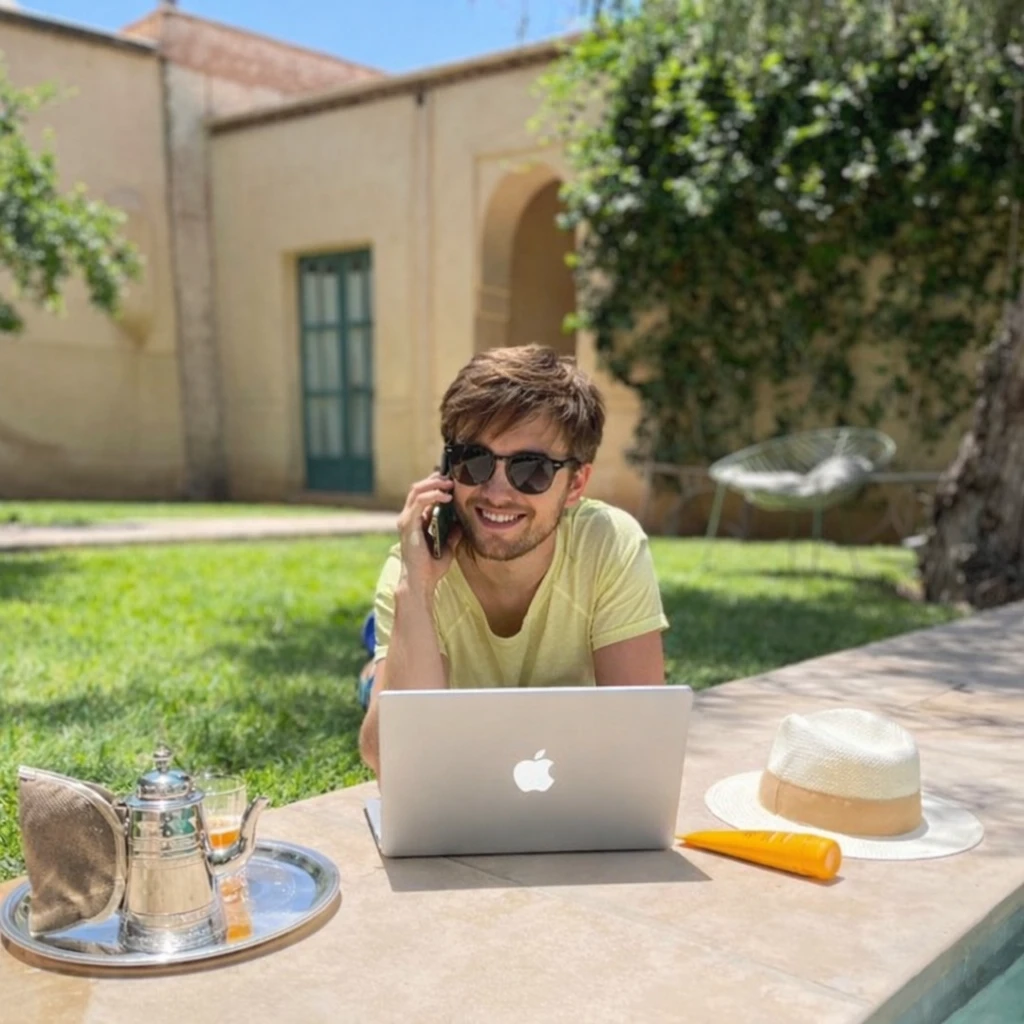
↑There’s something almost effortless about the way Morocco absorbs new arrivals. One afternoon you’re filing a client report from a rooftop riad, the minaret’s call to prayer drifting over terracotta rooftops below, and the next morning you’re in a sleek coworking space with fiber-optic Wi-Fi and a flat white. This combination of soul and infrastructure has turned Digital Nomad Morocco from a niche experiment into a genuine conversation in 2026.
The country sits at a compelling crossroads: geographically just 14 km from Europe; culturally blending Amazigh heritage, Arab influence, and francophone modernity into something entirely its own. Practically speaking, it offers one of the lowest costs of living on either side of the Atlantic without asking you to sacrifice connectivity or safety. And if you’re curious about where Morocco sits on the map, that context alone reshapes how you plan flights and time-zone overlap.
Visa Reality 2026 — What You Actually Need to Know
↑This is the question every nomad forum gets wrong, so let’s be precise. As of 2026, Morocco does not have a dedicated Digital Nomad Visa in the way Portugal’s D8 or Spain’s Startups Visa work. What Morocco does have is a remarkably permissive tourist entry regime — and that’s what the vast majority of nomads actually use.
Citizens of over 60 countries — the entire EU, UK, US, Canada, Australia, most of Latin America, and many others — enter Morocco visa-free for up to 90 days per entry. You arrive as a tourist. There is no law prohibiting remote work for foreign employers or clients on tourist status, provided you’re not generating income from Moroccan clients or registered as a Moroccan business.
After 90 days, many nomads do a “border run” — a quick trip to Ceuta or Melilla (Spanish enclaves reachable by bus from Tetouan/Fnideq), or a short flight to the Canary Islands, then re-entry. In practice this resets the clock and works consistently for most nationalities. It is not an officially sanctioned long-term strategy, but it is widely used.
Those planning to stay 6+ months should look at the carte de séjour (long-stay residency permit), which requires a local address and proof of income. Many long-term nomads in Marrakech and Agadir hold one. For current official entry procedures and eVisa options: Accès Maroc.
Money, Cards & ATMs — The Practical Financial Guide
↑Morocco’s currency, the Moroccan Dirham (MAD), is a non-convertible, state-controlled currency — you cannot buy or sell it outside Morocco in any meaningful volume. Before arriving, read this primer on how Morocco’s currency works so you’re not caught off guard at ATMs.
Do Wise and Revolut Work in Morocco?
Yes — both work well. Wise gives near-interbank exchange rates to MAD, saving you 2–4% versus a standard debit card. Revolut also works but applies a weekend conversion markup. The variable factor is ATM fees charged by Moroccan banks on international cards:
Cash vs Card — When to Use Which
Card works reliably at supermarkets, restaurants in modern districts, coworking spaces, and most hotels. Cash is essential for medina souks, local taxi drivers, hammams, street food, and anything under MAD 50.
- Withdraw in large amounts. Each transaction incurs a fee — MAD 2,000–3,000 at once is more economical than multiple small withdrawals.
- Keep a cash float. Always have MAD 300–500 on hand. Taxis, markets, tips, and emergencies require it instantly.
- Airport exchange booths are fair. Morocco’s official bureaux de change at Casablanca and Marrakech airports are regulated and offer reasonable rates. No need to pre-buy dirhams abroad.
- Don’t try to reconvert leftover MAD outside Morocco. The Dirham’s non-convertibility means you’ll struggle. Reconvert at the airport (keep your exchange receipt).
- PayPal works in Morocco. You can send/receive in your home currency. Note that withdrawing to a Moroccan bank account involves a conversion step.
Getting Around: Al Boraq, Taxis & Transport Apps
↑Morocco’s transport infrastructure is a genuine advantage for the mobile professional. Moving between cities is efficient, and within cities, the right apps eliminate the negotiation headaches that once defined Moroccan taxi culture.
The Al Boraq (البراق) connects Tangier to Casablanca at up to 320 km/h — a journey that used to take 4+ hours now takes under 2h10.
For digital nomads: seats have power outlets, onboard Wi-Fi exists (bring a 4G backup for critical calls), and the ride is smooth enough for focused work. 1st class tickets: MAD 250–350. Book via the ONCF app — sell out fast on Friday evenings and Monday mornings.
ONCF’s regular network also covers Casablanca–Marrakech (3h15), Casablanca–Fes (4h30). For Agadir: train to Casa then CTM coach.
Transport Apps — Skip the Negotiation
Uber does not operate in Morocco. Active alternatives: InDrive, Careem, and Bolt — available in major cities. Download and add a payment method before landing.
- InDrive — Most widely used ride-hailing app in Morocco. You offer a price; drivers accept or counter. Available in Casablanca, Marrakech, Rabat, Agadir, Fes, and Tangier.
- Careem — Fixed pricing, slightly higher than InDrive but consistent. Popular with business travellers who prefer not to negotiate.
- Bolt — Growing rapidly in Casablanca and Marrakech. Often cheapest for short in-city trips.
- Petit taxi (city cab) — For short urban trips. Meters are mandatory but not always used — insist on the meter or agree a price. Very cheap for distances under 5km.
- Grand taxi — Shared intercity taxis for routes the train doesn’t cover. Essential for Taghazout, Essaouira, Chefchaouen, and other smaller towns.
At train stations and airports, using a licensed taxi from the official rank is always the safest and most hassle-free option.
Best Cities for Digital Nomads in Morocco
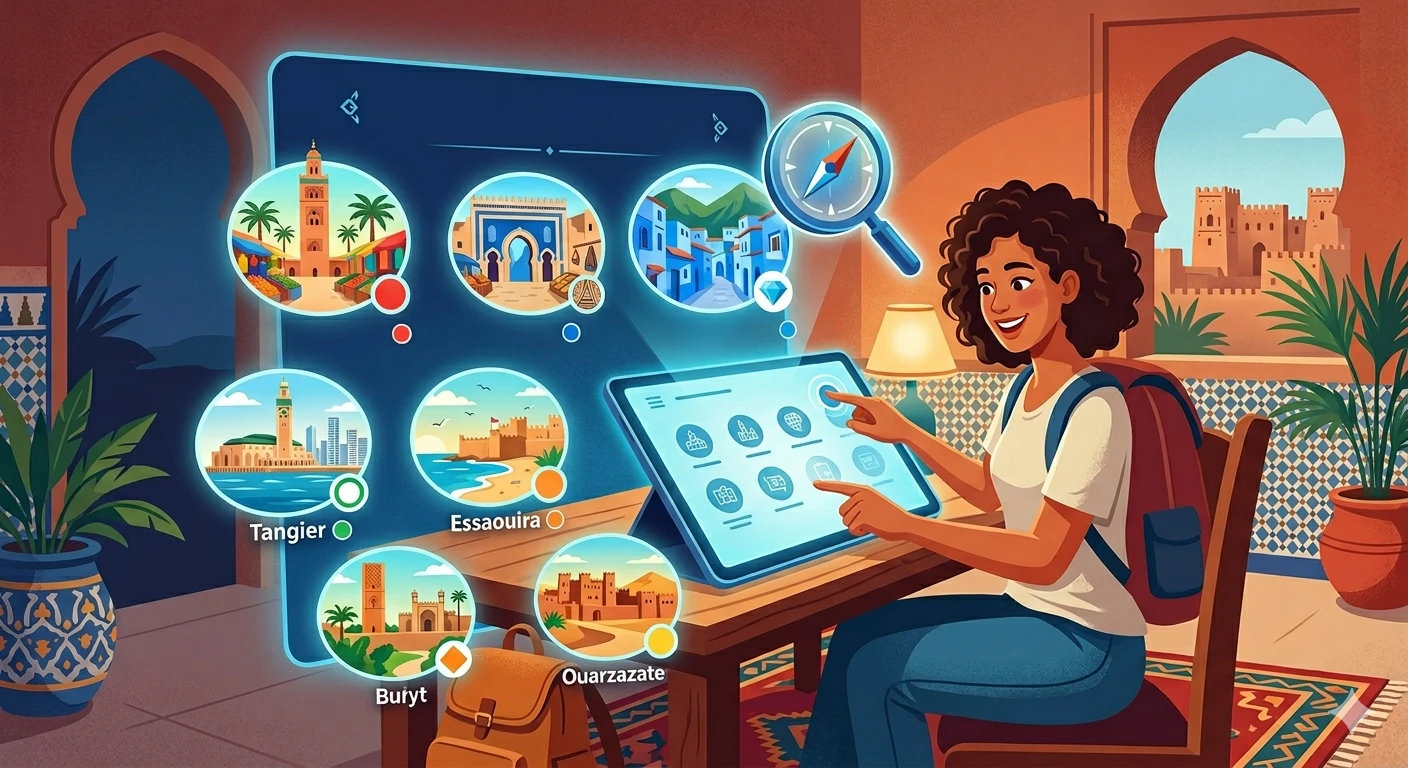
↑Morocco is not a single experience — it’s a collection of distinct atmospheres packed into one country. The full range of Moroccan cities reveals just how much variety there is. Below are the standouts for the location-independent professional.
Find Your Best City in Morocco
↑Use the sliders below to weight what matters most to you. The tool scores each city across six real indicators and instantly ranks your best matches.
Internet Speed, 5G & Rural Connectivity
↑Connectivity is the make-or-break factor for any remote worker, and here Morocco tends to pleasantly surprise. Internet speeds have improved dramatically over the past three years, driven by competition between Maroc Telecom (IAM), Orange Maroc, and inwi — all of whom have expanded fiber and 4G+ coverage substantially.
“In major cities, fiber at 50–100 Mbps is routine. Video calls, large uploads, and cloud tools all run without friction. The real surprise is how solid 4G is even in smaller towns like Taghazout or Chefchaouen.”
Before committing to accommodation, check real-time performance using this Morocco-specific internet speed test.
5G in Morocco — Progressive Rollout
Morocco has officially launched 5G Maroc, currently active in selected coverage zones in Casablanca, Rabat, and Marrakech. The rollout is progressive — operators have committed to expanding 5G to many additional cities across Morocco in planned phases. Coverage within cities remains uneven in 2026, with business districts and newer residential zones typically covered first.
Internet Outside Major Cities — The Honest Picture
- Secondary towns (Chefchaouen, Ouarzazate, Essaouira): 4G generally available in town centres, but speeds can drop to 10–20 Mbps during peak hours.
- Mountain villages (High Atlas, Rif): 4G is patchy and often drops to 3G or EDGE. Expect 1–5 Mbps at best.
- Sahara / Deep South (Merzouga, Zagora, Erg Chebbi): Minimal to no reliable 4G. Some Starlink-equipped desert camps now exist for nomad travellers.
- Atlantic coast villages north of Agadir: Taghazout, Tamraght, and Imsouane now have workable 4G — though SunDesk-type dedicated connections are still most reliable for intensive work.
- General rule: A dual-SIM setup (Maroc Telecom + inwi) improves rural coverage significantly since tower coverage varies by operator.
- Buy a local SIM on arrival — prepaid data packages are very affordable. See the full comparison in our guide to the Best SIM Card in Morocco for Tourists. Bring your passport; registration is required.
- Ask your accommodation for the actual measured speed before signing. Old medina buildings with thick walls can significantly degrade Wi-Fi signals.
- inwi’s high-data prepaid packages serve well as a backup city connection.
- Best times for lowest latency on video calls: early morning (6–9am) and mid-afternoon on weekdays.
Official Average Speeds by City (2025–2026)
| City | Fixed Broadband | Mobile 4G Avg. | 5G Available | Relative Speed |
|---|---|---|---|---|
| Casablanca | 60–110 Mbps | ~40 Mbps | ✅ Selected zones | |
| Rabat | 50–90 Mbps | ~35 Mbps | ✅ Selected zones | |
| Marrakech | 40–70 Mbps | ~30 Mbps | ✅ Selected zones | |
| Agadir | 30–60 Mbps | ~25 Mbps | 🔄 Rollout planned | |
| Tangier | 35–65 Mbps | ~28 Mbps | 🔄 Rollout planned | |
| Fes | 25–50 Mbps | ~20 Mbps | 🔄 Rollout planned | |
| Taghazout | 15–35 Mbps | ~15 Mbps | ❌ Not yet | |
| Chefchaouen | 10–25 Mbps | ~12 Mbps | ❌ Not yet |
Power Adapters & Plugs
Morocco uses Type C and Type E sockets (same as continental Europe) at 220V/50Hz. If arriving from the US, UK, or Australia, you’ll need an adapter. Check the full guide on Morocco plug type to arrive prepared.
Coworking Spaces, Community & Cafés
↑Remote work can be isolating anywhere in the world. Morocco has developed a genuinely interesting coworking ecosystem where several spaces function as proper community hubs, not just desk-rental operations.
Cost of Living & Daily Budget
↑For someone earning in euros, dollars, or sterling and spending in dirhams, the purchasing power differential is genuinely significant. A full month of decent living — comfortable apartment, groceries, meals out, coworking, transport, and leisure — is achievable for €700–1,200 depending on the city and lifestyle.
- Furnished apartment (city centre, 1 bed): MAD 4,000–7,500 / €370–690 · Marrakech & Casa at higher end; Rabat & Fes at lower
- Coworking hot desk (monthly): MAD 800–1,800 / €75–170 · Day passes typically MAD 80–150
- Groceries (for one): MAD 1,200–2,000/month · Local market shopping significantly cheaper than supermarkets
- Eating out (mid-range): MAD 80–180 per meal · Excellent tagine lunch can cost MAD 35–50
- Café session (coffee + water): MAD 30–60 · Most good cafés have no time limit
- Monthly transport (apps + taxis): MAD 400–900
- International health insurance: approx. €50–120/month · Strongly recommended
- SIM + data (inwi or IAM): MAD 100–200/month for ample 4G data
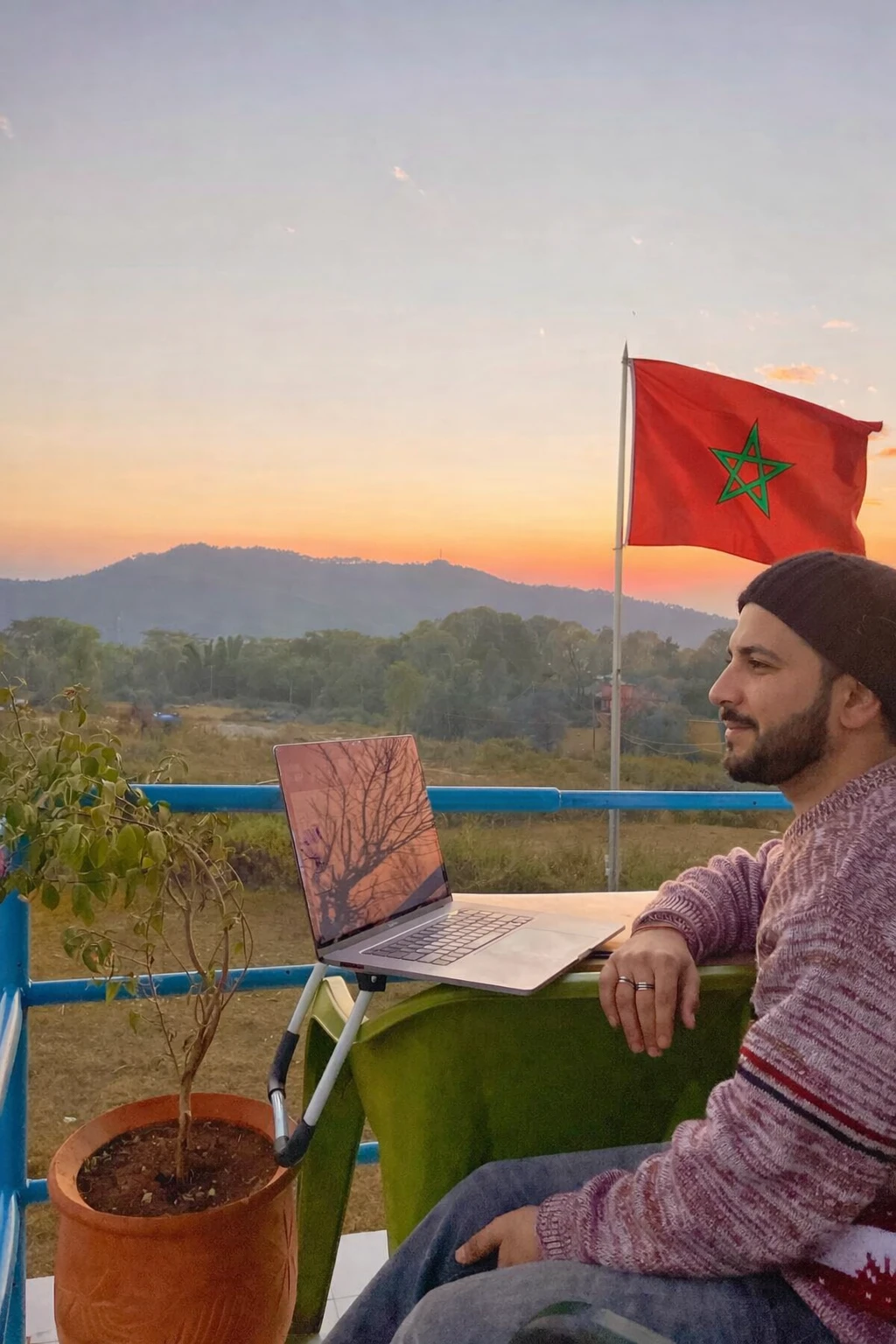
Monthly Cost Calculator
↑Estimate your real monthly budget in Morocco based on your lifestyle choices. All amounts in MAD with euro equivalent.
Setting Up Your Mobile Workspace
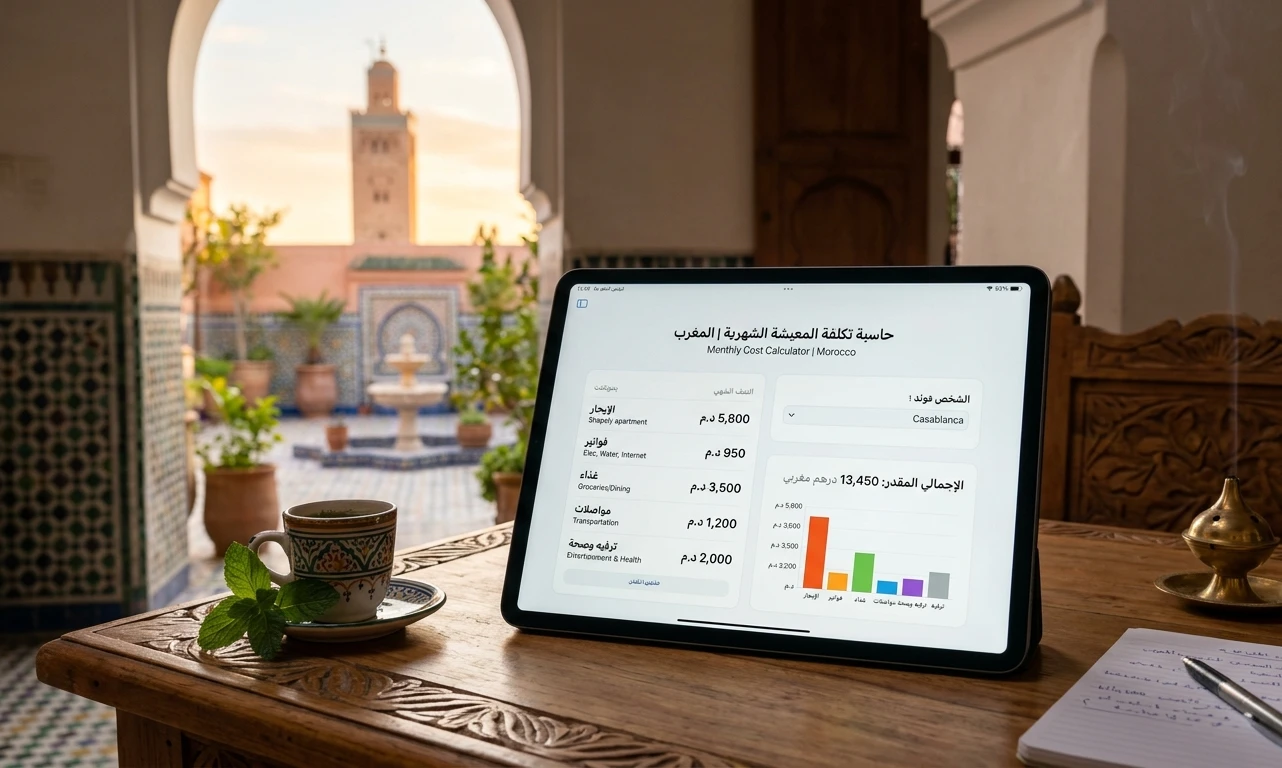
↑Your physical workspace matters far more than it seems in the excitement of a new destination. A poor chair or bad lighting can turn an inspired morning into a back-ache-fuelled afternoon. If you plan to stay in Morocco for more than a few weeks — and many people extend well beyond initial plans — investing in your ergonomic setup is worth it.
Beyond the chair: a portable monitor riser, compact keyboard, noise-isolating headphones for noisy riads, and a universal travel adapter with extra USB-C ports. All findable in Morocco, particularly at Casablanca’s Derb Ghallef electronics district.
Safety & Practical Life Tips
↑Morocco has a well-established reputation as one of the region’s safest and most tourist-friendly countries. Petty scams in high-traffic medina areas are real but avoidable with basic awareness. For a thorough regional breakdown, this Morocco safety guide is worth reading in full.
- Download InDrive and Bolt before landing. At train stations and airports, use official taxis at the designated rank.
- Ramadan shifts the daily rhythm significantly. Restaurants have reduced daytime hours; the city comes alive after sunset.
- Morocco has a public healthcare system, but nomads use private clinics for anything serious. International health insurance is strongly recommended.
- Learning even basic Darija or French makes a noticeable difference. Even “shukran” (thank you) and “la shukran” (no thank you) changes how you’re received in markets.
- Emergency numbers: 19 (Police), 15 (Medical/SAMU), 177 (Gendarmerie). Save these the day you arrive.
- Register your extended stay with your embassy if staying 3+ months — optional but sensible for emergency consular support.
FAQ — Digital Nomad in Morocco
↑
Arriving for an extended stay as a remote worker is a completely different experience from a standard holiday. You need to understand neighbourhoods, not just landmarks — which areas are genuinely walkable for daily errands, where the coworking spaces and reliable cafés are, which streets to live on versus avoid, and how to navigate local logistics from SIM cards to finding a decent apartment.
Guide Mouhssine is a government-licensed Moroccan guide (official reference No. 2898) who specialises in helping long-stay visitors and digital nomads settle into Morocco intelligently. He provides practical tips, insider knowledge, and honest local advice you won’t find online — and can take you on a curated city tour through the neighbourhoods that matter so you can make an informed final decision before committing to a long-stay plan.
Book via WhatsApp · +212 671 437 971✦ No intermediaries, no platform fees — direct contact with a licensed professional. Ask about arrival orientation tours and neighbourhood walkthroughs for digital nomads.

Thank You!