
BlogGuides & TipsPractical Information

List of Common Tourist Scams in Morocco & How to Outsmart Them

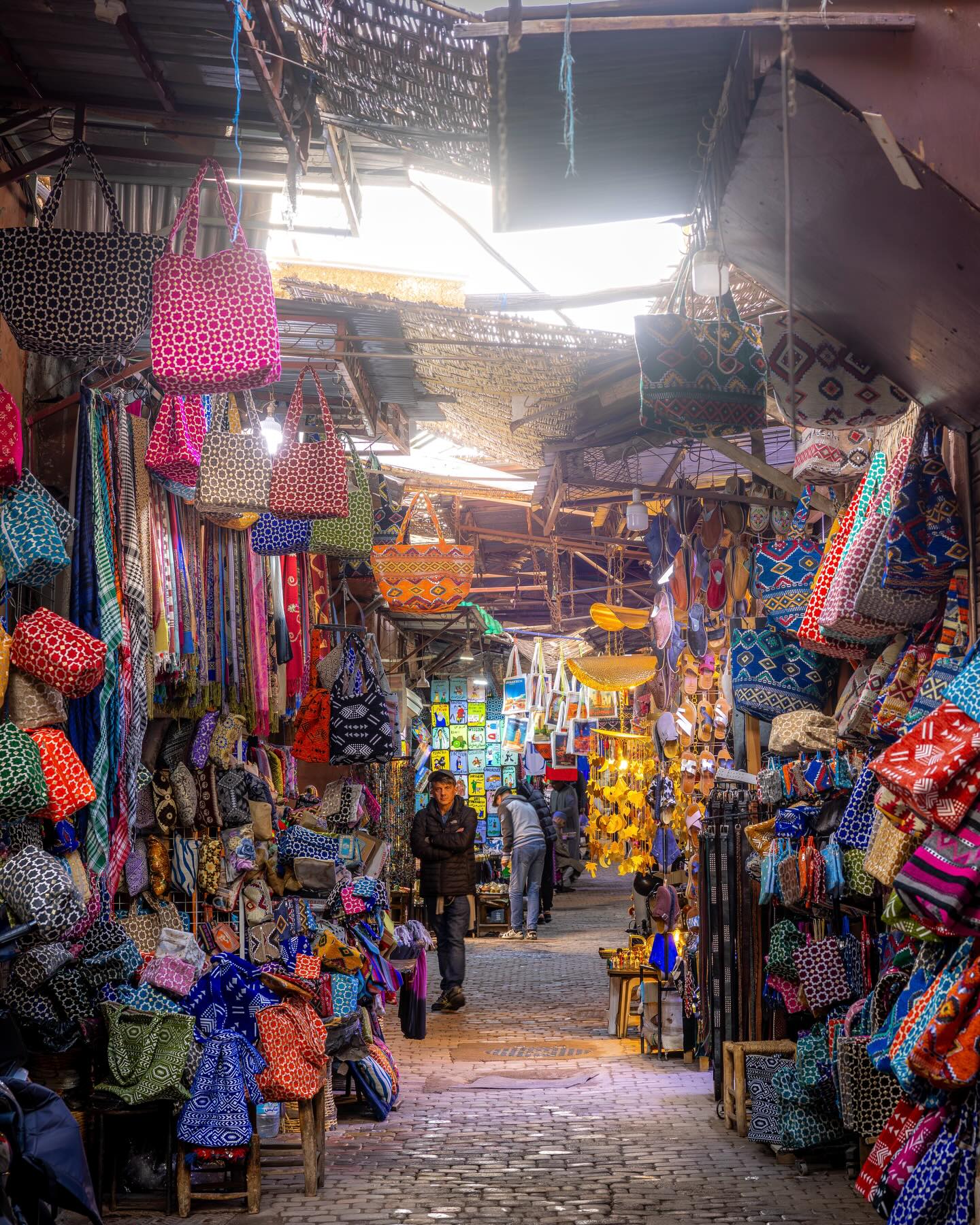
Moroccan medina streets — common tourist scams in Morocco guide
Traveler’s Safety Guide · 2026 Edition

List of Common Tourist Scams in Morocco — & How to Outsmart Them

Essential Reading 🕐 18 min read 📍 Morocco ✅ Verified by locals

“Morocco is one of the most captivating destinations on earth — labyrinthine medinas, saffron-scented souks, and hospitality that feels genuinely warm. But like any major tourist destination, knowing what to watch for makes the difference between a dream trip and a frustrating one.”

Morocco welcomed over 17.4 million international tourists in 2023, according to the Moroccan Ministry of Tourism, and the country has continued to grow as a global travel hotspot heading into 2025 and 2026. With that growth comes an inevitable handful of opportunists targeting newcomers in the medinas of Morocco’s iconic cities.

The good news? The vast majority of Moroccans are exceptionally kind, generous, and proud to share their culture. The Moroccan Tourism Police (Brigade Touristique) has become increasingly active in protecting visitors — many complaints result in rapid police response. This guide exists not to discourage travel, but to give you the honest, street-level knowledge you need to travel confidently. If you want a full picture of safety, read our dedicated piece on whether Morocco is safe to visit for tourists.

17.4M
Tourists in 2023
#1
African Destination
72h
Avg. Police Response
95%
Visitors Feel Safe

The Complete List of Common Tourist Scams in Morocco


Before diving into each one in detail, here is the at-a-glance list of common tourist scams in Morocco that travelers encounter most frequently. Every item below has been documented through traveler reports, official tourism advisories, and local knowledge.

🚕 Transport
Taxi Meter “Broken” Scam

One of the most widely reported Morocco taxi scams — the driver claims his meter is broken and quotes an inflated price, often 3–5× the real fare.

✦ Tip: Always demand the meter, or use Careem/inDriver apps.
🧭 Medina
Fake “Friendly Guide” Scam

A friendly local offers to show you around for free, leads you through the medina, then demands a large tip — or escorts you to a shop where he earns commission.

✦ Tip: Only accept guidance from officially licensed guides.
🔑 Distraction
Morocco Shaking Keys Scam

Someone approaches rattling keys, claiming you dropped them. While you’re distracted, an accomplice picks your pocket or bag is grabbed.

✦ Tip: Ignore any unexpected approach. Walk away calmly.
💎 Shopping
Fake Geodes & “Fossils” Morocco

Vendors near Erfoud, Agadir, and Marrakech sell painted rocks disguised as amethyst geodes or trilobite fossils. Some are even convincing to the untrained eye.

✦ Tip: Buy minerals only from reputable, established shops.
💞 Emotional
Morocco Romance Scams

A charming local builds a quick emotional connection with a solo traveler, slowly extracting money for “family emergencies,” flights, or business investments.

✦ Tip: Move slowly. Never send money to someone you just met.
🧆 Food & Drink
Unrequested “Free” Food Trick

A vendor places snacks, olives, or mint tea in front of you without being asked, then charges a steep fee when you eat or drink them.

✦ Tip: Clarify prices before accepting anything. Decline if unsure.
🐍 Photo Scam
Snake/Monkey Photo Demand

In Jemaa el-Fna square, handlers place snakes or monkeys on tourists without consent and demand 100–300 MAD for photos they didn’t agree to take.

✦ Tip: Do not approach handlers. If it happens, pay a small amount and move on.
🌿 Spice Souk
Souk “Argan Oil” Fake Products

Sellers market sunflower oil or cheap blends as pure argan oil, one of Morocco’s most prized exports. Prices seem like deals but the product is worthless.

✦ Tip: Real argan oil is expensive. Buy from certified cooperatives.
🏨 Accommodation
“Your Riad is Closed” Redirect

A person near the medina entrance tells you your pre-booked riad is closed, flooded, or full — and offers to take you to another place where they earn commission.

✦ Tip: Always verify directly with your riad by phone before listening to strangers.
💱 Currency
Unofficial Currency Exchange

Street money changers offer tempting rates but palm off counterfeit or discontinued dirham notes. This is illegal and leaves you with worthless paper.

✦ Tip: Exchange only at licensed bureaux de change or ATMs. See our guide on Morocco’s currency.
🖼️ Art
Overpriced “Handmade” Crafts

Items labelled as handmade — ceramics, leather goods, rugs — are sometimes mass-produced imports. Prices can be 10× what locals pay.

✦ Tip: Visit fixed-price cooperatives first to calibrate your sense of value.
🧣 Henna
Henna Women Price Trap

Women offer a “free” henna design on your hand, then demand 200–500 MAD once it’s done. Refusing causes a public scene designed to embarrass you into paying.
✦ Tip: Agree on a price and have it written before any application begins.
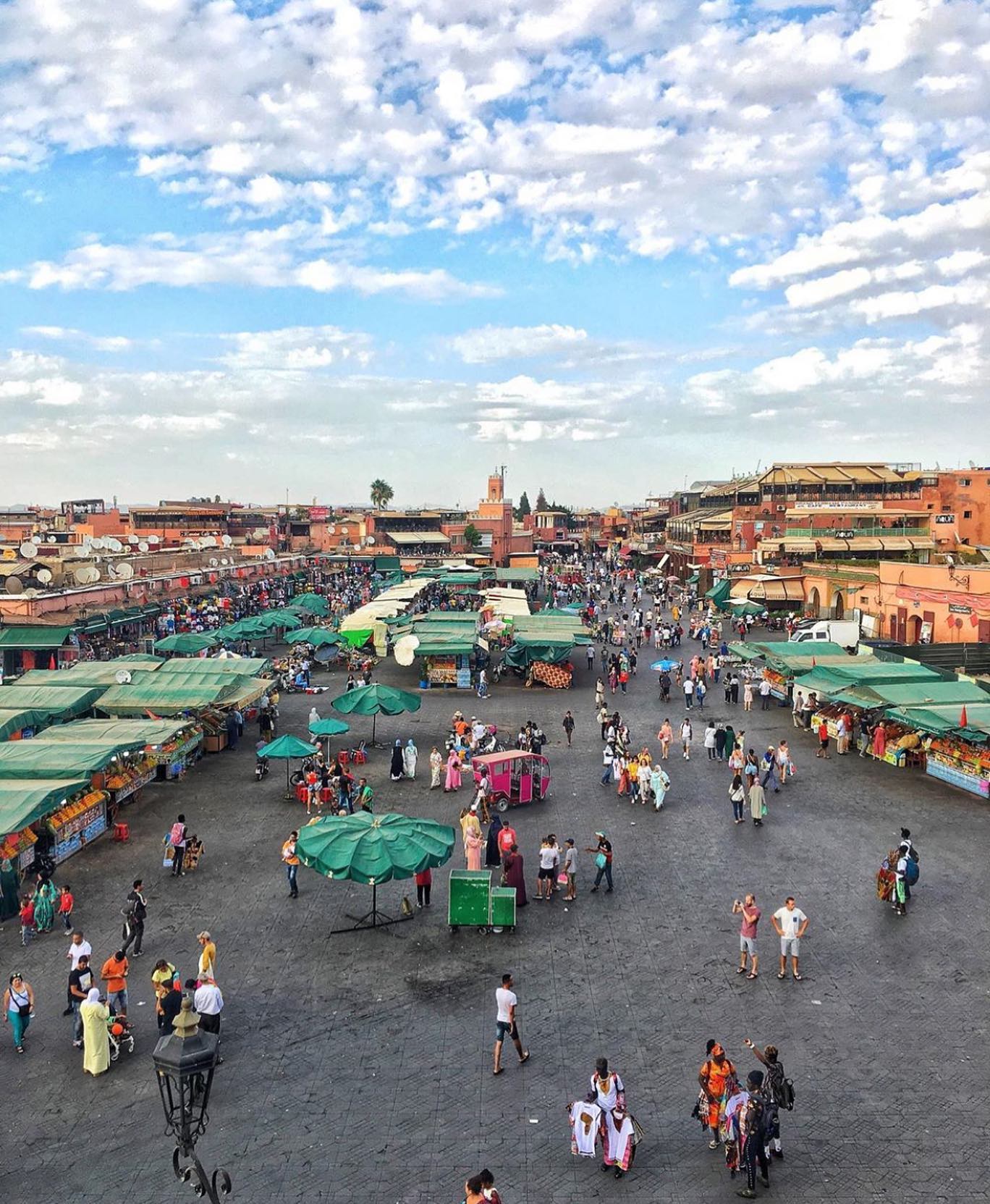
Jemaa el-Fna square Marrakech — a hotspot for tourist scams in Morocco

Jemaa el-Fna, Marrakech — vibrant and beautiful, but worth navigating with awareness.


Morocco Taxi Scams — The Transport Traps You’ll Face


Marrakech taxi scams and those in Fes, Casablanca, and Agadir follow similar patterns. Understanding how they work puts you in control before you even open the door.

The Broken Meter

Petit taxis (small city taxis) in Morocco are legally required to use their meters. If a driver tells you the meter is broken or proposes a flat rate first, it’s almost certainly an attempt to overcharge. For reference, a cross-town trip in Marrakech should cost 10–20 MAD, not 100 MAD. Always insist on the meter, or simply get out and hail another cab.

Airport Transfer Overcharging

The stretch between Marrakech Menara Airport and the medina is notorious. Unofficial drivers outside the terminal can quote 300–400 MAD. The official taxi fare is around 70–100 MAD depending on time of day. Look for licensed taxis with the municipality sticker, or pre-book your transfer online.

🚕 How to Avoid Marrakech Taxi Scams
  • Download Careem or inDriver — ride-hailing apps operate in Casablanca, Marrakech, and Rabat.
  • Always sit in the back and confirm meter is running before the journey starts.
  • Screenshot the official fare table displayed inside official taxis.
  • At night, fares are legally 50% higher — account for this.
  • Grand taxis (shared intercity) have fixed routes — confirm the destination price with other passengers first.

How to Avoid Scams in Marrakech — The Fake Guide Problem


The medina of Marrakech is a UNESCO World Heritage Site and one of the most disorienting, enchanting places on earth. Its 9,000 lanes were designed to confuse invaders — and they work equally well on tourists. This is exactly where the fake guide scam thrives.

A person, often young, well-dressed, and speaking excellent English or French, will approach you near Jemaa el-Fna or a major landmark. They claim to be a student, someone’s cousin, or simply a “friendly local,” and offer to show you a shortcut or a special place. After 30–40 minutes of navigation, they guide you into a shop — a cousin’s rug store, a spice stall, a leather tannery viewing platform — where you’re pressured to buy. The shop owner and guide split the commission.

⚠️
Morocco’s government banned unlicensed guiding in 2007 under Law 05-12. Only officially licensed guides from the Ministry of Tourism have the legal right to offer paid tourist guiding services. A license badge (No. Réf.) is a visible proof of legitimacy. Unlicensed guiding is not only a scam risk — it’s illegal.

Genuine guides are proud of their license and will show it without hesitation. If you’re planning to explore a medina independently, embrace getting a little lost — but have your riad’s address on your phone in Arabic, which any local can help you with.

Fake Geodes Morocco — Don’t Get Fooled by Pretty Rocks


Southern Morocco — particularly around Erfoud, Rissani, and the Sahara gateway towns — is genuinely rich in fossils and crystals. But fake geodes Morocco is a real and widespread problem, especially near tourist overlooks and roadside stalls.

Common fakes include: plaster cast “ammonites” painted to look aged, cheap quartz dyed to resemble amethyst, and polyester resin molds sold as natural selenite or aragonite. A truly convincing fake geode can fool even enthusiasts. The rule of thumb: if the price seems impossibly low for the size and beauty of the specimen, it probably is.

💎 Buying Genuine Minerals in Morocco
  • Visit the Museum of Fossils and Minerals in Erfoud — reference point for authentic pieces.
  • Ask if you can see under UV light; genuine fluorite and some calcites will fluoresce. Dyed fakes won’t react correctly.
  • Reputable shops in Ouarzazate and Marrakech’s Mellah often have certified pieces.
  • Real fossils are cool to the touch; plaster warms up quickly in your hand.

Morocco Romance Scams — The Emotional Long Game


Morocco romance scams are perhaps the most psychologically complex on this list. Unlike a grab-and-run pickpocket, these are carefully orchestrated emotional relationships — sometimes played out over weeks or months online before a traveler even arrives.

The pattern typically goes: a charming person (often targeting solo women, but by no means exclusively) strikes up a genuine-feeling friendship or romance in a café, on social media, or in a hostel. Over time, a financial request emerges — a sick mother, a business opportunity, a visa fee, a flight to visit you. The sums escalate. By the time the victim realizes what’s happening, significant money has been transferred.

It’s worth noting that Morocco romance scams are also perpetrated digitally, before the traveler ever boards a plane — some victims are never physically in Morocco at all. Morocco’s general safety for tourists is well-documented, and the vast majority of interactions with locals are warm and genuine. But emotional investment can bypass rational caution.

💔
Key red flag: Any new acquaintance — whether met online or in person — who asks for money, bank transfers, cryptocurrency, or gift card codes within days or weeks of meeting should trigger immediate caution. Real relationships, wherever they begin, don’t ask for financial help from strangers.

The Morocco Shaking Keys Scam — A Classic Distraction


The Morocco shaking keys scam is a classic distraction technique. Someone approaches you rattling a set of keys, enthusiastically pointing at you and asking “did you drop these?” While you’re momentarily confused — did I drop something? — an accomplice positioned nearby lifts your wallet, phone, or bag.

Variations involve dropping something near you (a phone, a coin), bending to pick it up, and using the momentary proximity to unzip your bag. In crowded areas like Djemaa el-Fna, the Grand Mosque entrance in Casablanca, or the Fes medina’s Bab Boujloud gate, these techniques are most effective because the chaos masks the moment of theft.

The defense is simple: keep your valuables in a front zipped pocket or a secure cross-body bag, be skeptical of any approach by strangers claiming you’ve dropped something, and trust your instincts if something feels orchestrated.
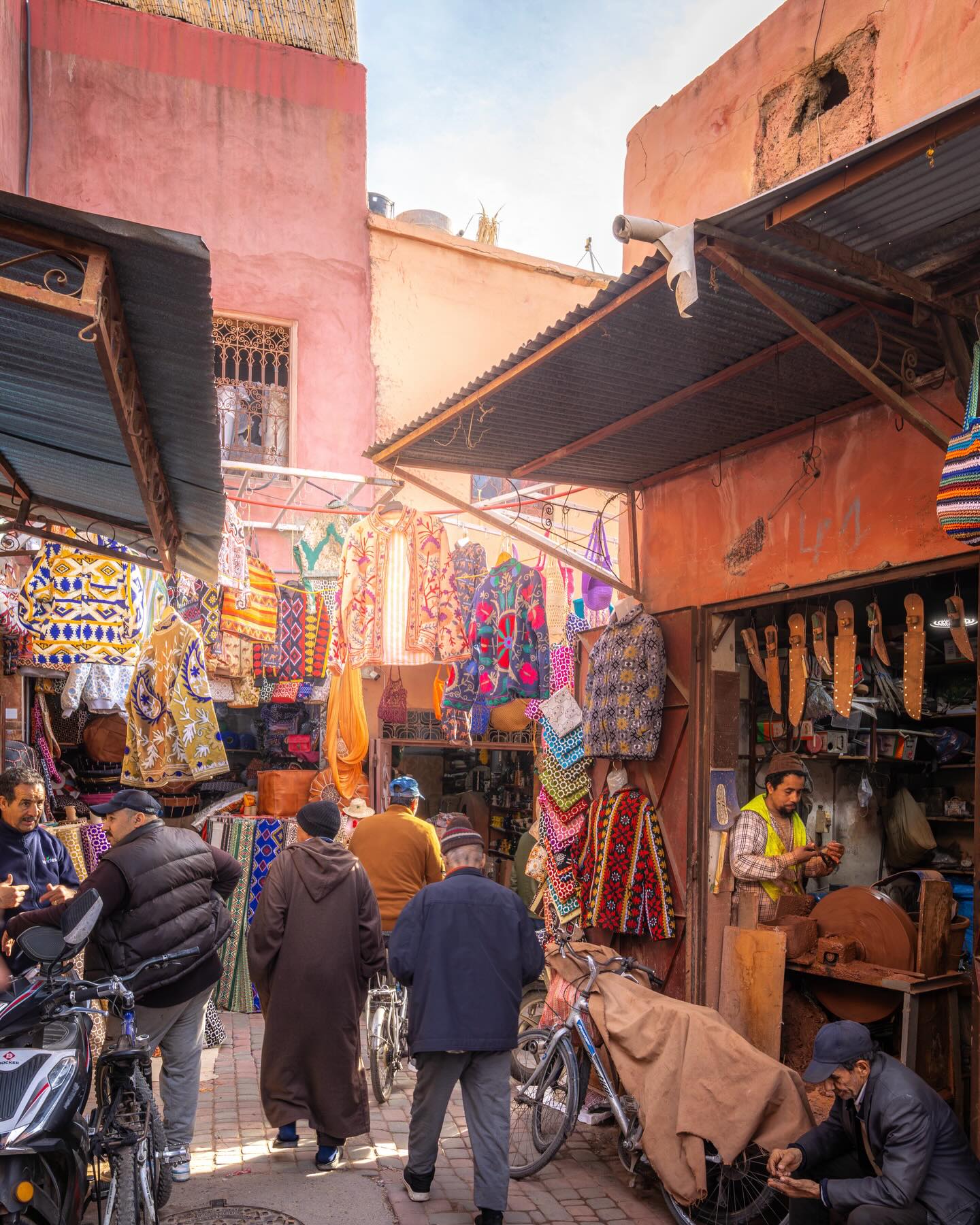
Marrakech medina souk streets — tips for avoiding tourist scams in Morocco

The souks of Marrakech are a feast for the senses — and a place where awareness pays off.


Morocco Scams Reddit — Real Stories from Real Travelers


Reddit’s r/Morocco and r/travel communities are goldmines of candid, unfiltered traveler experiences. Here are some of the most instructive stories, analyzed for what they teach us.
u/
u/BackpackingBrendan_92
r/travel · Verified Experience
“A guy in Fes approached us saying our riad was ‘in the new medina’ and he would take us there. We followed for 20 minutes before he stopped in front of a carpet shop. We hadn’t asked him anything. He then demanded 200 MAD for guiding us. We said no, he called us names and a policeman nearby actually intervened — the cop escorted us to our actual riad which was 5 minutes away.”
Analysis: This story illustrates several things at once. First, the redirect scam — the false claim about your accommodation’s location is a textbook opener to the fake guide trap. Second, it shows the police intervention that many Morocco scams reddit threads also confirm: Moroccan tourist police are genuinely responsive when called upon. The traveler’s mistake was following a stranger without first calling the riad. The lesson? Always have your accommodation’s phone number saved, and call them directly the moment any stranger questions your plans.
Source: r/travel on Reddit (paraphrased for privacy)
u/
u/SoloInMarrakech
r/Morocco · Verified Experience
“I was at Jemaa el-Fna when someone put a snake around my neck before I even noticed. I panicked and they immediately said ‘300 MAD for photo.’ I paid 50 MAD and walked away fast. Later I learned I should have just said no and walked away without paying at all.”
Analysis: The snake/animal photo scam relies entirely on the shock factor. Once the snake is placed on you without consent, you feel powerless. Legally, in Morocco, these handlers have no right to demand payment for an unsolicited interaction. The tourist police have cracked down significantly on this since 2022. If it happens: stay calm, hand the snake back firmly but without aggression, and walk away. Paying even a small amount reinforces the cycle. If possible, flag down the nearest tourist police officer wearing a blue vest.
Source: r/Morocco on Reddit (paraphrased for privacy)
u/
u/DigitalNomad_Wanderer
r/digitalnomad · Verified Experience
“I was living in Chefchaouen for a month as a remote worker. In the first week I fell for the ‘you need to see my brother’s shop’ thing twice. By week two I’d made friends with actual locals who were horrified by this and helped me understand the city properly. The scammers are a vocal minority.”
Analysis: This account captures the arc of most longer-term visitors: initial vulnerability followed by genuine community integration. As a digital nomad in Morocco, spending more than a few days allows you to distinguish the handful of scammers from the vast majority of honest locals — who are often embarrassed and frustrated by the reputation these opportunists create. The lesson: time in Morocco rewards patience, and real friendships here are among the most enduring.
Source: r/digitalnomad on Reddit (paraphrased for privacy)

🇲🇦 Morocco Is Still One of the Safest Destinations in Africa


It would be profoundly unfair — and factually wrong — to let this guide end without saying clearly: Morocco is a safe and welcoming country. The Global Peace Index consistently ranks Morocco among the safest nations in the Arab world and North Africa. Street crime rates are low compared to many European cities, and violent crime against tourists is rare.

The Moroccan government has invested significantly in tourism infrastructure and police presence. The Brigade Touristique (Tourist Police) is active in Marrakech, Fes, Agadir, and other major destinations. Response times to tourist complaints have improved markedly since 2020, with many reports resolved within 24–72 hours. Complaints can be filed in French or English at any tourist police station.

Beyond the institutional protections, Moroccan culture places enormous value on hospitality — diyafa — and the vast majority of locals take genuine pride in making visitors feel welcome. The scammers you may encounter represent a tiny fraction of a nation of nearly 37 million people, most of whom are mortified by such behavior. Don’t let a few bad experiences color your impression of an extraordinary country. You can explore more about where Morocco is and what makes it unique.

Mouhssine ELIOUJ — Licensed Moroccan Tourist Guide No. 2898
✓ Ministry Licensed
Your Solution to Every Scam on This List
Mouhssine ELIOUJ
Licensed Guide · Ministry of Tourism Morocco · Ref. No. 2898

The single most effective way to avoid every scam listed in this guide is to travel with a licensed, government-certified guide. Mouhssine ELIOUJ holds official accreditation from the Moroccan Ministry of Tourism (Ref. No. 2898), giving you full legal protection, professional knowledge, and a genuine local perspective that no app or blog can replicate. Reach out directly on WhatsApp for tips, private tours, or simply to ask questions before your trip — his guidance is invaluable whether you’re visiting for three days or three months.

Chat on WhatsApp — +212 671 437 971

General Tips for Avoiding Scams Across Morocco


Whether you’re visiting Morocco’s imperial cities or coastal towns, these principles apply universally across all destinations.

✦ Universal Safety Principles
  • Learn basic Darija phrases: “La, shukran” (no thank you) delivered confidently stops most approaches cold.
  • Walk with purpose — hesitation and map-checking signal vulnerability.
  • If you’re a woman traveling solo, research which cities are safest for solo female travelers before choosing your destination.
  • Keep a small amount of cash (50–100 MAD) in an accessible pocket for small transactions — no need to reveal your wallet.
  • Screenshot your accommodation’s location on Google Maps for offline access.
  • Trust official spaces: licensed restaurants, certified cooperatives, and government tourist offices are scam-free zones.
  • When in doubt, Morocco’s tourist police emergency number is 190.
  • Consider whether Morocco’s development context matters to your expectations — it’s worth reading our piece on Morocco’s economic development.
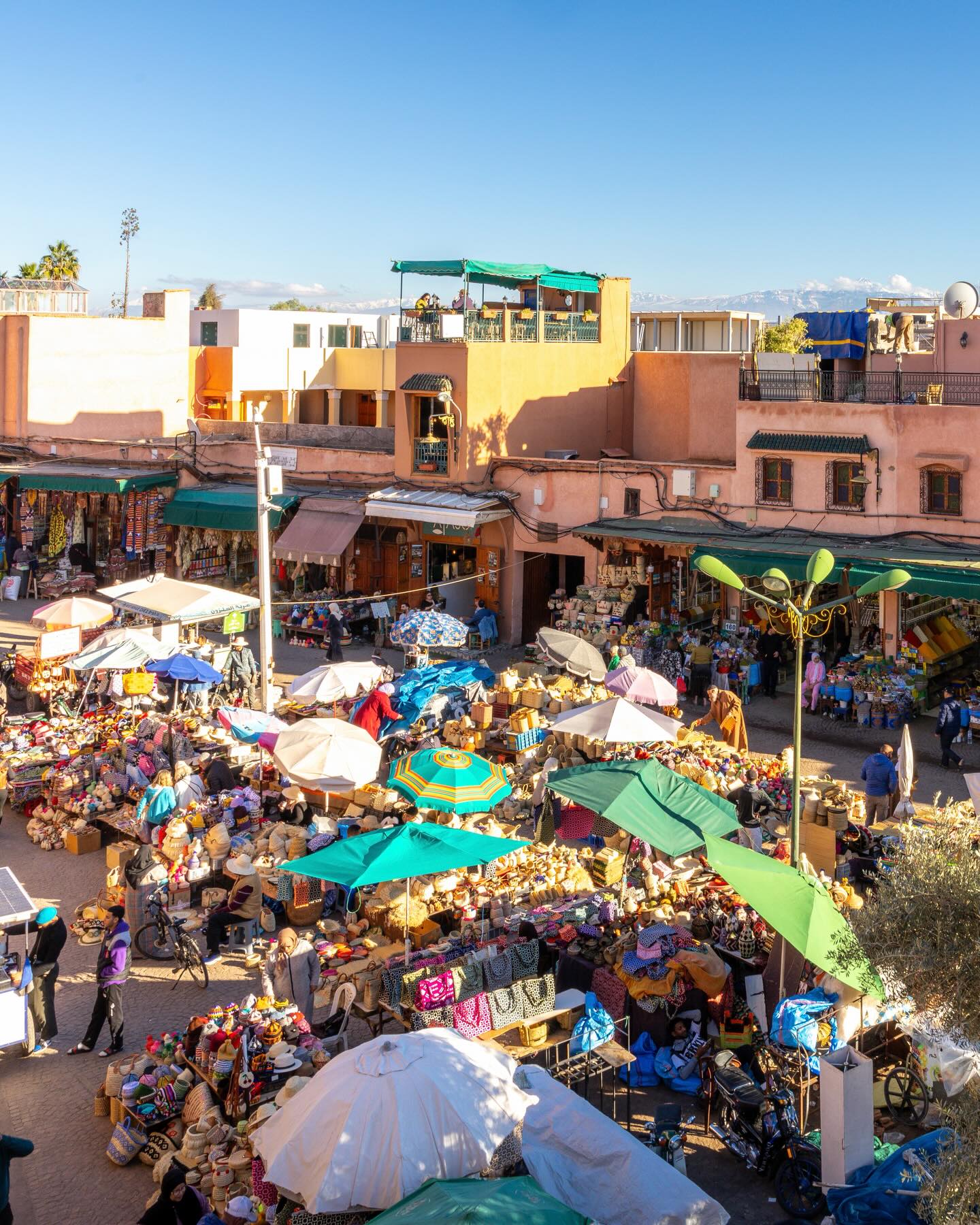
Morocco souks — tips to avoid tourist scams and travel safely

Traveling aware doesn’t mean traveling afraid — Morocco rewards those who engage openly.


Frequently Asked Questions


Q What are the most common scams in Morocco?
The most common tourist scams in Morocco include: the fake friendly guide who earns shop commissions, Marrakech taxi scams involving broken meters or inflated airport fares, unsolicited henna application followed by steep fee demands, fake geodes sold as genuine crystals, snake and monkey photo traps in Jemaa el-Fna, the riad redirect lie, unofficial currency exchange using counterfeit notes, and the Morocco shaking keys distraction technique. Being aware of all of these, as detailed throughout this article, dramatically reduces your risk.
Q What are 5 of the most current scams in Morocco in 2025–2026?
Based on current traveler reports and 2025–2026 updates: (1) Online romance scams targeting solo travelers before they even arrive; (2) Fake argan oil cooperatives selling diluted or synthetic products; (3) QR code phishing at tourist sites, where fake codes redirect to payment pages; (4) AI-generated fake tour agencies on social media that collect deposits and vanish; and (5) Medina “shortcut” guides who still operate despite the licensed guide laws. Staying updated via r/Morocco and using vetted platforms like Booking.com for accommodation helps avoid these newer threats.
Q What areas should tourists avoid in Morocco?
Morocco is generally very safe, but a few zones require extra awareness. In Marrakech, the area immediately around Jemaa el-Fna after midnight, and certain narrow alleys in the medina where visibility is low, warrant caution. In Casablanca, the Hay Mohammadi neighborhood is not recommended for tourists without a local guide. In Tangier, the port area has historically had more aggressive touts. The disputed regions of the Western Sahara are politically sensitive and worth researching through your government’s travel advisory before visiting. Read our full safety guide for city-by-city breakdowns.
Q How do I avoid scams in Marrakech specifically?
To avoid scams in Marrakech: always use metered taxis or ride apps; decline guidance from anyone who approaches you unsolicited; agree on all prices before sitting, eating, or receiving any service; use the licensed guide system for medina tours; stay in verified riads with strong Booking.com reviews; and keep your phone and valuables in a front-zipped compartment in crowded areas like Jemaa el-Fna. The Tourist Police (Brigade Touristique) patrols the main square and responds quickly to complaints — don’t hesitate to approach them.
Q Are Morocco romance scams common online?
Unfortunately, Morocco romance scams have become increasingly common via Instagram, Facebook, and WhatsApp. The perpetrators often create elaborate false identities and invest weeks or months in building emotional trust before requesting money. This is not unique to Morocco — it is a global problem — but Morocco is frequently named in victim reports, possibly because the country’s romantic cultural image makes it easier to construct convincing narratives. Report any suspicious accounts to the platform and to Action Fraud (UK) or the FTC (US).
Q What is the Morocco shaking keys scam?
The Morocco shaking keys scam is a distraction theft technique where someone approaches you rattling keys, claiming you dropped them. While your attention is diverted, an accomplice steals from your bag or pockets. The best defense: ignore the approach entirely and keep walking. Keep your bag zipped and worn across the body in any crowded public space.
Q Is it worth buying a geode or fossil in Morocco?
Absolutely — if you buy from reputable sources. Morocco has genuine, extraordinary mineral wealth, particularly in the Draa-Tafilalet region. The key is to research before buying: visit established shops in Marrakech’s Mellah or certified cooperatives near Erfoud, and expect to pay a fair price. True ammonites, celestite geodes, and selenite specimens from Morocco are world-class. Fake geodes Morocco sellers are easy to avoid once you know what authentic pieces look like and what they cost.
Q How should I report a scam or crime in Morocco?
For tourist-specific issues, approach the Brigade Touristique (Tourist Police) — identified by their blue vests in major medinas and tourist zones. The emergency police number in Morocco is 190. For non-emergency reports, visit the nearest police station (commissariat). If you’ve been scammed financially, also report to your bank immediately to contest the transaction, and notify your country’s embassy if the situation is serious. Morocco’s tourist authorities take these complaints seriously, and documented reports help them prosecute repeat offenders.

This article is for informational purposes only. Traveler safety experiences vary. Always check your government’s latest travel advisory before visiting Morocco.
Sources: Moroccan Ministry of Tourism, Global Peace Index 2023, r/Morocco, r/travel (Reddit), Brigade Touristique official guidelines, IATA travel safety reports.
Is Morocco Safe? · Morocco Currency Guide · Cities in Morocco
Leave a Reply

Your email address will not be published. Required fields are marked *

Others

Chat Icon