Table of Contents
Why a Morocco Trip from Spain Is Unlike Any Other Journey
There is a specific quality of light in the early morning above the Strait of Gibraltar — a pale pewter brightness that belongs to neither Europe nor Africa, but to the threshold between them. Stand on the deck of a ferry departing Tarifa, and within minutes the Spanish coastline softens into Atlantic haze while the ridgeline of the Moroccan Rif sharpens ahead. In that brief crossing, something fundamental shifts.
A Morocco trip from Spain is, by any rational measure, one of the most accessible and most genuinely transformative journeys a traveller can make. The two countries sit fourteen kilometres apart, yet the cultural, architectural, culinary, and sensory distance between them is immense. Understanding where Morocco is located — at the crossroads of the Atlantic and the Mediterranean, between sub-Saharan Africa and southern Europe — begins to explain why this kingdom carries such an extraordinary layering of civilisations, tastes, and traditions.
Morocco’s physical geography alone is staggering: the snow-capped High Atlas, the Sahara’s shifting dunes, fertile Atlantic plains, and ancient Atlantic and Mediterranean coastlines all exist within a country roughly the size of California. Berber villages cling to Atlas slopes above walnut groves. Royal medinas fold inward over centuries of trade, scholarship, and craft. The Sahara — the world’s largest hot desert — begins where the palm groves of the Draa Valley end. Morocco doesn’t reveal itself in fragments. It arrives all at once, and it stays with you long after you’ve gone home.
The most compelling journeys are not always the longest. They are the ones that change the register of your experience entirely. From Spain, Morocco achieves exactly that — and in less time than a transatlantic flight.
How to Travel from Spain to Morocco
The practical reality of a Morocco trip from Spain is far more convenient than most travellers expect. Whether you prefer the drama of a sea crossing or the efficiency of a short-haul flight, entry points are well-served and logistics are straightforward. Below are the primary routes, each with its own character and best-fit traveller.
| Route | Departure | Arrival | Duration | Best For |
|---|---|---|---|---|
| High-Speed Ferry Fastest | Tarifa | Tangier Med | ~35 min | Foot passengers, spontaneous crossings |
| Standard Ferry | Algeciras | Tangier Med | 60–90 min | Vehicles, groups with luggage |
| Flight | Madrid / Barcelona | Marrakech / Casablanca | 2–3 hrs | Direct access to southern Morocco |
| Flight | Málaga / Seville | Fez / Agadir | 1.5–2.5 hrs | Northern & Atlantic Morocco |
| Drive + Ferry Flexible | Any Spanish city | All of Morocco | Flexible | Road-trippers, extended stays |
The ferry crossing from Tarifa remains the most evocative option — the moment Moroccan soil comes into focus is one that travellers consistently describe as the most memorable of their trip. That said, flying directly into Marrakech or Fez allows you to reach the deeper interior of Morocco without losing a day to overland transfers.
Six Reasons Your Morocco Journey Will Stay With You
Morocco rewards travellers of every temperament — the culturally curious, the photographically obsessed, the gastronome, the adventurer, and the seeker of genuine quiet. What follows is not a checklist but an invitation.
The Imperial Cities
Fez, Meknes, Marrakech, and Rabat each contain a different chapter of Moroccan civilisation. The medina of Fez — a UNESCO World Heritage site and the world’s largest car-free urban area — has been continuously inhabited since the 9th century. Its tanneries, madrasas, and caravanserais remain gloriously unchanged. A thorough overview of Morocco’s cities helps you build the itinerary that suits you best.
Erg Chebbi & the Sahara Desert
The dunes of Erg Chebbi rise 150 metres above the pre-Saharan plains near Merzouga. At dusk, when the light turns amber and the wind stills, the desert becomes something close to sacred. A night under the Milky Way in a luxury desert camp is the single most commonly cited memory among travellers who’ve made this journey from Spain — and it’s easy to understand why.
The High Atlas Mountains
Few visitors from Spain anticipate the sheer scale of the Atlas range — a mountain system stretching 2,500 kilometres with Jebel Toubkal reaching 4,167 metres, the highest peak in North Africa. Between its passes, Amazigh (Berber) villages of terraced stone have sustained their own languages, customs, and calendar for millennia. Morocco’s remarkable physical geography makes every drive across the Atlas a journey through geological time.
Chefchaouen, the Blue Pearl
Set in the Rif Mountains, Chefchaouen was founded in 1471 as a refuge for Moorish and Jewish exiles from Andalusia. Its streets were painted blue — some say to mirror the sky, others to ward off mosquitoes, others simply because collective memory made it so. It remains one of the most photogenic cities on earth, and far more peaceful than its social-media fame suggests.
Moroccan Gastronomy
A proper Moroccan meal is a ceremony. The bastilla — a gossamer pastry filled with pigeon, almonds, and cinnamon — was carried across the Strait from Andalusia centuries ago and perfected on the other side. A lamb tagine slow-cooked with preserved lemon and olives arrives still bubbling in its earthenware vessel. Breakfast alone — msemen, amlou, argan honey — deserves its own itinerary. This is a cuisine fifteen centuries in the making, and it shows in every bite.
Kasbahs & Desert Architecture
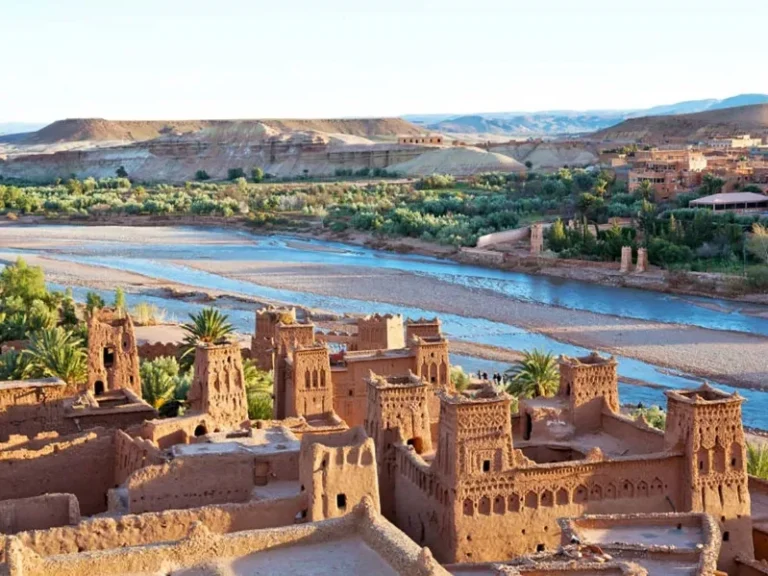
The earthen kasbahs of the Draa Valley and Dadès Gorge are among the most architecturally distinctive structures in the world — built from pisé and straw, geometric and fortress-like, glowing amber at sunrise. Aït Benhaddou, a UNESCO-listed ksar on the ancient trans-Saharan caravan route, has appeared in more films than almost any location on earth. Experience it in person, without a film crew, and you understand why.
Marrakech — Where the Senses Rule
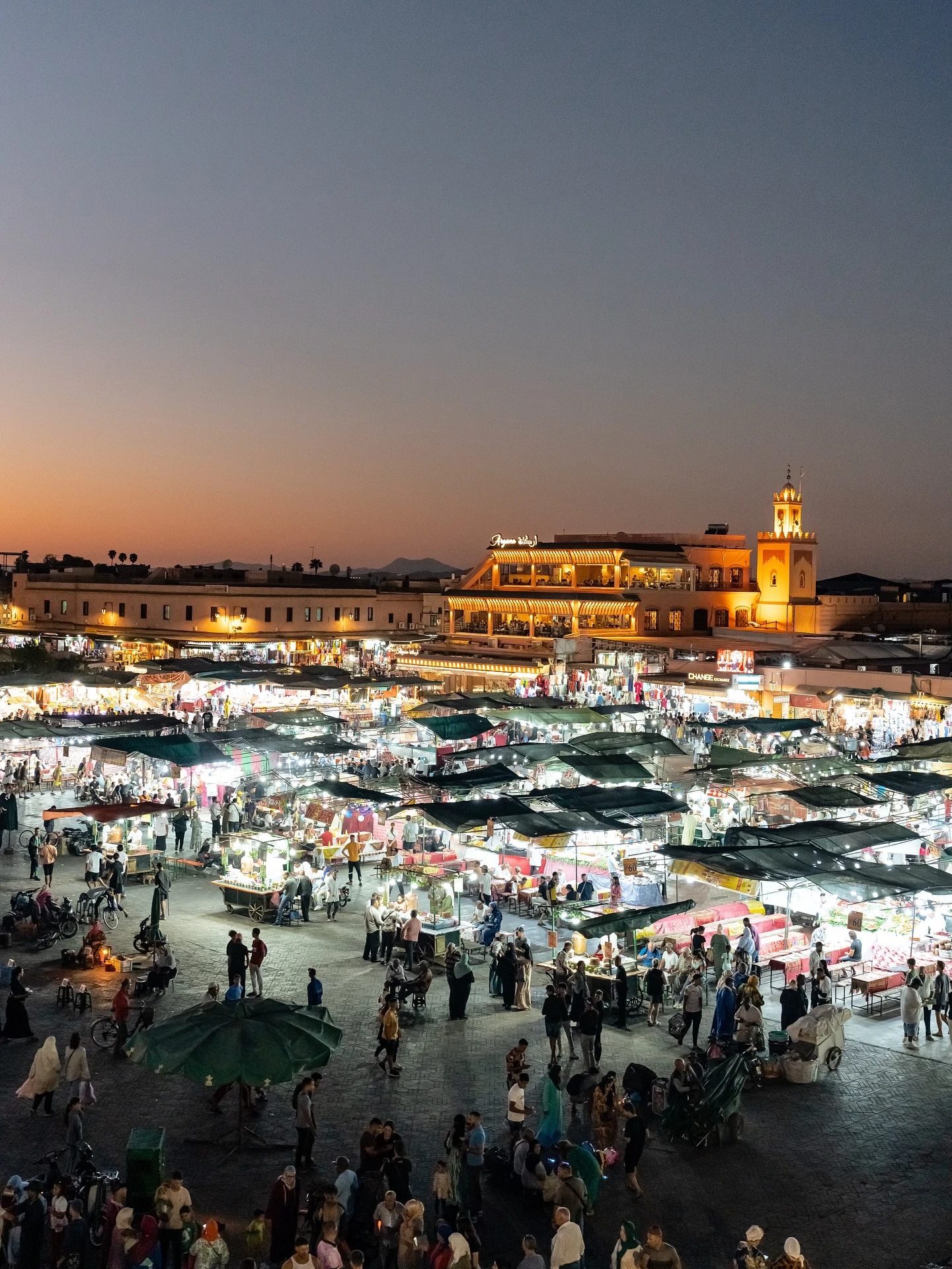
No Morocco trip from Spain feels complete without Marrakech. This is a city that operates at its own tempo — urgent, theatrical, and entirely itself. Djemaa el-Fna square is the pulsing heart of it all: by afternoon it belongs to herbalists, henna artists, and fresh-squeezed orange juice vendors; by night it transforms into an open-air stage for storytellers and musicians whose traditions predate the printing press.
Inside the medina’s rose-tinted walls, the souks are not merely markets — they are a living archive of Moroccan craft. Leatherworkers in the Chouara quarter have dyed hides in earthenware vats since the 11th century, using the same natural pigments — poppy red, saffron yellow, indigo blue — as their medieval predecessors. Every alley turned reveals another artisan at another loom, another furnace, another chisel.
From the Atlas to the Draa Valley
One of the world’s great overland drives begins in Marrakech and climbs the Tizi n’Tichka pass — where snow-dusted cedar gives way to a pre-Saharan palette of ochre, rust, and terracotta — before descending toward the kasbahs of the Draa Valley and the Sahara beyond. The landscape shifts every hour: mountain, gorge, oasis, desert. It is a journey through geological time as much as through geography.
Our Morocco tour packages include private, air-conditioned transport along this legendary route with local guides who know the names of the nomadic families whose tents appear at the roadside. The road isn’t the destination — but it is very much part of the experience.
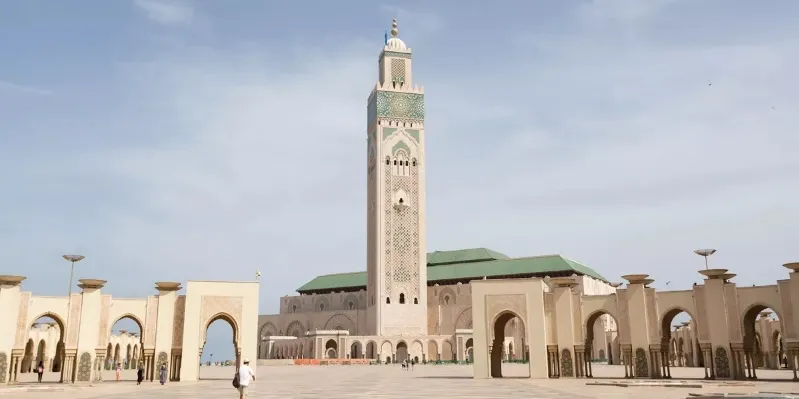
The Sahara does not offer spectacle. It offers silence — and that is far rarer.
Planning Your Morocco from Spain Trip with Confidence
A successful journey begins with informed decisions made before departure. These essentials cover everything a traveller from Spain needs to know before crossing the Strait.
March to May and September to November are the golden windows — mild temperatures across all regions, blooming landscapes in the Atlas, and passable desert roads. High summer is intense inland; the Atlantic coast stays agreeable year-round. Winter brings dramatic solitude and cool clarity to the Sahara.
Holders of EU passports and Spanish national identity cards enter Morocco visa-free for up to 90 days. A valid travel document and evidence of onward travel are required at the border. No vaccinations are mandated under standard entry conditions, though consulting your doctor before departure is always advisable.
Morocco uses the Moroccan Dirham (MAD). Knowing what currency Morocco uses before you travel helps you budget accurately. Exchange euros at official bureaux for the best rates; ATMs are widely available in cities, but cash remains essential in rural souks and remote villages.
Dress modestly near mosques, in rural villages, and in traditional medinas. Accept mint tea when offered — declining is considered impolite. A greeting of “As-salamu alaykum” and a few words of Darija are received with genuine warmth. Photography of individuals always requires a courteous ask first.
Riads — traditional courtyard houses converted into guesthouses — are the most atmospheric way to sleep in a Moroccan medina. They range from family-run retreats to opulent boutique hotels with rooftop terraces and private hammams. In the desert, glamping camps at Merzouga offer exceptional stargazing with surprising comfort.
Morocco maintains a strong record for traveller safety and consistently ranks among the safest destinations in North Africa. Standard precautions apply in crowded medinas. For an honest, up-to-date assessment, read our full guide on Morocco safety for tourists before you travel.
Morocco can be navigated independently, but the medinas of Fez and Marrakech are genuine labyrinths where a knowledgeable guide transforms a potentially confusing experience into an enlightening one. First-time visitors from Spain benefit enormously from local expertise — language, context, and genuine insider access make the difference.
A long weekend covers Marrakech and the nearby Atlas valleys. Seven days adds the imperial cities. Ten days reaches the Sahara and back at a comfortable pace. For the full arc — coast, mountain, desert, and medina — allow twelve to fourteen days. Morocco consistently rewards the time invested in it.
Chat Directly with a Licensed Moroccan Guide
The difference between a good trip and an unforgettable one is often the person standing beside you — someone who knows the stories behind the stones, the families behind the craft, and the roads that lead beyond the guidebooks. You can reach your guide directly, right now, on WhatsApp.
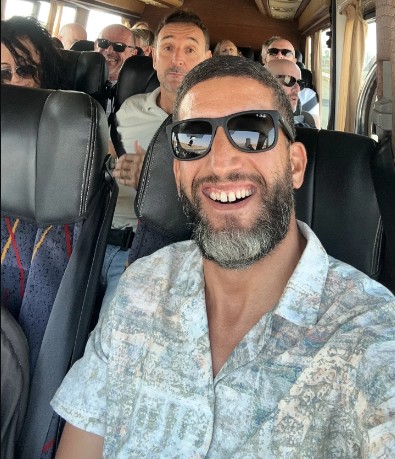
Based in Morocco · Available for Groups & Private Tours
Mouhssine has guided travellers from Spain and across Europe through Morocco’s imperial cities, Atlas mountains, and Saharan dunes for over a decade. Fluent in Arabic, French, Spanish, and English, he brings both deep historical knowledge and a genuine passion for connecting visitors to the country he calls home. Whether you’re planning a weekend in Marrakech or a two-week expedition to the desert, Mouhssine can help you design the exact journey you’re looking for.
Chat on WhatsApp · +212 671 437 971Everything You Need to Know About a Morocco Trip from Spain
How long does the crossing from Spain to Morocco take?
The fastest passenger ferry from Tarifa to Tangier Med takes approximately 35 minutes. From Algeciras, the crossing is around 60–90 minutes depending on vessel type. Flights from Madrid or Barcelona reach Marrakech or Casablanca in under three hours. With the right planning, you can leave Spain after breakfast and be sitting in a Moroccan medina by lunchtime.
Do Spanish citizens need a visa to enter Morocco?
No. Spanish passport holders and other EU nationals enter Morocco visa-free for stays of up to 90 days within any 180-day period. A valid national identity card or passport is required. Carry evidence of onward travel if asked at border control, and ensure your documents are valid for the duration of your stay.
How many days should I plan for a Morocco trip from Spain?
For a meaningful first visit, seven to ten days is the minimum we recommend. A 10-day tour from Fes covers the imperial cities, the Atlas, and the Sahara at a comfortable pace. Short escapes of three to four days work well for Marrakech combined with Atlas excursions. The more time you give Morocco, the more it reveals.
Which cities in Morocco should I visit on my first trip?
Marrakech, Fez, Chefchaouen, Essaouira, and Meknes are the most beloved by first-time visitors from Spain. Rabat — Morocco’s capital — is often overlooked and genuinely rewards the effort. Our guide to the cities of Morocco maps out every major destination with practical detail to help you choose.
Is Morocco safe for tourists travelling from Spain?
Morocco consistently ranks among the safest travel destinations in North Africa. Tourist infrastructure is well-developed, police presence in medinas is visible, and the hospitality culture is both genuine and strong. Standard precautions apply in busy areas. For a detailed and objective assessment, read our guide on Morocco safety for tourists.
Can I bring my car from Spain to Morocco on the ferry?
Yes. Vehicle ferries operate between Algeciras and Tangier, and several other ports along the southern Spanish coast. Booking in advance is strongly recommended during summer months and major holidays when demand peaks significantly. Road-tripping Morocco — through Atlas passes and along pre-Saharan highways — is a deeply rewarding way to experience the country’s diverse landscape.
Do I need to speak Arabic or French to visit Morocco?
Not at all. English is widely spoken in tourist areas, riads, and by licensed guides. French remains Morocco’s administrative second language. Spanish is understood and often spoken in northern Morocco — particularly in Tetouan — giving travellers from Spain an unexpected linguistic advantage. A few words of Darija are always received with genuine warmth.
What currency should I bring to Morocco from Spain?
Morocco uses the Moroccan Dirham (MAD), which is not convertible outside the country. Bring euros and exchange them on arrival at official bureaux de change for significantly better rates than airport kiosks. ATMs are plentiful in cities. In rural souks and remote villages, cash is the only viable option. Our guide to Morocco’s currency explains everything you need to know before you travel.
Begin Your Journey
Your Morocco Adventure
Starts in Spain
From the first morning light above the Strait to the last glass of mint tea beneath a desert sky, every detail of your Morocco trip from Spain deserves the care that only comes from people who truly love the country they guide you through. Moroccan Travel Trips — your trusted bridge between Spain and the kingdom across the water.