
Tajine Morocco: The Story of a Nation Told in a Single Pot
Lift the conical lid of a Moroccan tajine, and a plume of steam rises thick with saffron, ginger, and slow-coaxed onions. Below it, a burnished stew glistens, quiet and alive. This is not simply dinner. It is an invitation into the soul of a country.
The word tajine carries a rare duality: it names both the iconic earthenware vessel and the luminous, slow-cooked stew that forms inside it. To understand this dish in all its history, science, and ceremony is to begin understanding Morocco itself — a nation simmered to depth through centuries of intersecting civilizations. And once you taste it, the question of what to eat in Morocco answers itself.
The tajine is not merely a cooking vessel. It is a time capsule of Moroccan history — a place where flavors, cultures, and quiet traditions have converged for over two thousand years.
From Nomad’s Necessity to Sultan’s Delight: A Brief History Top
The Amazigh Genesis
Long before Arab caravans or European explorers reached these shores, the indigenous Amazigh people inhabited the landscapes of North Africa — from the Atlas peaks to the open pre-Saharan plains. For these communities, resourcefulness was not a virtue; it was survival. The tajine pot emerged from this necessity over 2,000 years ago, a masterpiece of practical thinking shaped by the land itself.
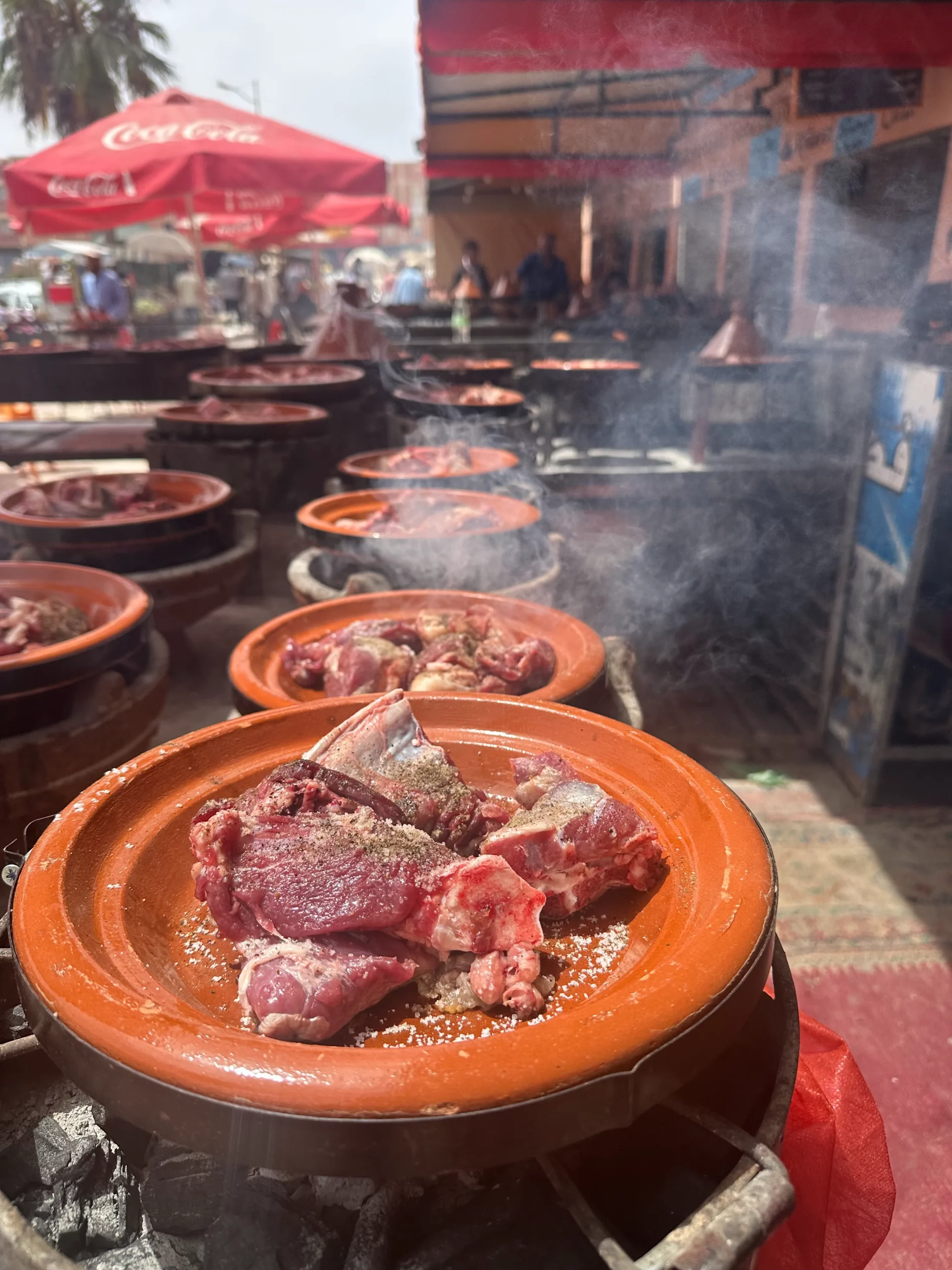
Thick clay walls retained heat efficiently, enabling a long, gentle cook over minimal charcoal or wood embers. The conical lid trapped every drop of moisture, tenderizing tough cuts of lamb or goat alongside whatever foraged vegetables and grains were on hand. These earliest tajines were honest, hearty, and deeply rooted in the earth — a direct reflection of the lives of those who made them.
Layers of Influence: How History Flavored the Pot
The evolution of the Moroccan tajine mirrors the history of Morocco itself — a resilient indigenous foundation enriched, never erased, by successive waves of cultural exchange spanning more than a millennium.
Arab Influence (7th century onward): The spice routes introduced cinnamon, ginger, turmeric, cumin, and saffron to the Moroccan kitchen. Inspired by Persian culinary philosophy, Arab dynasties also brought the revolutionary idea of sweet-and-savory pairing — adding dried prunes, apricots, and dates to braised meat, a combination that defines the tajine’s most celebrated expression to this day.
Moorish and Jewish-Moorish Contributions: Andalusian Moors arriving from Southern Spain planted olive and citrus groves across the country, transforming both landscape and larder. Jewish-Moorish communities that followed contributed one of Morocco’s most iconic condiments: the preserved lemon — cured in salt and citrus, intensely aromatic, and impossible to replicate. It remains a cornerstone of the classic chicken tajine found in homes across the country.
Ottoman and French Echoes: The Ottoman presence reinforced a love of grilled and spiced meats. The French protectorate left a subtler imprint — a café culture and, in some northern regions, the introduction of glazed enamel cookware that modernized, if also diluted, the tajine’s earthy character.
A single bite of a classic Fassi tajine — lamb with prunes, almonds, and a whisper of cinnamon — holds all of this within it. It is edible history: Berber patience, Arab spice, Andalusian olives, and the preserved lemon’s briny brilliance folded into one extraordinary pot.
The Alchemical Vessel: Science and Soul of the Tajine Pot Top
The Physics of the Cone
The tajine’s conical lid is not decorative — it is a precisely functional piece of culinary engineering. As the stew simmers, steam rises along the sloping interior walls. When it reaches the cooler apex, it condenses back into liquid. Gravity returns these concentrated, flavor-laden droplets into the base, bathing the contents in their own fragrant juices in a continuous self-basting cycle.
The result is meat that yields without resistance, and vegetables deeply saturated with flavor — all while consuming far less water than any Western equivalent. This efficiency is no accident. It is the survival logic of a dish born in an arid land where every drop of water carried weight.
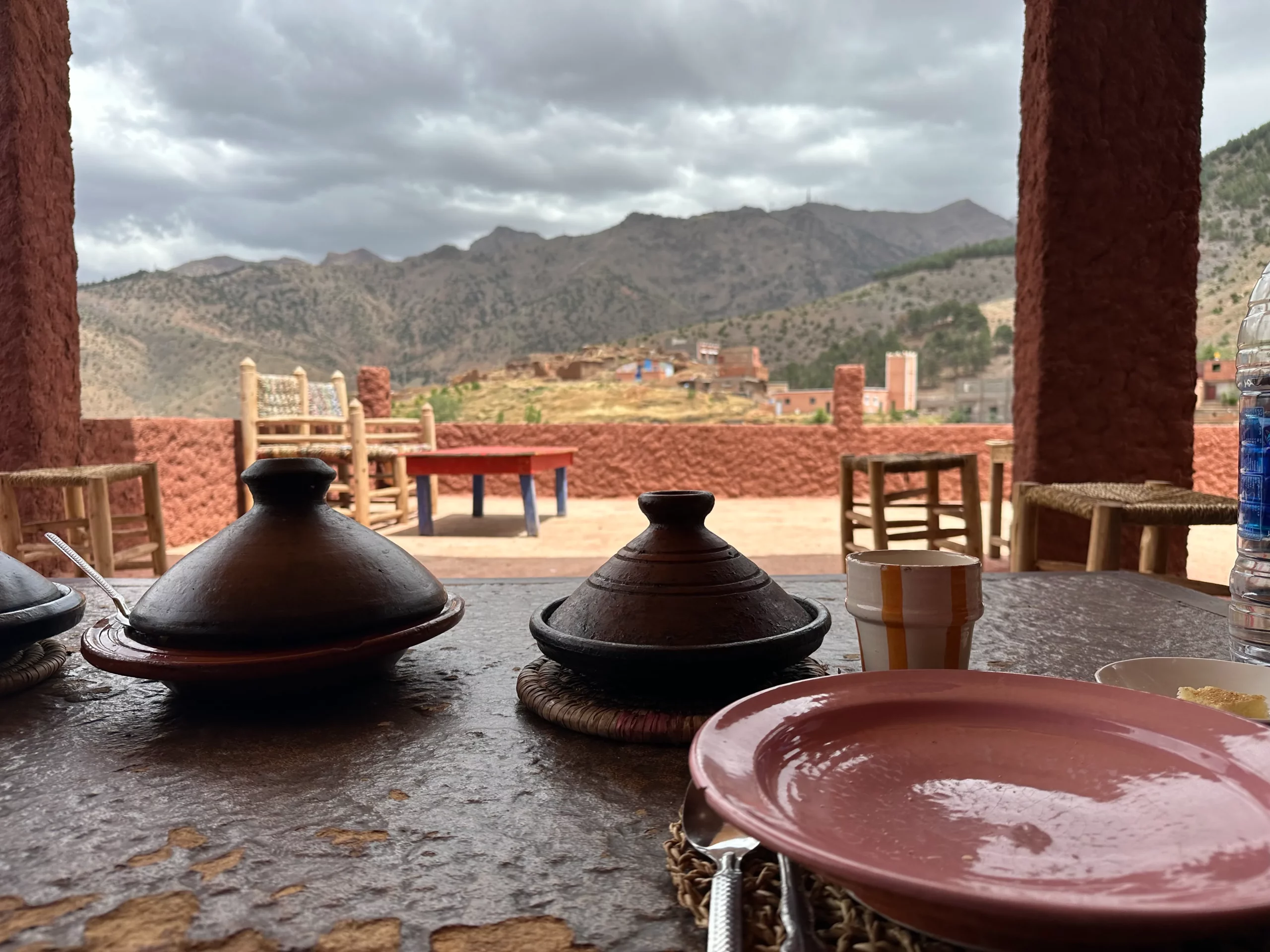
A clay tajine releasing its steam — the self-basting system that has nourished Morocco for millennia.
Why Unglazed Clay Changes Everything
An authentic Moroccan tajine is shaped from unglazed, porous earthenware. That porosity is essential: the clay breathes, allowing slow and even heat distribution and a circulation of moisture that prevents scorching. More profoundly, the raw earth imparts a subtle mineral quality to the finished dish — what cooks in Fez call the taste of the soil. This cannot be replicated in glazed ceramic or cast iron, however beautiful those vessels may be.
The Majmar: Fire Beneath the Earth
Authentically, a tajine does not rest on a gas ring. It sits on a majmar, a low terracotta charcoal brazier. The gentle radiant heat of smoldering embers sustains a slow simmer without fluctuation, allowing spices to bloom and proteins to transform over several hours. The faint smoke that permeates the clay is a final, irreplaceable note — a ghost flavor that no modern appliance produces. Remove the majmar and you have a good stew. Keep it and you have a tajine.
A Culinary Atlas: Morocco’s Regional Tajines Top
To speak of a Moroccan tajine is to misunderstand it. The dish is a culinary chameleon, reshaped by climate, agriculture, and centuries of local tradition across every corner of the country. Traveling through Morocco’s cities and regions is to eat your way through its most honest map.
| Region | Flavor Character | Key Ingredients | Signature Dish |
|---|---|---|---|
| Fez | Sweet & savory, aromatic, complex | Lamb, prunes, almonds, cinnamon, saffron | Mrouzia — Lamb with Prunes & Almonds |
| Marrakech | Robust, earthy, hearty | Kefta (spiced meatballs), tomatoes, eggs, cumin | Kefta Mkaouara — Meatball & Egg Tajine |
| Atlantic Coast | Zesty, herbaceous, briny | White fish, sardines, chermoula, tomatoes | Fish Tajine with Chermoula |
| Southern Sahara | Sweet, nutty, floral | Chicken, dates, argan oil, saffron | Chicken Tajine with Dates & Almonds |
In Fez — Morocco’s gastronomic capital — tajines arrive complex and perfumed, the celebrated mrouzia layering lamb, honey-caramelized prunes, and toasted almonds into something that feels closer to a slow poem than a recipe. In Marrakech, flavors are bolder and more immediate; the kefta tajine, with its spiced meatballs poached in a concentrated tomato sauce and finished with eggs, is the city’s most satisfying expression of the dish. Along the Atlantic coast between Casablanca and Essaouira, the tajine opens to the sea, celebrating fresh catch marinated in the herbaceous, cumin-bright paste called chermoula. And in the Saharan south, the oasis kitchen produces tajines scented with argan oil, dates, and figs — the taste of abundance in a landscape that offers it sparingly.
More Than a Meal: Tajine as Social Ritual Top
In Morocco, the tajine is not plated — it is shared. Placed at the center of a low table, it becomes the gravitational point around which family and guests gather. There are no individual servings, no demarcations of mine and yours. Everyone eats from the same vessel, reaching for pieces of crusty khobz bread to scoop tender meat and aromatic sauce from the section closest to them — an unspoken etiquette that assigns space without a single instruction.
To be invited to eat from a tajine in a Moroccan home is not a casual gesture. It is the culture’s most direct expression of hospitality — a word that in Arabic, diyafa, carries an almost sacred weight. The shared pot makes visible what Moroccan culture values above most things: the primacy of presence, of eating together, of slowing down enough to be genuinely with one another.
A note for the curious traveler: In a traditional Moroccan home, you will almost never find tajine served alongside couscous. Despite what many international restaurants suggest, they are two separate main courses. Couscous is its own ceremony — reserved, by long tradition, for Friday family gatherings and special celebrations. If you want to understand Moroccan food culture beyond the surface, this distinction matters.
Experience Marrakech Through Its Flavors
A Private Luxury Food Tour in Marrakech takes you beyond the tourist trail — into the medina’s hidden kitchens, family-run fondouks, and spice souqs where the real story of Moroccan cuisine lives. Taste fresh-pulled msemen, slow-simmered harira, and a kefta tajine cooked the way it has always been cooked: over fire, with patience.
Two Timeless Moroccan Tajine Recipes Top
Lamb Tajine with Prunes & Toasted Almonds — The Taste of Fez
This is the taste of celebratory Fez, the dish that best captures the sweet-and-savory soul of Moroccan cuisine. Bone-in lamb shoulder is braised slowly with onions, ginger, saffron, cinnamon, and turmeric until the meat yields at the merest touch. The prunes are prepared separately — simmered with honey, a cinnamon stick, and a ladle of lamb broth until plump and glossy. They are spooned over the finished tajine at the table, crowned with a scatter of almonds roasted in butter until golden. The result is a layered, almost paradoxical dish: deeply savory and gently sweet, perfumed and quietly restrained. Serve with nothing more than warm khobz bread and good company.
Chicken Tajine with Preserved Lemons & Olives — The Everyday Classic
This is perhaps the most beloved tajine in Morocco — the one that appears on kitchen tables from Tangier to Agadir, week in, week out. The preparation, known as djaj mqualli, begins with patience: onions are sweated slowly in olive oil until they dissolve into a jammy, golden base. Chicken pieces are nestled in, coated with a paste of ginger, turmeric, cumin, and white pepper, and left to simmer until the fat runs clear. Then comes the transformation — quartered rinds of preserved lemons, intensely fragrant and sharp with cured brine, and a generous handful of cracked green olives. A bouquet of fresh cilantro is tied and added to the broth during cooking, perfuming the sauce with herbal brightness. The result is clean, vivid, and deeply satisfying — a dish that proves restraint is its own form of luxury. It is, in every sense, the gateway to understanding what to eat in Morocco.
How to Find a Truly Authentic Tajine in Morocco Top
Finding a great tajine requires looking past the obvious. While the spectacle of Djemaa el-Fna in Marrakech is an experience worth having, the most memorable tajines are rarely found at its loudest stalls. Here is how to eat well — and honestly — while visiting Morocco.
Follow the Locals
The best indicator of an authentic kitchen is a room full of Moroccan diners. Venture into the medina’s side alleys and look for places with no English menus on the door — just the smell of charcoal and slow-cooked onions drifting into the lane.
Seek Out Riads
A traditional riad that takes its kitchen seriously will often serve the most nuanced, home-style tajines — cooked by someone who grew up eating them, not reading about them in a culinary school textbook.
Take a Cooking Class
A tajine class — ideally one that begins with a souq tour for fresh ingredients — connects you with the techniques and people behind the dish in a way no restaurant table ever can.
Look for Seasonality
A restaurant with a short, rotating menu is a better bet than one offering the same five tajines year-round. Authentic Moroccan cooking tracks the seasons: spring artichokes, summer tomatoes, winter root vegetables.
Before your trip, it helps to prepare. Know that Morocco uses the Moroccan Dirham (MAD) — an essential detail for navigating local markets and paying at small family-run spots that rarely accept cards. And rest assured: Morocco is a safe and welcoming destination for travelers, with a culture of hospitality that makes solo and group dining remarkably easy to navigate.
Frequently Asked Questions About Moroccan Tajine Top
A tajine and a stew share the same basic principle — slow-cooking meat and vegetables in liquid — but they differ in nearly every important way. A tajine uses its clay cone to recirculate steam back into the pot, so no external water is added. The result is a more concentrated, deeply perfumed dish with a thicker, glossier sauce. A stew is typically cooked in an open pot and requires more liquid. The clay vessel itself also contributes a subtle mineral flavor that is entirely absent from anything cooked in metal.
Yes, provided the tajine is oven-safe and you preheat it gently to avoid thermal shock. Place it in a cold oven, set the temperature to around 160°C (325°F), and allow it to come up to heat slowly. The self-basting function still works in an oven, though the faint charcoal smoke of a majmar fire cannot be replicated. For those cooking at home outside Morocco, the oven method produces excellent results — the key is patience and a low temperature.
The flavor of a Moroccan tajine is warm, aromatic, and layered in ways that are difficult to describe until you have experienced them. Saffron adds a floral depth that no other spice replicates. Ginger provides gentle heat without sharpness. Preserved lemon contributes a briny, citrusy brightness. The meat — lamb, chicken, or beef depending on the recipe — is butter-soft after hours of slow cooking. Taken together, the flavor is simultaneously comforting and exotic, deeply familiar and entirely unlike anything else.
Most traditional tajine recipes take between 2 and 3 hours of slow cooking over low heat. The preparation itself — trimming meat, sweating onions, grinding spices — adds another 20 to 30 minutes. The long cooking time is not a flaw; it is the point. Proteins break down gradually, spices bloom fully, and the sauce reduces to a concentrated, silky consistency that a shorter cook simply cannot produce. Rushing a tajine is the one thing Moroccan cooks agree you should never do.
Moroccan tajine is aromatic and warmly spiced, but not hot in the chili sense. The spices used — ginger, cumin, cinnamon, saffron, turmeric — create depth and warmth without the burn associated with Thai or Indian cuisines. Harissa, a fiery red paste, is sometimes served on the side for those who want heat, but the tajine itself is almost always mild enough for all palates. This makes it one of the most accessible dishes in Moroccan cuisine for first-time visitors.
An Invitation to the Moroccan Table
The journey of the tajine — from a nomad’s portable oven to a symbol of national identity — mirrors the journey of Morocco itself. It is a dish shaped by patience, by trade, by displacement and return, by the wisdom of knowing that the best things cannot be rushed. To share one is not merely to eat. It is to participate in a ritual of welcome that is thousands of years old: the act of gathering close, breaking bread, and accepting warmth from strangers who, in Morocco’s generous tradition, quickly become something more.
Whether you are planning your first trip or have returned many times, the tajine remains the most direct entry point into what Moroccan culture actually values. It is on every table, in every season, in every corner of the country — always the same in principle, endlessly varied in practice. Start there, and the rest of what Morocco has to offer at the table will reveal itself naturally.
Plan Your Authentic Moroccan Culinary Experience
Ready to go beyond the tourist trail and discover Morocco through its kitchens, markets, and family tables? A knowledgeable local guide makes all the difference.
Contact Mouhssine ELIOUJ, a licensed Moroccan tour guide (Réf. 2898 — Ministry of Tourism), to plan a personalized culinary journey through the flavors, stories, and hidden kitchens of Morocco.