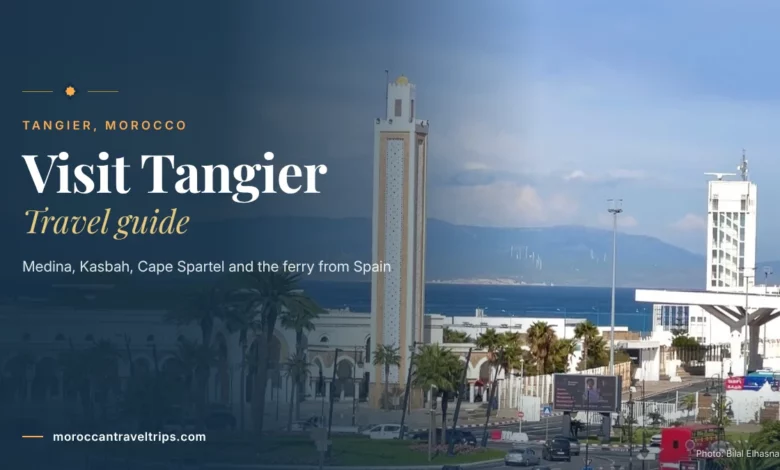
Most people meet Tangier from the deck of a ferry, watching the white city climb the hill above the bay and wondering whether to stay one night or push straight on to Fes. Tangier, Morocco, deserves more than a stopover: two full days give you the medina, the Kasbah, the Atlantic cliffs at Cape Spartel and an evening on the Café Hafa terraces, without rushing any of them.

Tangier is Morocco’s northern port city on the Strait of Gibraltar, linked to Spain by ferry and to Rabat and Casablanca by the Al Boraq high-speed train. Plan two full days for the medina, the Kasbah, the American Legation, Cape Spartel and the Hercules Caves, and add a third if you want a beach afternoon.
Stay at least two nights. Tangier rewards slow walking more than box-ticking, and the city reads very differently after dark. Skip it only if your trip is short and centred on Marrakech and the desert: going north for one night costs a full day of travel each way.
- Time needed
- Two full days
- Best months
- April to June, September to October
- Arriving from Spain
- Ferry from Tarifa or Algeciras
- Currency
- Moroccan dirham (MAD)
- Languages you will hear
- Darija, French, Spanish
- Pairs well with
- Asilah, Chefchaouen, Tetouan, Fes
Getting to Tangier: which port, which trainContents ↑
The detail that catches people out is the port. Tangier has two: Tanger Ville, the passenger harbour at the foot of the medina, and Tanger Med, a large commercial port well to the east along the coast. Where your ferry lands decides whether you walk to your riad or need a road transfer, so check it before you book the crossing.
| Route | Arrives at | Crossing or ride | Good to know |
|---|---|---|---|
| Ferry from Tarifa | Tanger Ville, in town | About one hour | Best for foot passengers |
| Ferry from Algeciras | Mostly Tanger Med | About 90 minutes | Plan transport into the city |
| Al Boraq train | Tanger Ville station | About 2 h 10 from Casablanca | Book ahead at weekends |
| Flight | Ibn Battouta Airport | Short taxi ride to town | Direct links to several European cities |
The high-speed line changed how Tangier fits into a route. Rabat is now an easy morning away and Casablanca a little more, which makes it realistic to land in Casablanca, ride north and start a loop here. Our page on riding Al Boraq and the rest of the rail network covers classes, stations and booking.
Ferry operators and timetables change more often than guidebooks admit. The fast ferry once advertised as a thirty-five minute hop is now sold as a crossing of about an hour, so build in margin if you have a train to catch.
The medina, from Grand Socco upContents ↑
Start at Grand Socco, officially Place du 9 Avril 1947, named for the day Sultan Mohammed V gave his Tangier speech calling for Moroccan independence. The square is a crossroads rather than a monument: buses, taxis, the tiled minaret of the Sidi Bou Abib mosque, and the gate of Bab Fahs leading into the old town.
Through the gate, Rue es-Siaghine, the street of the jewellers, runs downhill to Petit Socco. That small square of cafés carried a lot of legend during the years of the International Zone, from the 1920s to 1956, when Tangier was run by a group of foreign powers and drew writers, bankers and people with reasons to be far from home. Today it is a good place to sit with a mint tea and watch the medina go about its business.

Compared with Fes or Marrakech, this medina is small and climbs steeply, which makes it easier to keep your bearings: downhill leads to the port, uphill to the Kasbah. Leather, brass lanterns, djellabas and woven goods are the usual buys. Prices start high everywhere, and our notes on haggling without giving offence apply here word for word.
Ibn Battuta, the fourteenth-century traveller whose name the airport carries, was born in Tangier in 1304. A modest tomb attributed to him stands in the upper medina, signposted but easy to walk past.
The Kasbah and its museumContents ↑
The Kasbah sits on the highest ground of the old town, behind its own walls, and it is the place to understand why every empire wanted this hill. From the terraces near the old palace you look straight across the Strait.

The former sultan’s palace, Dar el Makhzen, now houses the Kasbah Museum, with collections that run from the ancient settlement of Tingis through the Roman period to the Islamic centuries, plus a courtyard garden that is worth the visit on its own. Opening days and ticket prices change, so check them locally on the day rather than trusting a figure printed months ago.
Go up to the Kasbah in the morning and come back down through the medina. Doing it the other way round means climbing the steepest lanes in the heat of the afternoon.
Five places beyond the wallsContents ↑
Half of what makes Tangier interesting sits just outside the medina or along the coast to the west. You can walk to the first three; the last two need a taxi or a driver.
American Legation
Morocco was one of the first states to recognise the United States, in 1777, and Sultan Moulay Slimane gave this building to the young republic in 1821. It is the only United States National Historic Landmark located abroad, and today a museum and cultural centre with paintings, maps and a room dedicated to Paul Bowles.
St Andrew’s Church
An Anglican church built in a Moroccan style, with the Lord’s Prayer carved in Arabic near the altar and a shaded cemetery where several figures of the expatriate era are buried. It is a quiet half hour a few minutes from Grand Socco.
Café Hafa
Open since 1921, a series of plain terraces stepping down the cliff in the Marshan district, facing Spain. The tea is simple and nobody comes for the service. Go late in the afternoon and expect it to be busy with locals, which is part of its charm.
Cape Spartel
West of the city, the coast turns from the Strait to the open Atlantic at Cape Spartel, where a lighthouse from the 1860s stands above the cliffs. The road up passes through pine and eucalyptus forest, and the viewpoint is at its best at sunset.

Hercules Caves
A little further south, near Achakar beach, the caves open onto the ocean through a gap whose outline is often compared to a reversed map of Africa. Myth puts Hercules here; history records centuries of millstones cut from the rock walls, and the marks are still visible.
Beaches: city bay or AtlanticContents ↑
Tangier has two kinds of beach, and they suit different days. The long municipal beach along the bay is right in town, lined with a promenade, cafés and evening walkers. It is a place to stroll more than a place to swim. East of it, Malabata looks back across the bay to the city and the Spanish coast.
For a proper beach afternoon, head west to the Atlantic side. Achakar, next to the Hercules Caves, is a broad stretch of sand that fills up on summer weekends, and Sidi Kacem a little further on is quieter. The Atlantic here brings real waves and currents: swim where others swim, respect the flags in summer, and do not assume a calm surface means calm water.
Best time to visit TangierContents ↑
Tangier’s climate is milder than the rest of the country’s: summers rarely reach the heat of Marrakech or Fes, and winters are damp rather than cold. The factor most visitors do not expect is wind. The strong east wind that funnels through the Strait, the Levante, can blow for days, cancel fast ferries and turn a beach plan into a museum day.
| Season | Typical daytime highs | What to expect | Best for |
|---|---|---|---|
| April to June | About 19 to 25 °C | Green hills, long days | Walking, day trips |
| July to August | About 27 to 29 °C | Busiest, crowded beaches | Atlantic beaches |
| September to October | About 23 to 27 °C | Warm sea, thinner crowds | Almost everything |
| November to March | About 16 to 19 °C | Rain spells, quiet streets | Museums, medina, cafés |
July and August are also when families from across Morocco and Moroccans living in Europe head north for the summer, so traffic, ferries and hotels all fill up. If you can choose, late May or late September give you the warm days without the queues.
Money, language and getting aroundContents ↑
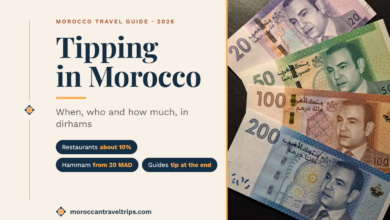
The currency is the Moroccan dirham, and only the dirham. Being this close to Spain does not make euros a payment currency: some hotels quote in euros, but taxis, cafés and souk stalls work in dirhams. Withdraw from a bank ATM or change money at a bank or official exchange office, and read our guide to Moroccan money, cards and cash before you go.
Morocco’s official languages are Arabic and Amazigh. In the street you will hear Darija, Moroccan Arabic, and in Tangier more Spanish than anywhere else in the country, alongside French. English is common in hotels and with guides, less so in small shops.
- In town: walk the medina and Kasbah; use petits taxis, the small city cabs, for longer hops and ask for the meter.
- Cape Spartel and the caves: a grand taxi hired for a few hours, or a private driver, saves waiting on the roadside for a ride back.
- Dress: Tangier is relaxed by Moroccan standards, but shoulders and knees covered in the medina is the respectful default.
Day trips worth the roadContents ↑
Asilah is the easy one: a small whitewashed town on the Atlantic, with ramparts, murals and fish grills, close enough for a relaxed half day. Tetouan, to the east at the foot of the Rif, has a medina listed by UNESCO and a strong Andalusian character, and sees a fraction of the visitors.
Chefchaouen is the one people ask about most, and the one we least recommend as a day trip. The road through the Rif takes long enough that a return trip leaves you only a few hours in town, mostly in the flat midday light. Sleep there instead, ideally on the way south to Fes. If you are curious before you go, here is the real story behind the blue walls.
Multi-day tours starting in TangierContents ↑
Tangier works best as a first chapter. The routes below start here and head south through the mountain towns and imperial cities of the north, each ending somewhere different.
-
 3 days: Tangier, Fes and ChefchaouenAsilah and Volubilis on the way to Fes, a night in Chefchaouen, back to Tangier. Short and dense.View
- 5 days: the north and the imperial citiesChefchaouen, Volubilis, Meknes and two days in Fes, ending in Rabat and Casablanca.View
- 7 days: Tangier to the Sahara and MarrakechChefchaouen, Fes, a night at the Merzouga dunes, the Todra and Dades gorges, then Marrakech. Long driving days.View


Seven days from Tangier to Marrakech via the desert is about the minimum for that crossing. It is doable, but two of those days are mostly road; if you can add a day, add it in Fes or at the dunes.
Mistakes we seeContents ↑
- Booking a ferry to Tanger Med and planning to walk to the medina. It is a separate port well outside the city; arrange the transfer before you sail.
- Following the unofficial guide who greets you at the port. Guiding is a licensed profession in Morocco. Ask to see the badge, or book a licensed guide in advance.
- Treating Tangier as a one-night stop. Arriving tired at dusk and leaving at nine the next morning shows you the port and little else.
- Leaving the Atlantic side for the last afternoon. When the Levante blows, the cape and the beaches are the first plans to fail. Do them early, keep the medina for the windy day.
Questions travellers ask about TangierContents ↑
Is Tangier worth visiting, or should I go straight to Fes?
It is worth two nights if you arrive from Spain or by train. The city has a history and a seaside character unlike any other Moroccan city. If your trip is a week centred on Marrakech, though, the detour north rarely pays for itself.
Can I pay with euros in Tangier?
Not in everyday life. The dirham is the only legal currency for payments, and taxis, cafés and shops expect it. Some hotels and tour services quote prices in euros, but plan to withdraw dirhams on arrival from a bank ATM.
Can I visit Tangier as a day trip from Spain?
Yes, with the fast ferry from Tarifa, which lands in the city. You will see the medina, the Kasbah and perhaps Café Hafa. Leave a buffer for the return crossing: wind and port checks can delay departures, and the last boat does not wait.
Is Tangier safe for tourists?
Most visits pass without trouble, but take the usual city precautions: watch your phone and wallet in crowds, use petits taxis at night, and ignore unofficial guides at the port. Our article on safety for visitors to Morocco covers the official travel advice.
Do I need a guide in the Tangier medina?
Not to find your way: the medina is small and slopes between the port and the Kasbah. A licensed guide earns their fee on history, on the International Zone years and on the places you would walk past, which is why many travellers book one for the first morning only.
What is the best base for a first stay?
A riad in or near the Kasbah puts you closest to the sights and the views, at the cost of steps and no car access. A hotel in the new town, around the boulevards and the bay, is easier with luggage and closer to the train station.
Moroccan Travel Trips, operated by PROMYTHIC TOURS SARL AU, offers licensed tourist guide services in Morocco. The routes in this guide are the ones we plan for travellers who start their trip in the north.