
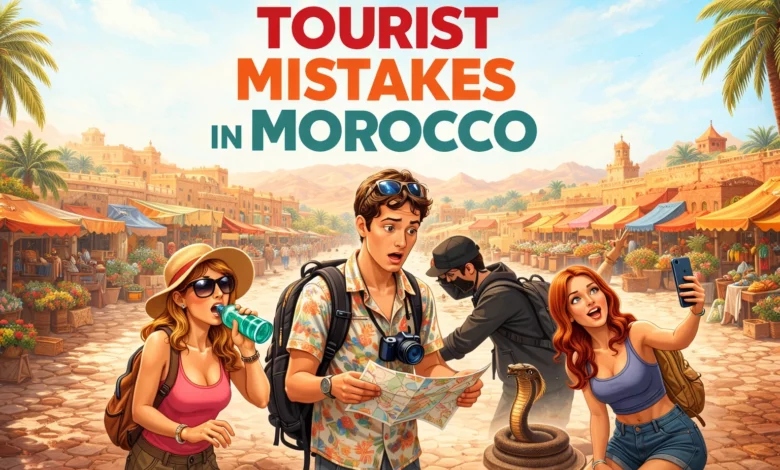
Every year, hundreds of thousands of travelers arrive in Morocco wide-eyed with excitement — and leave wishing someone had told them a few things in advance. Tourist mistakes in Morocco are remarkably consistent, cutting across nationalities, budgets, and travel styles. The medinas disorient first-timers; currency confusion leads to overpaying; well-meaning visitors inadvertently offend locals; and more than a few people end up sick from avoidable dietary missteps. This guide is not a list of scary warnings — it is a frank, practical roadmap that hands you the insider knowledge you’d normally only acquire after two or three trips. Read it once, and your first visit to Morocco can feel like your third.
Language & Communication Barriers
↑ Back to guideMorocco is linguistically layered in a way that surprises many first-time visitors. Arabic (Darija, the Moroccan dialect) is the mother tongue for most of the population. Modern Standard Arabic is used in formal and religious contexts. French functions as a de facto second language in government, business, education, and much of the service industry. Tamazight (Berber) languages are spoken widely in rural and mountain regions. English, while increasingly understood in larger cities and tourist hotspots, is far from universal.
The most common linguistic mistake is arriving with the assumption that English alone will carry you through every situation. In smaller medina shops, mountain villages, and long-distance bus stations, it frequently will not.
What to prepare before you arrive
- Learn ten to fifteen French phrases — greetings, numbers, directions, and a polite “I’m just looking.” Even imperfect French earns immediate goodwill.
- Pick up half a dozen Arabic expressions: As-salamu alaykum (peace be upon you), Shukran (thank you), La shukran (no, thank you — crucial for declining persistent vendors), and Bshal hada? (how much is this?).
- Download an offline translation app such as Google Translate with French and Arabic Moroccan dialects cached before departure.
- Do not confuse politeness with agreement. Moroccan communication culture tends to favour harmony; a vendor who nods may not be confirming your interpretation of a price.
Currency & Money Mistakes
↑ Back to guideMorocco’s official currency is the Moroccan Dirham (MAD). It is a closed currency, meaning you cannot legally obtain Dirhams outside Morocco; you must exchange money after arriving. This single fact generates a cascade of mistakes among tourists who do not research it beforehand.
ATM Withdrawals
Bank ATMs — particularly Attijariwafa, CIH, and BMCE — offer exchange rates close to the interbank rate. Withdrawing Dirhams on arrival is typically your most cost-effective option.
Official Exchange Bureaux
Licensed exchange offices (bureaux de change) found near major medinas are a reliable alternative. Rates vary, so comparing two or three takes only minutes and can make a meaningful difference.
Airport & Hotel Exchanges
Airport exchange booths and hotel desks offer convenience at a cost — their margins are consistently higher than city banks or ATMs. Use them only for small emergency amounts.
Street Money Changers
Exchanging money with individuals on the street is illegal in Morocco and reliably results in counterfeit notes, short-changing, or both. No legitimate exception exists.
Practical money habits
- Confirm prices in Dirhams before agreeing to any transaction — taxis, guided tours, and market stalls all benefit from explicit verbal confirmation of both currency and amount.
- Carry small denominations. A 200 MAD note at a street stall will invite inflated change, claimed unavailability of change, or simply frustration. Break large notes at supermarkets.
- Credit cards are accepted at larger hotels, upmarket restaurants, and chain stores — but the vast majority of medina shops, local restaurants, and taxis remain strictly cash-only.
- Do not exchange unused Dirhams back to euros or dollars at the airport on departure — the buyback rate is significantly worse than the sell rate.
Cultural Etiquette & Dress Code
↑ Back to guideMorocco is a Muslim-majority country where public spaces are to a meaningful extent still governed by norms of modesty and communal courtesy. The most impactful tourist mistakes in Morocco are cultural rather than logistical — and they are entirely avoidable.
Dress code considerations
Major cities such as Casablanca and Rabat have a relatively cosmopolitan atmosphere. Marrakech, Fez, and Chefchaouen are popular tourist destinations, yet remain deeply traditional in their older neighbourhoods. In rural areas and smaller towns, visitor dress that departs sharply from local norms draws unwanted attention and creates discomfort for residents.
- For all visitors: Shoulders and knees covered is the safe baseline when entering medinas, mosques, or rural communities. Lightweight linen or cotton fulfils this requirement without discomfort even in summer heat.
- For women: Loose-fitting trousers or maxi skirts and tops that cover the upper arms travel exceptionally well in Morocco. A lightweight scarf adds negligible weight to luggage and is invaluable at religious sites.
- For men: Shorts above the knee are not offensive in beach areas or tourist zones but attract less attention when replaced by light trousers in older urban neighbourhoods.
- Swimwear is appropriate at pools, resort beaches, and some coastal areas — but not in town centres, markets, or any public space away from the waterfront.
Behavioural courtesies
- During Ramadan: Avoid eating, drinking, or smoking visibly in public spaces during daylight hours. Most restaurants remain open, especially in tourist areas, but discretion is appreciated and in some localities expected.
- At mosques: Non-Muslims are not permitted to enter most Moroccan mosques. The Hassan II Mosque in Casablanca is a notable exception. Respect the perimeter, dress modestly, and never visit during prayer time in a way that causes obstruction.
- Alcohol: Available in licensed hotels, restaurants, and supermarkets but not expected to be consumed openly on the street, particularly in smaller towns.
- Public displays of affection between couples can attract negative reactions in conservative areas; exercise discretion.
Photography Etiquette
↑ Back to guideMorocco is extraordinarily photogenic and social media has intensified the appetite for capturing it — often at the expense of the people who actually live there. Photographing individuals, especially women, elderly residents, and craftspeople at work, without permission is one of the most consistent tourist mistakes in Morocco, and one that generates genuine resentment.
- Always ask first. A simple gesture — pointing to your camera and raising an eyebrow — communicates the question in any language. Most people will respond either with a smile or a firm wave of refusal; both answers deserve respect.
- A small tip is appropriate if someone poses for a photo, particularly performers, henna artists, or people with trained animals in squares like Djemaa el-Fna in Marrakech. These individuals earn their living through photography; declining to tip after shooting is considered impolite.
- Street photography of general scenes — architecture, markets at a distance, landscapes — carries no restrictions. The sensitivity is always around individuals.
- Some religious sites and artisan workshops ask visitors not to photograph interiors. Signage is not always present; when in doubt, ask.
- Tanneries such as the Chouara tannery in Fez sometimes charge a small informal entry fee, part of which implicitly covers photography. This is a longstanding arrangement, not a scam.
Tourist Scams: Know Before You Go
↑ Back to guideThe vast majority of Moroccans are honest and hospitable. Nevertheless, popular tourist areas attract a small number of opportunists who have refined certain approaches over years of practice. Forewarned is forearmed — understanding the most common tourist scams in Morocco before you arrive dramatically reduces your exposure.
The patterns to recognise
- The “free guide” who isn’t: A friendly local offers to show you to your destination or a point of interest. After a short walk, a payment is requested, often aggressively. The solution is simple — if you did not hire a guide, you are not obligated to pay one. Politely decline the escort from the outset.
- The medina misdirection: You are told (falsely) that your destination — riad, museum, restaurant — is closed, moved, or “not what you think.” The person then offers to take you somewhere better. Ignore this. Verify information with your accommodation directly.
- Inflated taxi fares: Petit taxis in most Moroccan cities are metered — insist the meter is running before you depart. For longer journeys or grand taxis, agree on a price before entering the vehicle.
- The unsolicited rug appraisal: You are invited to view a shop “with no obligation,” tea is offered, social pressure builds, and leaving without purchasing becomes uncomfortable. The protection: decide in advance your interest level, and hold that position calmly.
- The henna ambush: Women approach female tourists, particularly in Marrakech’s Djemaa el-Fna, offering free henna. Once applied, payment demands are high and aggressive. Only accept henna from stalls with prices clearly displayed.
Tipping Customs — a Widely Misunderstood Area
↑ Back to guideTipping in Morocco is neither the aggressive expectation you might encounter in some destinations nor the casual afterthought it is in others. It occupies a defined middle ground — appreciated, contextually appropriate, and in certain situations a genuine part of someone’s livelihood. Many tourists either overtip in tourist traps or undertip people who genuinely depend on gratuities. Knowing the norms matters.
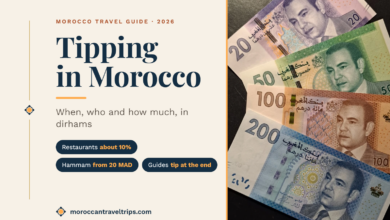
For a detailed breakdown of who to tip, how much, and when it is or is not appropriate across restaurants, hammams, riad staff, guides, and more, the guide on tipping in Morocco covers the subject with specificity. A few general principles are worth noting here:
- Restaurant service: Rounding up or adding 10% in sit-down restaurants is appropriate when service has been attentive. Service charges are rarely included in the bill.
- Licensed tour guides operate on a day rate and also receive tips. 50–100 MAD per person per day is a customary range for a half-day; adjust proportionally for longer engagements.
- Hotel staff: Porters, cleaning staff, and riad attendants appreciate small gratuities (10–20 MAD) for specific acts of service.
- Hammam attendants who provide scrub and massage services routinely receive tips as part of their expected compensation.
- Tipping is always in Dirhams. Offering foreign currency creates inconvenience for the recipient.
Transportation & Navigation
↑ Back to guideGetting around Morocco — particularly between cities — requires more planning than travellers accustomed to Western European transport infrastructure typically expect. Misjudging journey times, transport options, or road conditions produces some of the most frustrating tourist mistakes in Morocco.
Getting between cities
- ONCF trains connect Casablanca, Rabat, Fez, Tangier, and Marrakech with reasonable reliability. Book seats in advance on the ONCF website or app, especially during school holidays and Ramadan.
- CTM and Supratours buses cover routes the rail network does not, including Agadir, Ouarzazate, Chefchaouen, and the south. They are comfortable, air-conditioned, and punctual — but seats sell out.
- Journey times on mountain routes (e.g., Fez to Chefchaouen, Marrakech to Ouarzazate) are substantially longer than the straight-line distance suggests. Budget 1.5–2× the time a mapping app estimates.
Navigating medinas
- GPS and mapping apps work inside medinas but are imprecise — alley names change, entrances are unnamed, and some passages are too narrow to appear in mapping databases. Download an offline map and cross-reference with your accommodation.
- Getting briefly lost in a medina is practically universal and not dangerous. Simply note a recognisable landmark and ask a shopkeeper or café owner to orient you.
- Motorbikes and mopeds use medina alleys as transit routes. Walk close to walls and pay attention when moving through narrow passages.
Renting a car
- An International Driving Permit is required alongside your national licence.
- Verify that comprehensive insurance is explicitly included in your rental agreement, particularly covering third-party liability. Additional excess-reduction insurance is worth considering on mountain or desert routes.
- Night driving outside cities carries higher risk due to unlit roads, livestock, and cyclists without lighting. Strongly advised against.
- Petrol stations are reliably spaced on main routes but become sparse in the south and in mountain passes. Do not let the tank drop below half when travelling away from major highways.
Health, Food & Water Safety
↑ Back to guideMorocco’s cuisine — tagines, couscous, pastilla, fresh-pressed orange juice, street-cooked brochettes — is one of the genuine highlights of any visit. Ignoring a few basic food and water precautions, however, is a reliable path to spending portions of your trip unwell.
Water
- Drink bottled water throughout your stay, verifying that seals are intact when purchasing. This applies to brushing teeth as well — particularly in the first few days before your digestive system adjusts.
- Ice in restaurants within established tourist areas is generally made from treated water, though requesting drinks without ice is a low-effort precaution if you are particularly sensitive.
- Fruits and vegetables washed in tap water carry a degree of risk; peeling your own fruit or choosing cooked vegetables eliminates it.
Food
- Street food quality in Morocco ranges from outstanding to questionable — the indicator is usually visible hygiene and turnover. A busy stand with a rapid circulation of freshly-cooked items is far safer than a stand with food sitting out under the sun.
- Eat food that is hot and freshly prepared. Avoid anything that has been sitting at room temperature.
- Seafood in coastal cities (Essaouira, Agadir, El Jadida) is typically excellent and fresh; inland, exercise more caution about fish provenance.
Vaccinations and medical preparation
- Consult a travel health clinic before your trip. Hepatitis A and typhoid vaccinations are commonly recommended for Morocco. Routine vaccinations should be up to date.
- Morocco has been officially malaria-free since 2010. Mosquito repellent remains useful, particularly in warmer months, primarily for comfort rather than disease prevention.
- Pack oral rehydration salts and a basic antidiarrheal medication. Most pharmacies in Moroccan cities are well-stocked and pharmacists are often a quick first port of call for minor ailments.
- Travel insurance with medical evacuation cover is essential. Private hospitals in major cities are of reasonable quality; facilities in rural areas are limited.
Planning & Timing
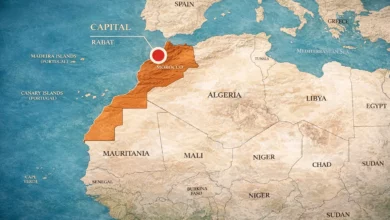
↑ Back to guideOver-ambitious itineraries and poorly chosen travel dates are among the most preventable tourist mistakes in Morocco. The country is large — slightly larger than California — and its diversity of landscapes means that conditions, crowd levels, and access vary dramatically by season and region.
| Season | Conditions | Rating |
|---|---|---|
| Spring (Mar – May) | Mild temperatures nationwide, wildflowers in the Atlas foothills, manageable crowds. Ideal for hiking, desert, and city exploration alike. | Best |
| Autumn (Sep – Nov) | Heat subsides after August, harvest season in Skoura and Ziz valley, fewer tourists than peak summer, pleasant evenings everywhere. | Best |
| Winter (Dec – Feb) | Cold nights and Atlas snowfall — ski resorts near Ifrane operate. Coastal and desert areas are mild but evenings cold. December holidays see a crowd spike. | Varies |
| Summer (Jun – Aug) | Temperatures in Fez, Marrakech, and the south regularly exceed 40 °C. Coastal areas are crowded with domestic tourists; prices peak. | Challenging |
| Ramadan | Dates shift annually (~one month, lunar calendar). Unique cultural immersion; reduced dining hours outside tourist zones; heightened spiritual atmosphere. | Plan ahead |
Itinerary mistakes to avoid
- Trying to cover everything in one trip. Marrakech alone warrants two or three days to explore properly. A route that strings together Casablanca, Rabat, Chefchaouen, Fez, Merzouga, Todra Gorge, Ouarzazate, and Marrakech in seven days produces a blur of bus stations and exhaustion, not travel memories.
- Not booking accommodation in advance for popular riads in Marrakech, Fez, and Chefchaouen — particularly during spring and autumn peaks. Quality options fill up weeks ahead.
- Ignoring Friday logistics. Friday is the main prayer day in Morocco; government offices close and some businesses reduce hours around midday prayer (around noon to 2 pm). Factor this into any bureaucratic or administrative plans.
- Assuming distances equal time. The 550 km from Marrakech to Fez takes 8–9 hours by road through the mountains or 4.5 hours by CTM bus via the direct highway. Plan accordingly.
Morocco’s Geography & Climate Diversity
↑ Back to guideMorocco contains one of the most varied landscapes of any single country in the world. Many tourists, picturing only medinas and desert dunes, arrive unprepared for altitude cold, Atlantic swells, or snow on mountain passes. This mismatch between expectation and reality creates avoidable discomfort.
The Atlas Mountains
The High Atlas reaches 4,167 m at Toubkal — the highest peak in North Africa. Temperatures in Imlil and mountain villages are cold year-round at altitude. Pack proper layers even in summer. Mountain passes can be snowed-off between December and March.
The Saharan South
Merzouga and M’hamid offer access to dune landscapes. Summer temperatures regularly exceed 45 °C at midday. Desert nights can be cold (below 10 °C in winter). Sunrise and sunset are the optimal times for dune activities.
Atlantic Coast
Essaouira’s constant Atlantic wind (the Alizée) keeps summer temperatures cooler than inland cities — a deliberate destination for heat-avoiders — but requires a windbreaker even in July. Agadir offers calmer beach conditions further south.
Northern & Mediterranean
Chefchaouen, Tetouan, and Tangier experience a Mediterranean climate: warm dry summers, mild wet winters. The Rif mountains around Chefchaouen can be misty and cool even in May.
Packing for a single “Moroccan climate” is one of the quieter tourist mistakes in Morocco. Even a two-week itinerary that combines a northern city, an Atlas hike, and a desert camp will require clothing spanning 30 °C of range. Lightweight layering systems resolve this without adding significant luggage weight.
Leaving Morocco with no regrets
The vast majority of tourists who struggle in Morocco struggle because of information gaps, not because the country is inherently difficult to navigate. Respect for language, currency, and cultural norms; awareness of the scams that target visitors; a realistic sense of geography and journey times; and basic food and water precautions — these are not burdensome demands. They are simply the groundwork for a visit that goes the way you imagined.
Morocco rewards the curious and the prepared in equal measure. Its hospitality, its craft traditions, its food, its landscapes from cedar forest to Saharan erg — almost none of it is available in any comparable form anywhere else. Come informed, stay curious, and the experience will match every photograph you have seen of it.
ok