The Marrakech tanneries are not where most visitors expect them. They sit at the far north-eastern edge of the medina, just inside Bab Debbagh, the Tanners’ Gate, about twenty minutes on foot beyond the leather souk where the finished bags hang. Visiting the tanneries in Marrakech is easy once you know that, and slightly exhausting if you do not, because the lanes leading there are where unofficial “guides” wait for people who look lost.
This guide covers what you actually see, how to get there without being steered, what the smell is about, and how to buy leather in Souk Cherratine that still looks good a year later.
The Bab Debbagh tanneries are a working craft quarter, not a ticketed sight. There is no entry fee, but whoever shows you a terrace view will expect a tip. Go in the morning, take a petit taxi to the outside of Bab Debbagh, walk in, and politely ignore anyone who says the tanneries are closed or that today is a special day.
Our verdict. Worth an hour if you are curious about how things are made, and especially if you plan to buy leather. Skip it if you are sensitive to strong smells, travelling with a very tired child, or hoping for the rainbow of dye pits from photos of Fez: Marrakech’s tanneries are mostly white and brown, and that is the honest version of the craft.
- Where
- Bab Debbagh, north-east medina
- Time needed
- 45 minutes to an hour
- Best time
- Morning, while work is under way
- Entry
- Free, tip for a terrace view
- Combine with
- Souk Cherratine, Ben Youssef Madrasa
Where the tanneries are, and why thereContents ↑
Tanning needs water and room, and it produces a smell nobody wants next door. So the tanners’ quarter was set at the eastern edge of the city, close to the Oued Issil riverbed, apparently from the early days of Marrakech in the eleventh century. Its gate, Bab Debbagh, is one of the oldest of the medina and still gives the quarter its name: dbagh is the Arabic word for tanning.
Historians mention a second, smaller tanners’ area in the past, but Bab Debbagh is the older and larger one, and the only one most visitors will ever see. The map below shows the usual walk from Jemaa el-Fna through the souks, and the shorter option by taxi.
- Jemaa el-Fna, the main square
- Souk Semmarine, the covered street heading north
- Souk Cherratine, the leather souk, near Ben Youssef
- The tanneries, just inside Bab Debbagh
- Taxi drop-off outside Bab Debbagh
Schematic map, not to scale. The lanes in between are many and change names often.
If the medina layout is new to you, our guide to the quarters of the Marrakech medina explains how the old city is organised, and where the souks are covers the market streets on the way.
What you actually seeContents ↑
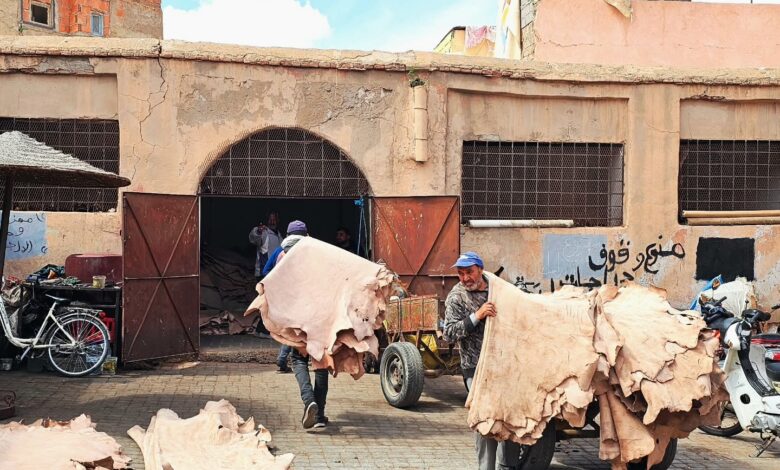
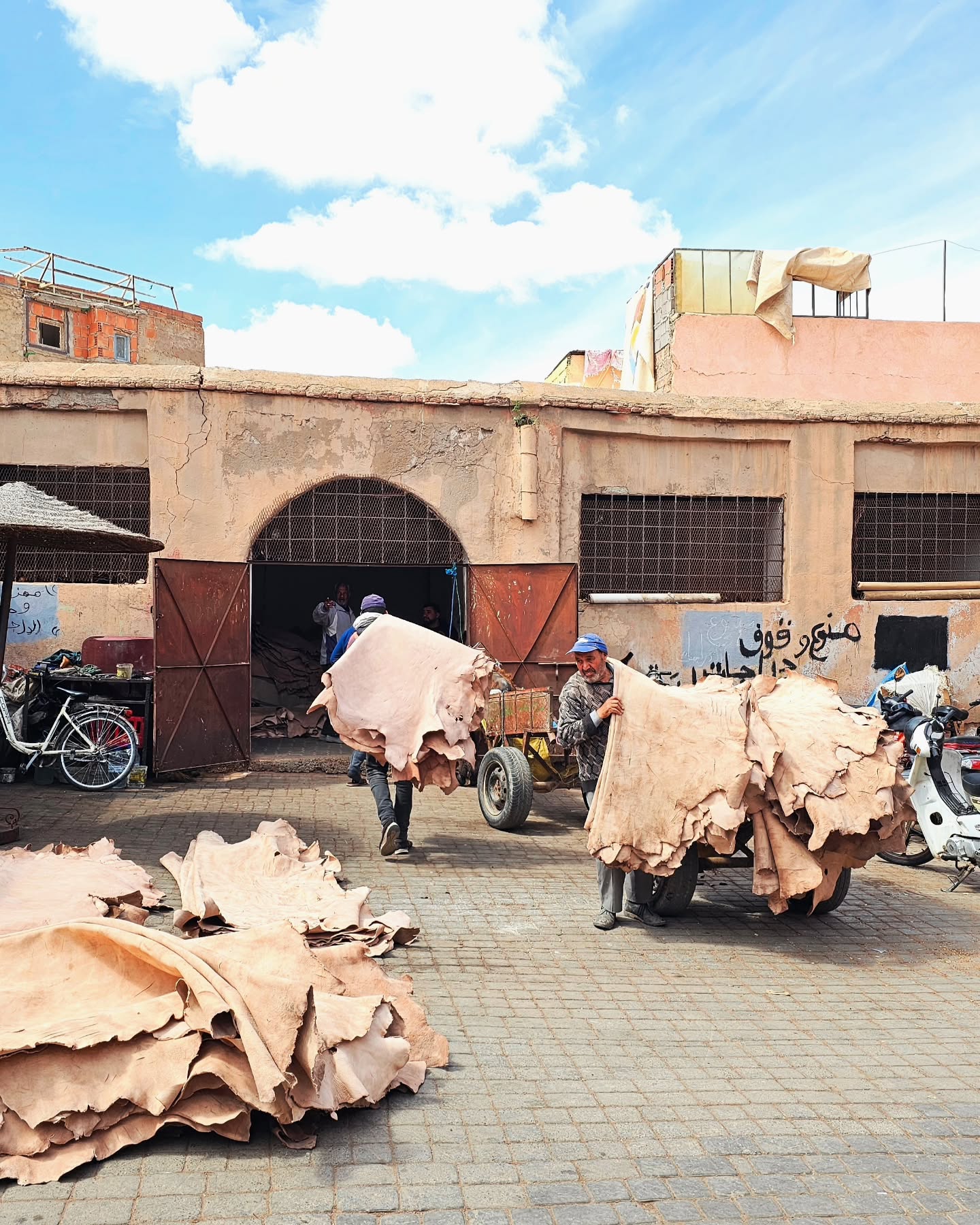
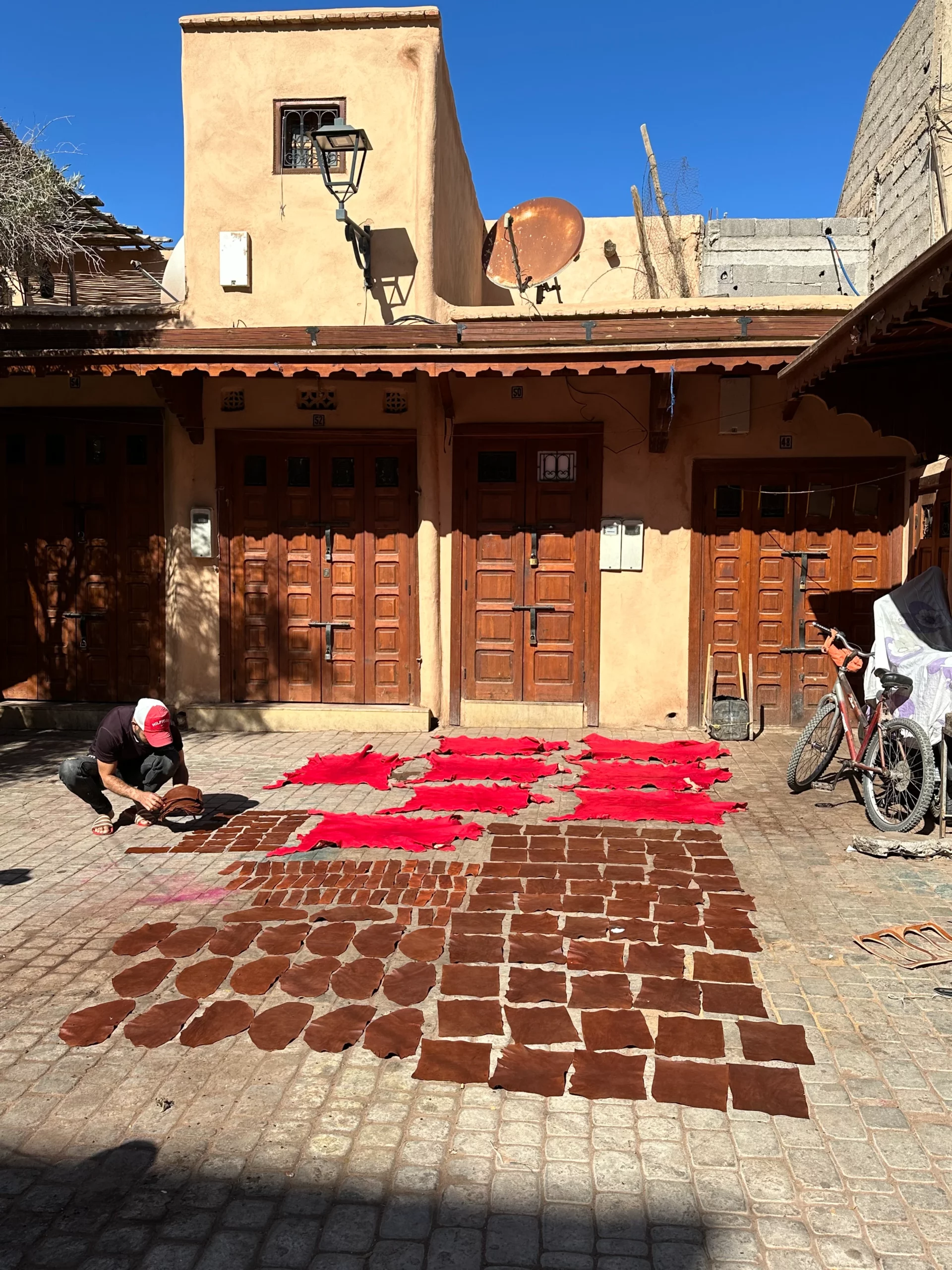
Expect a yard of stone pits sunk into the ground, some filled with a milky white liquid, others with shades of brown, and men standing in them up to the knee or the waist, moving hides with their hands and feet. Hides are stacked on the edges, scraped on wooden beams and laid out to dry. It is work, not a show, and nobody stops for visitors.
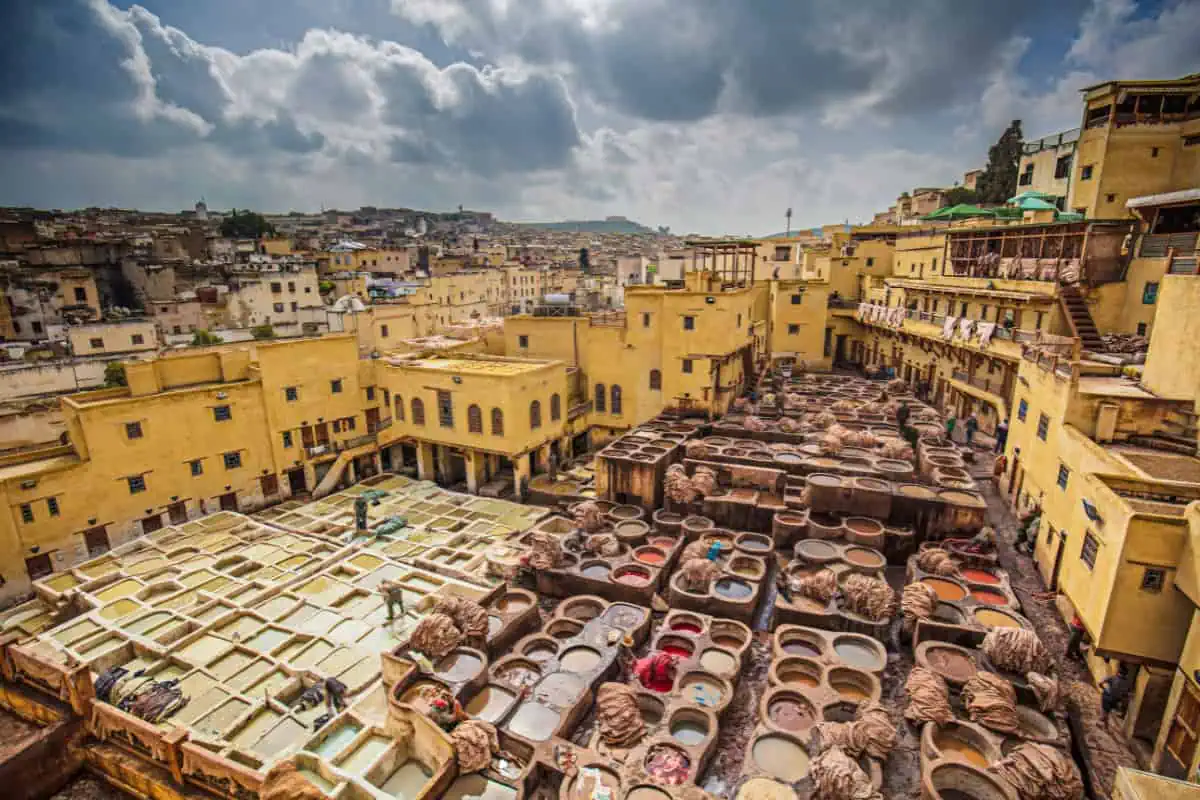
What you will mostly not see is colour. The famous photographs of red, yellow and blue vats come from Chouara in Fez. In Marrakech the tanneries mainly prepare natural leather, and much of the dyeing is done elsewhere, later. People who arrive expecting Fez sometimes feel short-changed; people who arrive expecting a working yard usually find it one of the most memorable hours of their trip.
How a hide becomes leatherContents ↑
The method is old and almost entirely manual. Goat, sheep, cow and camel hides all pass through Morocco’s traditional tanneries, and each goes through the same broad sequence. Tap a step to follow one hide through the yard.
The pigeon droppings are the part everyone remembers. They are rich in ammonia, which is also the main reason for the smell, and they do a job that modern tanneries do with chemicals. The white pits you see first are the lime; the brown ones further on hold the tanning baths.
Getting there without being steeredContents ↑
The simplest route is the one locals would take: a petit taxi to the outside of Bab Debbagh, on the road that runs along the ramparts, then a short walk through the gate. The tanneries are only just inside, so you spend almost no time in the lanes where people offer to show you the way. The Marrakech taxi tips cover meters and fair fares.
Walking is fine too, and pleasant in the morning. From the leather souk near Ben Youssef, follow Rue Bab Debbagh east for about twenty minutes. Keep the map on your phone open and walk as if you know where you are going, because in this part of the medina hesitation is noticed. Our page on not getting lost in the medina has the habits that help.
The “tannery tour” approach, and how to say noContents ↑
It usually starts with a friendly stranger and a piece of news. The road ahead is closed. The main square is the wrong way. Today is the last day the tanneries are open, or a special day when the Berber families work. The point of each story is to turn you around and lead you, first to a tannery terrace, then to a leather shop, and finally to a request for money that is larger than you expected.
A smile, “la, shukran” (no, thank you), and no stopping. Do not argue with the story and do not explain where you are going. If you would like someone to show you the yard, decide the amount before you follow anyone.
None of this is dangerous, and most of the people you meet in the quarter are simply working. But it is tiring, and it is the single biggest reason visitors leave the tanneries with a bad memory. Our list of common tourist scams in Morocco covers this one alongside the others you may meet in the medina.
Mint, terraces and tipsContents ↑
Someone will probably hand you a sprig of fresh mint at the door. It is for holding under your nose, and on a warm day you will be glad of it. The smell is strongest in the heat of the afternoon and fades quickly once you leave; it does not cling to clothes for long.
The best view is from above, from the terraces of the houses and shops around the yard. Access is offered in exchange for a tip, often followed by a visit to the leather shop below. You are not obliged to buy anything. Agree the tip before you climb, and keep small notes ready: our tipping calculator gives sensible amounts for this kind of help. Ask before photographing the workers, who are at their job, not posing; the photography etiquette guide explains why it matters.
The leather souk: Souk Cherratine and aroundContents ↑
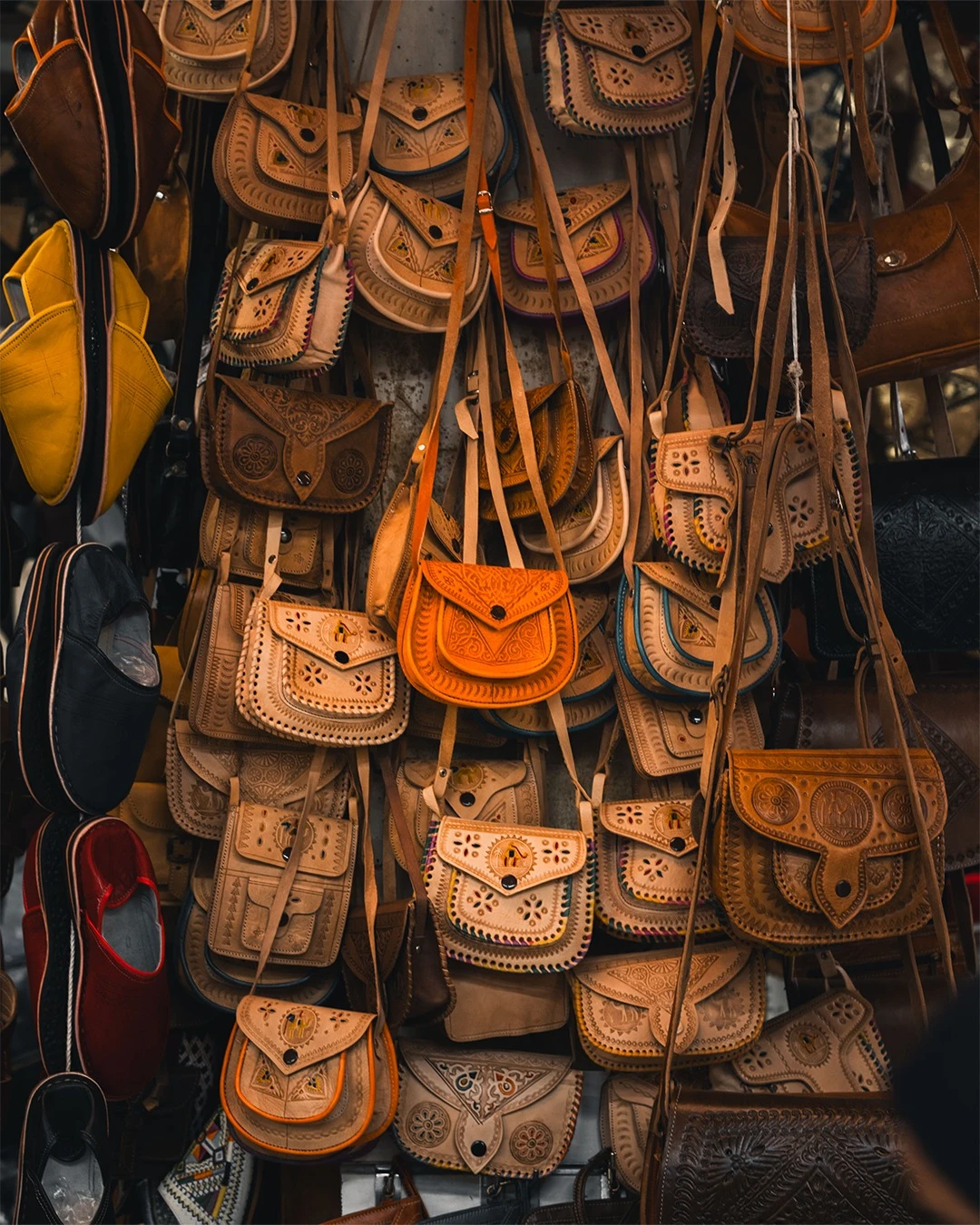
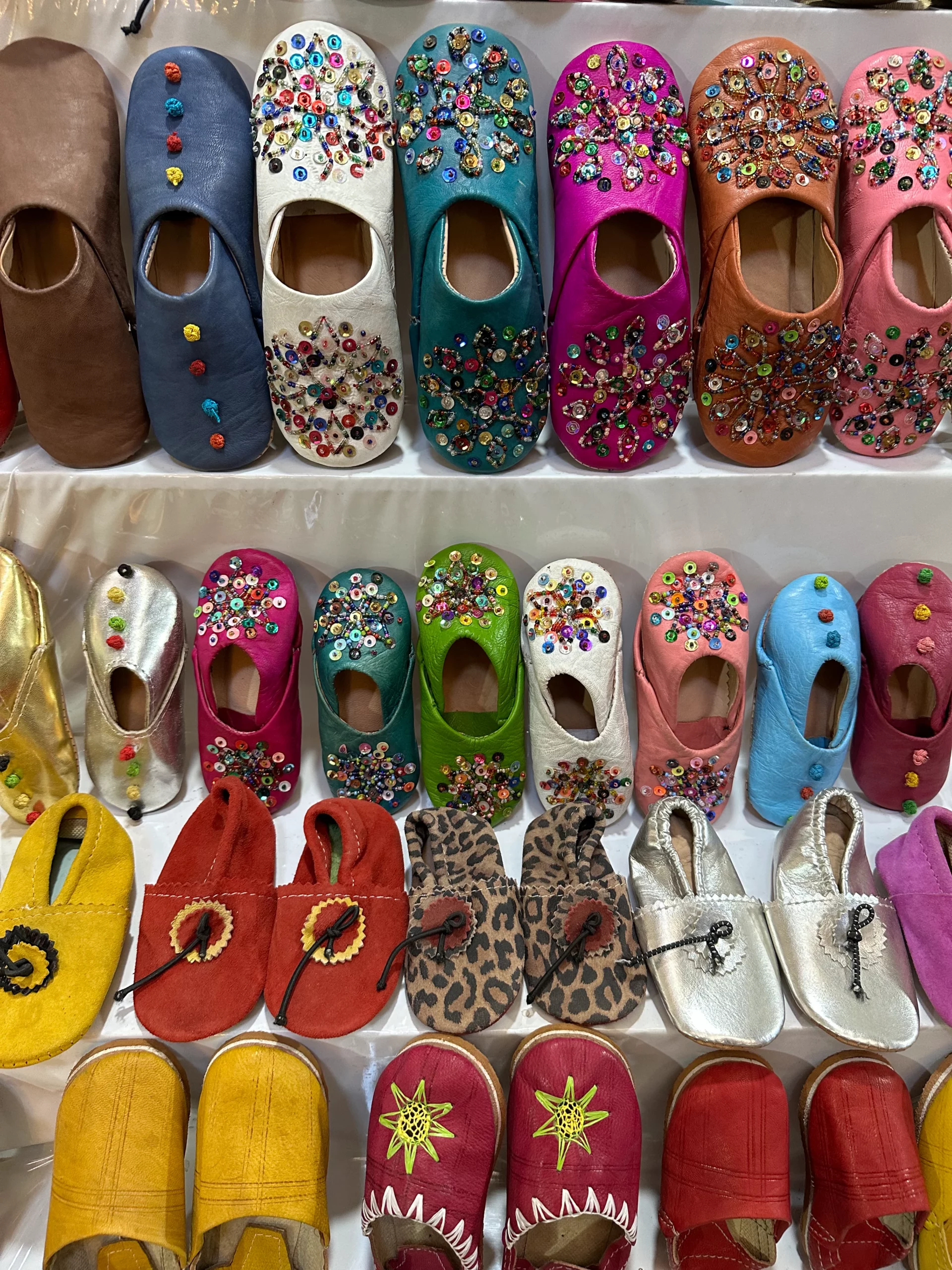
The finished leather comes back into the heart of the medina. Souk Cherratine, north of the main souks and close to the Ben Youssef Madrasa, is where it is cut and stitched into bags, wallets, belts and pouffes, in workshops so small that the craftsman and the shopkeeper are often the same person. Babouches, the soft pointed slippers, have their own lanes nearby.
Going to the souk before the tanneries makes the visit easier to read, and the half-day Marrakech city tour with a licensed guide passes through the leather lanes and ends at Ben Youssef, about twenty minutes from Bab Debbagh. For the medina’s other trades, see what to buy in the Marrakech souk.
Buying leather that lastsContents ↑
The quality in the souk ranges from beautiful to disappointing, sometimes in the same shop. A few checks take a minute and save most regrets.
- Look at the back. Real leather has a fibrous, suede-like reverse side. A woven fabric backing means a coated or synthetic material.
- Check the cut edges. Leather shows fibres at the edge; synthetic material shows layers.
- Rub the colour. A damp tissue on a dyed surface should come away clean. If it picks up colour, the dye may stain clothes later.
- Follow the stitching. Tight, even stitches and reinforced handles matter more than decoration.
- Open the zips and the lining. Hardware and lining are where cheaper pieces save money.
A strong smell is normal for freshly tanned leather and fades after a few days in the air; leave a new bag open on your balcony or in the riad courtyard. Prices are open to discussion, and our guide to haggling in the souks without being rude covers how that conversation usually goes.
Marrakech or Fez: which tannery to seeContents ↑
If your route includes both cities, the choice is not either or. They show different things.
| Marrakech, Bab Debbagh | Fez, Chouara | |
|---|---|---|
| Colour | Mostly white and brown | Many coloured dye pits |
| Setting | Working yard at the edge | Heart of the old medina |
| Viewpoints | A few house terraces | Many shop terraces |
| Best for | Seeing the process | The classic panorama |
Fez wins on the photograph; Marrakech is closer to how the work really looks. If you are only in Marrakech, there is no reason to feel you have seen the lesser version. If you are heading north, our Fez walking guide includes Chouara.
Mistakes that spoil the visitContents ↑
- Following someone without agreeing the tip first.
- Going in the hottest part of the day, when the smell is at its strongest.
- Wearing open sandals: the ground around the pits is wet and uneven.
- Buying in the first shop, before you have seen a few others in Souk Cherratine.
Questions travellers ask about the tanneriesContents ↑
Are the Marrakech tanneries worth visiting?
Yes, if you are interested in crafts or plan to buy leather, and you accept a strong smell and some pressure from touts. If you mainly want colourful vats for photos, Fez is the better place. Allow about an hour and combine it with the leather souk and Ben Youssef.
Is there an entrance fee for the tanneries?
No, there is no ticket. The tanneries are a working quarter. A tip is expected if someone takes you up to a terrace or explains the process, and it is fairer for everyone if you agree the amount before you go up.
Do I need a guide to visit the tanneries?
No. You can take a taxi to Bab Debbagh and walk in on your own. A licensed guide mainly helps by explaining what you see and keeping unofficial offers away, which some visitors find worth it in this part of the medina.
What time of day is best?
Morning. Work is usually most visible then, the light is softer and the smell is weaker than in the afternoon heat. In summer, aim to be there before eleven.
Is all the leather in the souk made at these tanneries?
Not all of it. Some leather is still prepared at Bab Debbagh, but shops also work with leather from other Moroccan tanneries and with factory-made material. Ask where a piece comes from, and use the quality checks above rather than the label.
Can I visit the tanneries with children?
Yes, older children often find the yard fascinating. Keep hands held near the pits, wear closed shoes, and bring the mint for the smell. With a small child who is already tired, the leather souk alone is a gentler choice.
Go for the craft, not the coloursContents ↑
The Bab Debbagh tanneries reward people who come to understand how a bag in the souk began its life, and disappoint those who come for a postcard. Take a taxi to the gate, go in the morning, agree any tip before you follow someone, and walk back through Souk Cherratine with a better eye for what you are buying.