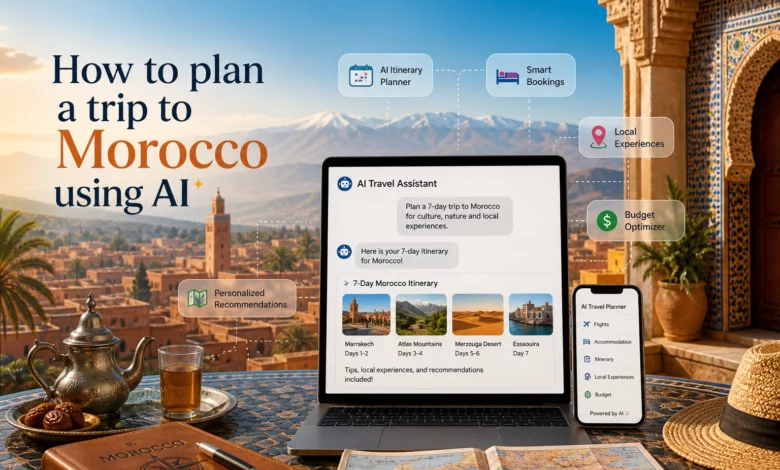
How to Plan a Trip to Morocco
Using AI
Discover how artificial intelligence can transform the way you research, organize, and experience Morocco — and where human expertise still matters most.
Planning a trip to Morocco has never been more exciting — or more complex. Between the winding medinas of Fes, the rose-red walls of Marrakech, the Atlantic sweeps of Essaouira, and the silence of the Sahara, there is simply too much to absorb in one sitting. That is where AI travel planning tools have genuinely changed the game: they can process thousands of data points, draft detailed itineraries in seconds, and answer your most obscure logistical questions at 2 a.m. when every tour operator is asleep.
But Morocco is also a country of nuance — of last-minute festival closures, seasonal road conditions, and hidden riads that never appear on any algorithm’s radar. This guide walks you through exactly how to plan a trip to Morocco using AI, where AI genuinely helps, where it falls short, and why pairing it with a licensed local guide produces the best result of all.
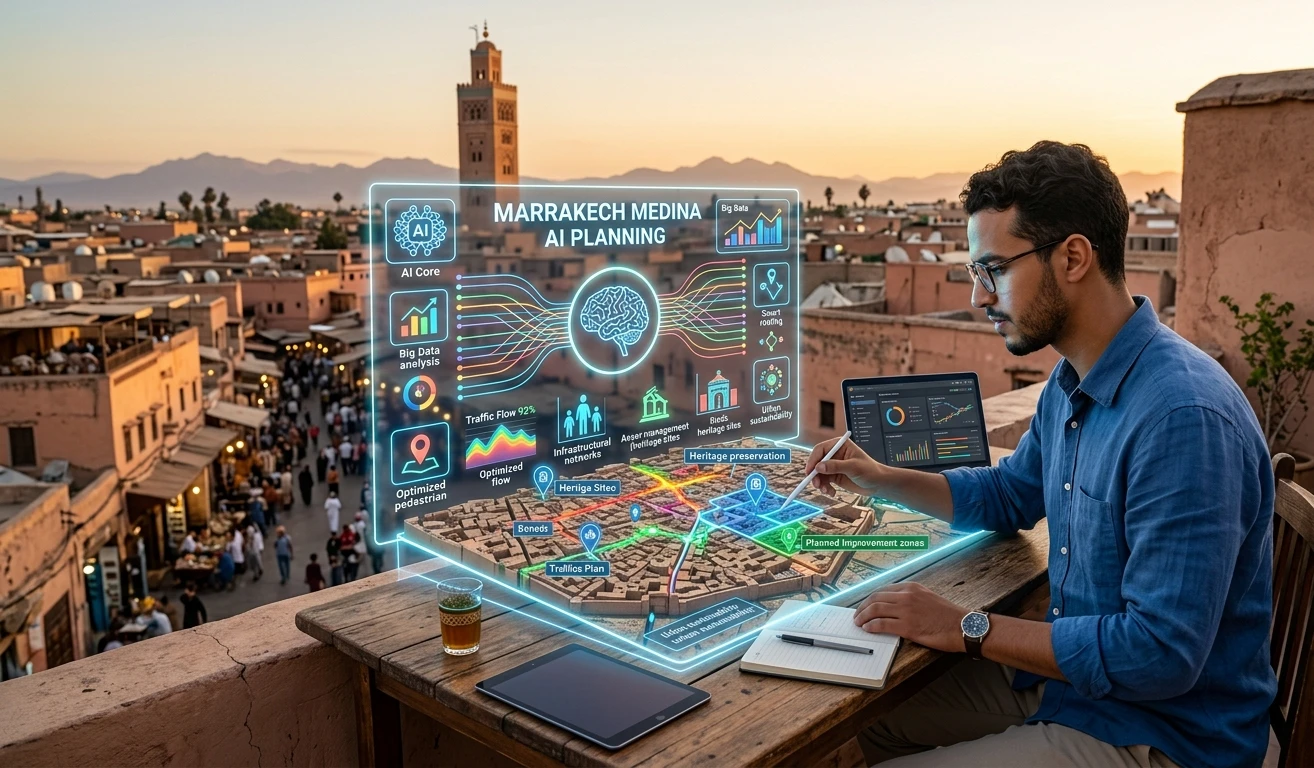
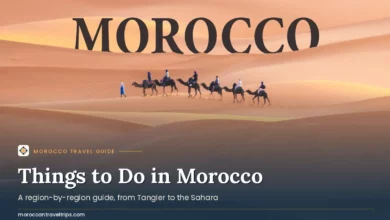
Morocco’s medinas and desert landscapes reward careful planning — with or without artificial intelligence.
Why Use AI to Plan Your Morocco Trip? ↑ Back to top
Before we dive into the how, it is worth understanding the why. AI travel planning has matured significantly — today’s large language models can synthesize information from travel blogs, official tourism databases, visa requirement pages, and transport schedules almost simultaneously. For a country like Morocco, which spans everything from Atlantic beaches to High Atlas snow to Saharan dunes, that synthetic capacity is genuinely useful.
Concretely, AI can help you:
- Generate a rough Morocco itinerary in seconds based on your travel style and duration
- Explain visa requirements, best travel seasons, and cultural norms
- Draft packing lists adapted to the Moroccan climate and your specific regions of visit
- Compare transport options between cities (CTM buses, trains, shared taxis, rental cars)
- Suggest experiences off the typical tourist trail based on your interests
- Translate phrases into Darija (Moroccan Arabic) or Tamazight for basic communication
The result is a planning head-start that once took days of forum-browsing and guidebook reading. That said, AI works best as a starting point, not a final authority — a distinction this guide returns to often.
Pros and Cons of AI-Assisted Morocco Travel Planning ↑ Back to top
Let us be honest about both sides of the equation. AI is a remarkable tool — but it comes with real limitations that every traveler planning a Moroccan travel trip should understand before relying on it.
- Instant itinerary drafts available 24/7
- Unlimited free iterations — ask, refine, ask again
- Aggregates general knowledge from many sources
- Excellent for brainstorming regions and experiences
- Helps with language, cultural etiquette, packing
- No sales bias or commissions influencing suggestions
- Prices change — AI quotes are often outdated or inaccurate
- Cannot verify if a riad, restaurant, or attraction still exists
- No awareness of current road conditions or seasonal closures
- Misses hidden gems that locals know but the internet doesn’t
- May “hallucinate” specific details (addresses, phone numbers)
- Cannot handle emergencies or real-time support on the ground
Step-by-Step: How to Use AI to Plan Your Moroccan Adventure ↑ Back to top
Here is a practical workflow that treats AI as your research partner while keeping human judgment in the driver’s seat.
Example prompt: “I have 10 days in Morocco in April, travelling as a couple. We love history, food, and one or two outdoor activities. We prefer authentic experiences over tourist traps. Draft a rough itinerary.”
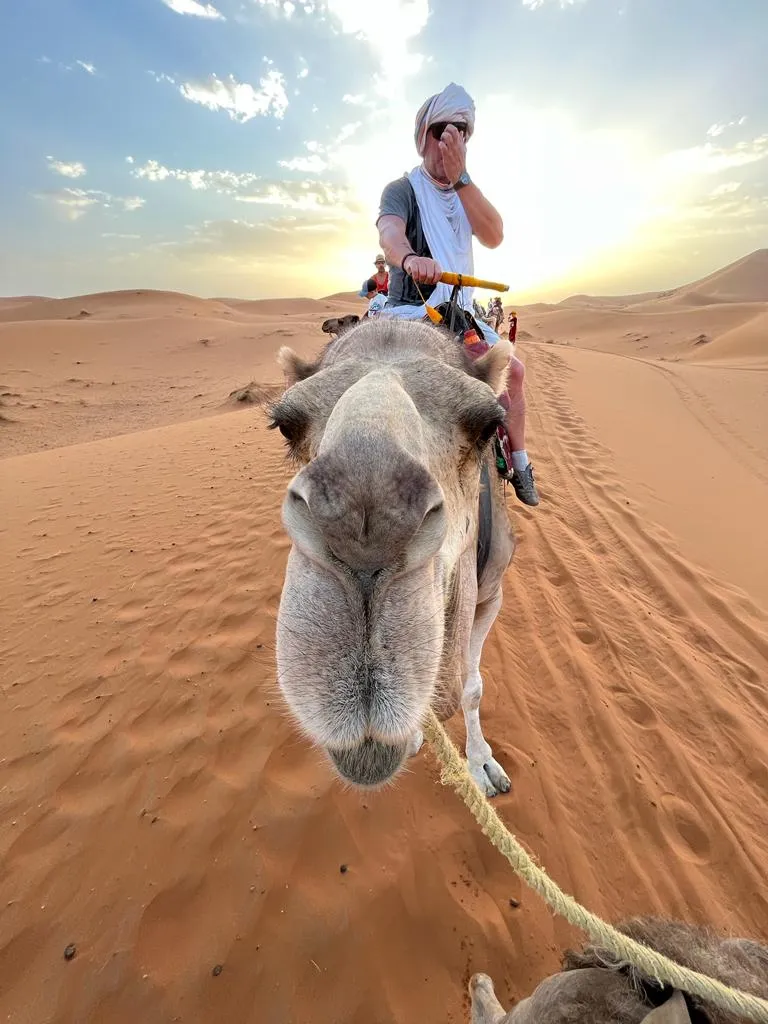
A camel trek at sunrise in Merzouga — something AI can recommend, but only you can truly experience.
Best AI Tools for Morocco Travel Research ↑ Back to top
Not all AI tools are equal for travel research. Here is a quick guide to what each type of tool does well for planning a Morocco trip:
Best for: itinerary brainstorming, cultural explanations, packing lists, language help, and answering open-ended questions. Use conversationally — follow up, refine, push back on generic answers. Claude and Gemini tend to be more up-to-date with web access enabled.
Best for: finding recent travel articles, current news about Morocco, and sourced answers. Perplexity cites its sources, which means you can verify claims directly — invaluable for travel planning.
Best for: comparing accommodation options and live prices. These tools have real-time data that standalone chatbots lack — they are better trusted for bookings than for cultural or logistical advice.
What AI Gets Right — and What It Gets Wrong About Morocco ↑ Back to top
Where AI Is Reliable
AI handles the broad strokes of Morocco well. It knows that Marrakech is best in spring and autumn, that Chefchaouen is photogenic but also genuinely charming beyond its Instagram profile, that the Sahara entrance near Merzouga requires an overnight journey from Marrakech, and that Ramadan changes travel rhythms considerably. These are well-documented, stable facts that AI absorbs reliably.
Where AI Misleads
The danger zones are specific and predictable. Prices are almost always wrong — entry fees, accommodation rates, and taxi fares change seasonally and year-on-year, and AI has no mechanism to track them. Restaurant and riad recommendations are hit-or-miss: establishments close, change ownership, or dramatically decline in quality. AI cannot know. Road access to remote areas like M’Goun Valley or Jebel Sirwa depends on seasonal conditions that only locals track in real time.
There is also the subtler problem of cultural flattening. AI describes Morocco as a single experience; the reality is that Tetouan feels nothing like Tiznit, and the Rif mountains have a completely different social texture to the Draa Valley. A licensed guide brings that granular, lived knowledge.
AI-Curated Itinerary Ideas for Morocco ↑ Back to top
Below is an example of how AI might structure different Morocco trip durations. Treat these as intelligent starting points — not confirmed schedules. Actual durations, logistics, and experiences should be validated with a licensed guide.
| Duration | Route Focus | Key Destinations | AI Use Case |
|---|---|---|---|
| 5 Days | Imperial Cities Sprint | Casablanca → Rabat → Fes → Marrakech | Draft daily schedule, train timings overview |
| 7 Days | Classic + Desert | Marrakech → Draa Valley → Merzouga → Fes | Routing logic, desert camp type comparisons |
| 10 Days | North & South Mix | Tangier → Chefchaouen → Fes → Sahara → Marrakech | Cultural briefing for each region, packing advice |
| 14+ Days | Deep Morocco | Atlas trekking, Sous Valley, Draa, Atlantic coast | Off-beat region research, language help |
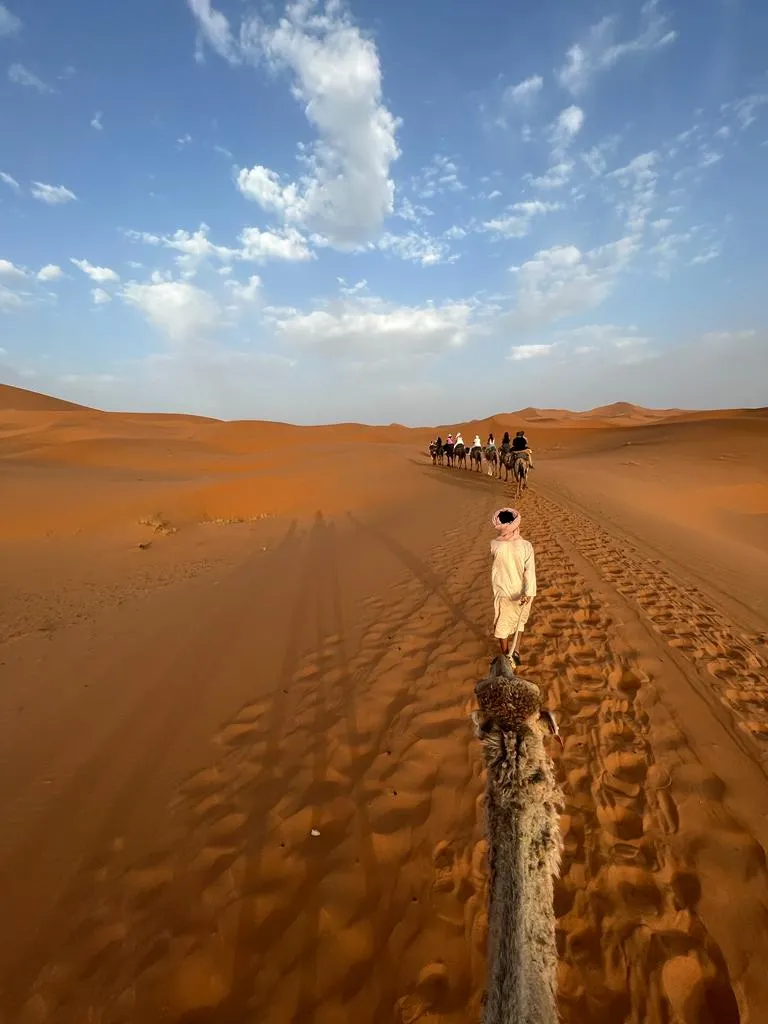
The Sahara near Merzouga — AI can map the route, but a guide reveals the stories along the way.
Essential Morocco Travel Tips for First-Timers ↑ Back to top
Whether your itinerary comes from AI or from a seasoned guide, some ground rules apply to every first-time visitor. For a comprehensive breakdown, you will want to read the full Morocco travel tips for first timers — but here are the essentials AI consistently gets right:
- Dress modestly outside of resort areas — shoulders and knees covered shows respect and avoids unwanted attention.
- Carry local currency (Moroccan Dirhams) — many smaller riads, souks, and rural areas are cash-only.
- Bargain in souks — it is expected and enjoyable if approached with good humour. Fixed-price shops will say so.
- Drink bottled water in cities and rural areas. Tap water is generally safe in Casablanca and Rabat, but elsewhere take no risks.
- Learn a few words of Arabic or French — Moroccans respond warmly to any effort in their language. “Shukran” (thank you) goes a long way.
- Check if your trip falls during Ramadan — the experience is unique and beautiful, but restaurants, schedules, and atmospheres shift significantly.
If you are wondering whether Morocco is the right destination for your situation, the guide Is Morocco Good for Solo Travelers? addresses safety, social dynamics, and practical considerations in depth — well worth reading before you book.
When to Trust a Licensed Guide Over AI ↑ Back to top
AI is a brilliant research assistant, but it has never walked the old city walls of Meknès at dawn, never smelled the tanneries of Fes before the tour buses arrive, and never negotiated with a camel herder in the Draa Valley. There are moments where human experience is irreplaceable — and Morocco has many of them.
A licensed guide certified by the Moroccan Ministry of Tourism brings several things no AI can match:
- Real-time ground conditions — road closures, festival disruptions, local events that change what is worth visiting today
- Hidden places — the artisan workshop in a medina alley that no algorithm has indexed, the viewpoint that locals actually use
- Safety and navigation — medinas in particular are designed to disorient; a guide turns confusion into confidence
- Cultural depth — stories, context, and human connection that transform sightseeing into genuine cultural exchange
- Emergency support — knowing who to call, where to go, how to handle situations that no itinerary anticipates
The ideal approach is synergistic: use AI to plan, a licensed guide to experience. Arrive informed, but arrive open.
Connect Directly with a Licensed Moroccan Guide ↑ Back to top
For a richer Morocco experience that goes beyond what any AI can provide, consider reaching out directly to a licensed professional. Mouhssine ELIOUJ is a certified guide authorised by the Moroccan Ministry of Tourism, with years of hands-on experience across the country’s most rewarding destinations.
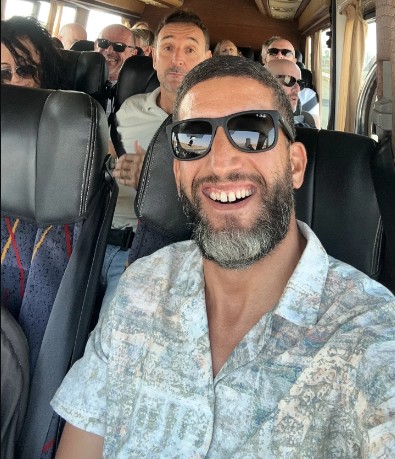
Mouhssine brings authentic local expertise, verified current knowledge, and a genuine passion for sharing Morocco’s culture and landscapes. Whether you are a first-timer exploring the imperial cities or an experienced traveler seeking remote Atlas or Sahara routes, a conversation with Mouhssine can transform your AI-drafted plan into an unforgettable reality.
Chat on WhatsAppUsing AI to plan a trip to Morocco is genuinely useful — it compresses hours of research into minutes, generates logical itinerary frameworks, and helps you understand cultural context before you land. For the geography of Morocco alone, AI’s ability to synthesize regions, distances, and logistics is a real advantage.
But Morocco rewards depth. Its greatest experiences are not indexed on the internet — they happen in the spaces between major sights, in conversations over mint tea, in the silence of a desert morning. AI can get you to the door. A licensed guide, and your own curiosity, open it.
Whether you are a solo traveler or arriving with family and friends, the best Morocco experiences come from blending smart preparation with genuine openness. AI gives you a head start — a logical framework, cultural context, and answers to logistical questions you did not know to ask. A licensed guide, and your own curiosity, turn that framework into something memorable.
Morocco has a way of exceeding whatever you imagine. Plan well, stay flexible, and trust the people who call it home.