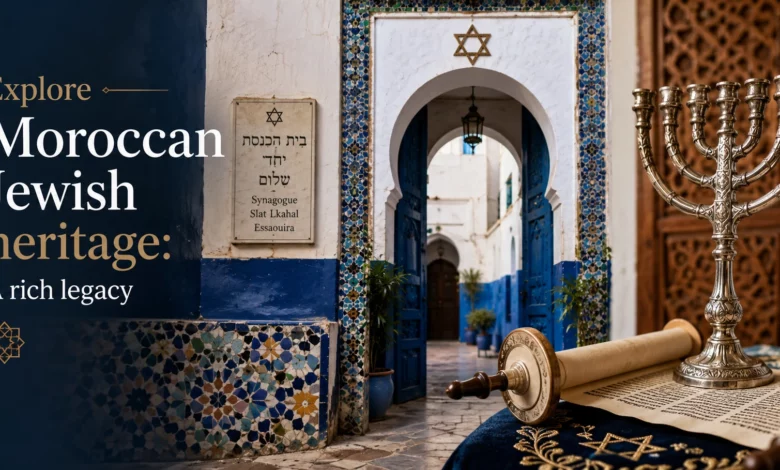
Moroccan Jewish heritage is one of the world’s oldest and most continuously documented cultural traditions, spanning more than two thousand five hundred years of history across the landscapes of North Africa. To understand this heritage is to discover a dimension of Morocco that is inseparable from its national identity — etched into the architecture of its ancient medinas, woven into the fabric of its music, and alive in the memory of communities stretching from Casablanca to Tel Aviv, from Paris to Montreal.
A Heritage Rooted in Antiquity ↑ Contents
The story of Moroccan Jewish heritage begins long before the great medieval dynasties built their imperial capitals. Oral traditions preserved within Moroccan Jewish communities, corroborated by archaeological evidence and medieval chronicles, suggest that Jewish settlement in the region dates to at least the sixth century BCE. Some accounts, including those recorded by the fourteenth-century historian Ibn Khaldun in his Muqaddimah, note that Amazigh tribes of the Moroccan interior had adopted Jewish beliefs and practices, pointing to an early and deep integration of Jewish life into the indigenous fabric of the land.
Through the centuries, Moroccan Jewish heritage absorbed successive cultural waves while preserving its own continuous thread. The Almoravid and Almohad periods, the flourishing of Merinid Fes as a center of scholarship, and the late medieval influx of Iberian Jews all left their marks. By the sixteenth century, Morocco had become home to one of the most intellectually and commercially vibrant Jewish communities in the Mediterranean world.
Understanding where Morocco is situated helps explain this richness: positioned at the crossroads of the Atlantic, the Mediterranean, the Sahara, and sub-Saharan Africa, the kingdom has always been a meeting place of civilizations, and its Jewish heritage reflects precisely that exceptional geography.
- Earliest estimated Jewish presence in Morocco: 6th century BCE
- First mellah established in Fes by the Merinid dynasty: 1438 CE
- Arrival of Sephardic Jews expelled from Spain and Portugal: 1492 CE
- Alliance Israélite Universelle schools open across Morocco: from 1862
- Peak Jewish population in Morocco: approximately 265,000 in the early 1940s
- Moroccan constitution explicitly recognizes the Hebrew-Jewish component of national identity: 2011
- Current Jewish community in Morocco: estimated 2,000 to 3,000 persons, mainly in Casablanca
The Mellah Quarters ↑ Contents
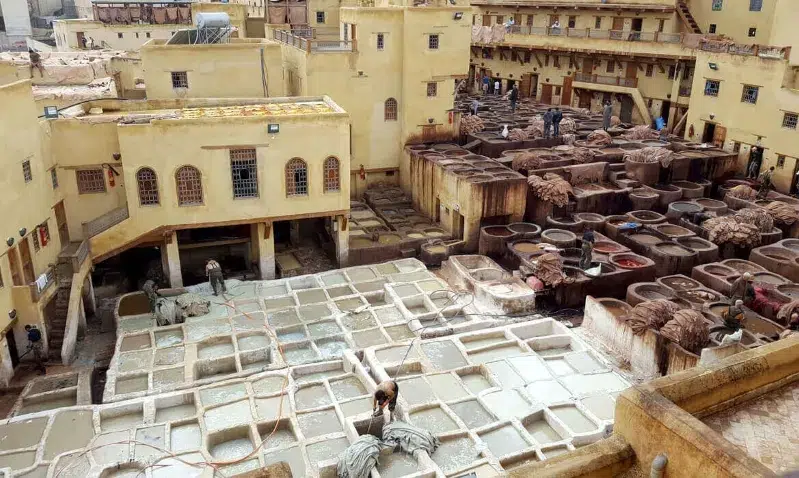
The mellah is among the most distinctive expressions of Moroccan Jewish heritage. The term, derived from the Arabic word for salt, came to designate the Jewish residential quarters established in major Moroccan cities from the fifteenth century onward. The first was created in Fes in 1438 under the Merinid sultan, and the model was subsequently adopted in Marrakech, Meknes, Rabat, Essaouira, and scores of smaller towns throughout the kingdom.
Each mellah developed its own architectural language: high-windowed facades to maximize interior light while maintaining privacy, overhanging upper floors that created shaded alleys below, finely worked carved plaster and cedarwood interiors, and synagogues whose entrances were set discreetly within the urban fabric. The mellah was far more than a residential enclave; it was a center of commercial activity, religious learning, and specialized craft production.
The mellah of Fes el-Bali, situated within a UNESCO World Heritage-listed medina, preserves some of the most intact examples of this architecture, including the Ibn Danan Synagogue, which was carefully restored in the late 1990s with support from the Foundation for Judeo-Moroccan Cultural Heritage and the Moroccan government. The Marrakech mellah, located near Bab Mellah and the Palais Royal, retains its original street pattern and several notable buildings. Essaouira, which once counted more than thirty synagogues and a Jewish community that constituted a majority of its merchant class in the eighteenth and nineteenth centuries, offers perhaps the most layered reading of Moroccan Jewish heritage outside of Fes.
Morocco’s network of historically significant cities means that travelers can encounter mellah quarters across the length and breadth of the kingdom, each with its own distinct character and stories to tell.
Judeo-Arabic: A Language Between Two Worlds ↑ Contents

One of the most compelling linguistic expressions of Moroccan Jewish heritage is Judeo-Moroccan Arabic, a variety of Moroccan Arabic written in Hebrew characters and enriched with Hebrew, Aramaic, and in coastal Atlantic communities, traces of Portuguese and Spanish. Linguists classify it as a significant example of how a minority community adapts a dominant spoken language while preserving a distinct religious and scholarly vocabulary.
This language served as the medium for contracts, religious commentaries, poetry, and daily conversation across the Moroccan Jewish community for centuries. Manuscript collections preserved at the Moroccan Jewish Museum in Casablanca and at the Ben-Zvi Institute in Jerusalem document a sophisticated literary tradition in Judeo-Arabic that circulated from Morocco across the wider Sephardic world.
Today, Judeo-Moroccan Arabic is classified by UNESCO as a seriously endangered language. Active documentation projects conducted by researchers at Moroccan universities and international institutions are working to record its remaining speakers — primarily elderly community members residing in Israel, France, and Canada — before the living oral tradition is lost. This work forms an important part of the broader effort to preserve the intangible dimensions of Moroccan Jewish heritage for future generations.
Sephardic Traditions in a Moroccan Landscape ↑ Contents
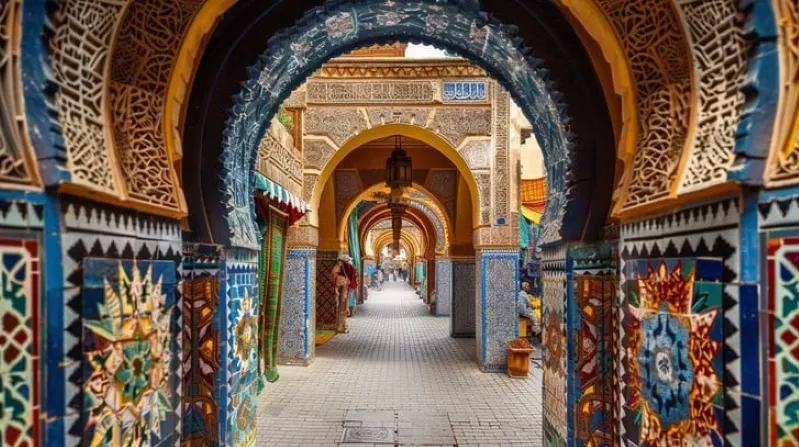
The Sephardic dimension of Moroccan Jewish heritage is inseparable from the broader story of Andalusia’s cultural legacy in North Africa. When Jewish families arrived from the Iberian Peninsula in 1492, they carried with them a refined tradition of poetry, music, liturgy, cuisine, and decorative craft rooted in the Golden Age of Al-Andalus. This tradition did not displace the existing Moroccan Jewish culture; it merged with it, creating a layered heritage that is entirely specific to Morocco.
Andalusian classical music — known in Morocco as Al-Ala — bears clear traces of this encounter. Recognized by UNESCO as an Intangible Cultural Heritage of Humanity, Al-Ala was preserved and transmitted in no small part through the participation of Jewish musicians, composers, and instrumentalists, particularly in Fes and Tetouan. Several of the foundational texts of this tradition were transcribed and annotated by Jewish scholars.
Sephardic culinary traditions also found their place within the Moroccan kitchen. Dishes prepared for Shabbat and Jewish holidays share ingredients, techniques, and sensibilities with their Moroccan Muslim counterparts, a reflection of the common markets, shared geography, and centuries of neighborly exchange. Morocco’s remarkable physical landscape — from the Atlantic coastline to the High Atlas and the Saharan south — provided the diversity of ingredients that shaped this shared culinary culture over time.
Mimouna: A Festival of Open Doors ↑ Contents
No aspect of Moroccan Jewish heritage captures the spirit of cultural exchange more vividly than the Mimouna. Celebrated on the evening following the end of Passover, this joyful gathering marks the return to leavened food with an abundant table of sweet breads, honey, fresh butter, symbolic pastries, and seasonal flowers. The origins of the name Mimouna are debated among scholars; some trace it to the Hebrew word for good fortune (mazal in its Arabic form), others to the name of Rabbi Maimon, the father of the philosopher Maimonides, who is said to have died on that date.
What is historically documented and widely attested in personal accounts is the tradition by which Muslim neighbors would bring leavened flour, milk, and fresh butter to Jewish households in the hours before the Mimouna began. This gesture of generosity became a defining feature of the celebration, transforming it into an annual affirmation of the communal bonds that tied Moroccan Jews and Muslims together in their shared cities and villages.
The Moroccan state formally recognized the Mimouna as part of the national cultural calendar in recent decades, and it is listed among the living traditions celebrated under the patronage of the Royal Palace. For visitors to Morocco, a country that has consistently been recognized as welcoming and safe for international tourism, encountering the Mimouna offers a rare window into one of the most genuine expressions of Moroccan Jewish heritage still practiced today.
Hebrew Manuscripts and Scholarship ↑ Contents
For scholars of Jewish civilization, Morocco’s contribution to rabbinic literature, kabbalistic thought, and legal scholarship constitutes one of the richest chapters in the broader story of Moroccan Jewish heritage. The city of Fes served for centuries as a preeminent center of Jewish learning, attracting students and producing authorities whose works were studied and debated from Amsterdam to Baghdad.
Among the most venerated figures associated with this tradition is Rabbi Yaakov Abuhatsera, the Abir Yaakov, a nineteenth-century mystic and scholar from the Draa Valley whose family produced a dynasty of spiritual leaders revered across the Sephardic world. His grandson, Rabbi Israel Abuhatsera, known as Baba Sali, became one of the most celebrated religious figures of twentieth-century Moroccan Jewry, and the pilgrimage to his tomb in Netivot, Israel, draws hundreds of thousands of visitors each year.
The Moroccan Jewish Museum in Casablanca, the only institution on the African continent dedicated entirely to Jewish heritage, preserves an important collection of Torah scrolls, illuminated marriage contracts (ketubot), parchment manuscripts, and silver ceremonial objects. Founded in 1997 under the patronage of the Foundation for Judeo-Moroccan Cultural Heritage, the museum has been recognized by international scholars as an irreplaceable resource for the study of North African Jewish civilization. Visitors traveling to Morocco are encouraged to include it in any heritage itinerary.
Jewish Artisans and Craft Traditions ↑ Contents
The material dimension of Moroccan Jewish heritage is perhaps most tangible in the domain of craft. In the traditional economy of Moroccan cities, Jewish artisans occupied a central role in silversmithing, goldsmithing, and the production of elaborate embroidered textiles. The silver filigree work associated with the Atlantic coast and the Souss region traces many of its characteristic techniques to Jewish craftsmen who developed and refined them across generations.
Jewish silversmiths produced both religious objects for their own communities — Hanukkah menorahs, spice towers, Torah finials, and marriage canopies — and the ceremonial jewelry worn by brides of all communities throughout Morocco. The heavy amber and silver necklaces, the engraved hand-of-Fatima pendants, and the intricate headpieces documented in ethnographic collections at the Musée de l’Homme in Paris and the Israel Museum in Jerusalem are among the finest expressions of this shared material culture.
The transfer of these craft techniques into the broader Moroccan artisan tradition illustrates a pattern found across all dimensions of Moroccan Jewish heritage: a give and take between communities that enriched the collective cultural vocabulary of the kingdom without erasing the distinct identity of those who contributed to it.
Heritage Sites to Visit ↑ Contents
Morocco offers one of the most complete networks of Jewish heritage sites in the world outside of Israel. The Moroccan government, through the Mohammed V Foundation for Solidarity and in cooperation with international Jewish organizations, has invested significantly in the restoration and maintenance of synagogues, cemeteries, and mellah quarters across the kingdom.
- Casablanca — Beth El Synagogue (active); Moroccan Jewish Museum (open to all visitors)
- Fes el-Bali — Mellah quarter (UNESCO World Heritage); Ibn Danan Synagogue (restored 1999); Jewish cemetery of Fes
- Marrakech — Mellah near Bab Mellah and the Royal Palace; Lazama Synagogue with its garden courtyard
- Essaouira — Historic mellah; Slat Lkahal Synagogue; Jewish cemetery; former Alliance Israélite school
- Meknes — Mellah with preserved domestic architecture; tomb of Rabbi Moshe Elbaz
- Draa Valley and Ouarzazate region — Rural shrines of venerated Jewish saints (tzaddikim), centers of annual hilulot pilgrimages
- Azemmour — One of the best-preserved small-city mellahs on the Atlantic coast
Several of these sites have restricted visiting hours or require advance coordination. Jewish cemeteries in particular are maintained by local associations and are best visited with a knowledgeable guide who can provide the necessary context and ensure a respectful experience.

Mouhssine Eliouj — Licensed Tour Guide
Specialized in the Moroccan Jewish heritage of Marrakech and Essaouira, Mouhssine holds an official license issued by the Moroccan Ministry of Tourism. His guided tours cover the mellah quarters, historic synagogues, Jewish cemeteries, and the artisan traditions associated with these communities — combining historical depth with an intimate knowledge of these cities’ living culture.
Available for private tours, day visits, and custom heritage itineraries. Contact directly via WhatsApp to arrange your visit.
Chat on WhatsAppFrequently Asked Questions ↑ Contents
Sources and References ↑ Contents
- Ibn Khaldun, Muqaddimah (14th century) — on Jewish presence among Amazigh tribes of North Africa. Published edition: Franz Rosenthal translation, Princeton University Press, 1967.
- Kingdom of Morocco, Constitution of the Kingdom of Morocco, 2011, Preamble — official recognition of the Hebrew-Jewish component of Moroccan identity. Source: Bulletin Officiel du Royaume du Maroc.
- Foundation for Judeo-Moroccan Cultural Heritage / Fondation du Patrimoine Culturel Judéo-Marocain — official documentation of heritage site restorations, Casablanca, ongoing since 1997.
- Moroccan Jewish Museum, Casablanca — collections and institutional records, founded 1997. Official institution.
- UNESCO, Al-Ala, Moroccan Andalusian Music — Intangible Cultural Heritage of Humanity, inscribed 2003. UNESCO reference 00082.
- Norman A. Stillman, The Jews of Arab Lands, Jewish Publication Society, 1979 — foundational historical and documentary study of Sephardic communities in North Africa.
- Emily Gottreich, The Mellah of Marrakesh: Jewish and Muslim Space in Morocco’s Red City, Indiana University Press, 2007.
- Ben-Zvi Institute, Jerusalem — manuscript collections in Judeo-Moroccan Arabic.